Sailing Into New Territory
Belgian Heavy Metal Outfit
HUNTER OMEGA
interviewed by Fok ‘bs’

“We’re definitely not going to jump on any kind of trend.”
“We want people to be as excited as we are with where the band is going.”
“Both David and myself would like to go heavier and angrier so the songwriting is going in that direction.”
“A heavy riff sounds heavy in every tuning.”
“Heavy is an attitude.”
“The Omega in this case stands for the end times. The sun setting on the world.”
“David’s lyrics have always been mostly about death and endings and they are becoming ever more apocalyptic.”
“I turned it into a sort of séance, where I welcome the audience to prepare together for the end.”
“It’s vast, it’s perilous and who knows what lies beneath the surface or awaits those who manage the crossing.”
“When you lose someone, you lose their warmth.”
“Nothing replaces them really. They leave a cold void.”
“Death must be the same: a dark, cold, silent, timeless nothing.”

“Some evil voice inside me grinds its teeth and seethes ‘sing more thrashier’ and I comply.”
“Definitely a band that’s evolving and sailing into new territory.”

“I think we can push them further to stop thinking about who we were and help us turn into something we are together with them.”
Changing a band name after two albums can easily look like an attempt to erase what came before.
For Hunter Omega, however, the addition of one word represents something very different.
The band remain proud of everything achieved as Hunter, but a new lineup, an evolving sound and an increasingly darker lyrical world made it clear that the next chapter needed an identity capable of carrying both the past and whatever comes next.
The Omega itself reflects that darker vision, representing the end times and a world approaching its final sunset.
The four songs on ‘Lake Of Death’ therefore occupy an unusual position.
Much of their foundation still comes from the previous Hunter lineup, while drummer Bram and guitarist Manu already contribute to a band that Joost and David expect to become heavier, angrier and broader in its influences.
Rather than making a dramatic stylistic break, Hunter Omega intend to evolve gradually, keeping the Heavy Metal foundations that have always defined them while refusing to become trapped by the old school label or by expectations of what the band is supposed to sound like.
In this interview by Fok ‘bs‘, guitar player Joost and vocalist David from Hunter Omega talk about leaving the Hunter name behind without abandoning its history, the apocalyptic meaning behind Omega, the cold emptiness at the heart of ‘Lake Of Death’, completing the ‘Knight Of The Black Rose’ saga, refusing musical trends, finding heaviness beyond tuning and distortion, and allowing a new lineup to push the band toward territory that has yet to be fully explored.
Changing a band name after two albums is a much bigger decision than simply changing a logo.
At what point did you realise that continuing as Hunter would actually say less about who you had become than taking the risk of introducing yourselves again as Hunter Omega?
Joost: “The reasons for the change are twofold. On the one hand, with two new members, the band isn’t the same that started ten years ago. The influence of the new members will become more apparent in the future, but there is a quite obvious evolution to the sound of the band. On the other hand, Hunter Omega is a lot easier to find on search engines and streaming services. In today’s music world, that’s a big advantage.”
The word ‘Omega‘ traditionally suggests an ending, yet for you it marks a new beginning.
Was that contradiction part of what attracted you to the name, and what does ‘Omega‘ specifically mean within the new identity of the band?
Joost: “The Omega in this case stands for the end times. The sun setting on the world. David’s lyrics have always been mostly about death and endings and they are becoming ever more apocalyptic. Hence the Omega.”
David: “What can I say. One of the first lyrics I wrote for Hunter had a line in it that said ‘Death shall have all dominion’, and it set a precedent for me. I thought about how to build a live set, and I turned it into a sort of séance, where I welcome the audience to prepare together for the end. I think heavy metal is nice because of this type of vibe. A show element. Call it cliché, but some clichés work and are fun.”
‘Lake Of Death’ deliberately connects Hunter’s past with Hunter Omega’s future rather than pretending the previous chapter never existed.
When reinventing a band, how do you decide which parts of your old identity deserve loyalty and which parts have become baggage?
Joost: “We are very proud of what we have achieved so far. Both Hunter albums got mostly great reviews, we got asked to play the Alcatraz festival when Fifth Angel had to cancel, we did a ton of great gigs… The music, as it stands, is something we are still 100% behind. What has become baggage in a sense is the ‘old school’ label. While we obviously play heavy metal that is firmly rooted in the 80s, we never set out to be a retro band. We will keep evolving and growing artistically. This also encompasses the production values, where we went for clarity and punch.”
David: “I didn’t realise a name change would get this much attention. Maybe in my head we were always Hunter Omega and we just came out of the closet for real now :D”
Two new musicians can change much more than the technical sound of a band.
They can disturb habits that the existing members may no longer even notice.
What did the new lineup question or challenge about Hunter that ultimately helped Hunter Omega emerge?
Joost: “Not much really, it was a pretty seamless transition. For Bram, our new drummer, it’s his first experience in a band, and he fell right into place. Manu, the new guitar player, is an old friend who we played with before in other projects. He worked in the USA for several years and returned just in time to fill the position. He brings in a ton of new songs he wrote while he was away and we’re working on those now with the eye on a new release. It was a smooth transition on both the musical and personal level but of course we did lose time getting both new guys fully integrated in the band.”
‘Ghost Of Anarchy’ was chosen to open the EP and still carries a strong connection to the classic heavy metal character of Hunter.
Was it important to begin somewhere familiar before showing listeners where the new band intends to go, almost like giving them a bridge rather than asking them to make a sudden jump?
Joost: “All four songs were mostly done with the old lineup still. Bram and Manu both brought their own input to the table but the basic structure of the songs was in place when they joined. The style of the band will most likely never change drastically, but rather evolve in a gradual manner. Both David and myself would like to go heavier and angrier so the songwriting is going in that direction. Sudden jumps in style are rarely a good sign in a band. We’re definitely not going to jump on any kind of trend. But we are going to keep incorporating our many varied influences into the music of Hunter Omega.”
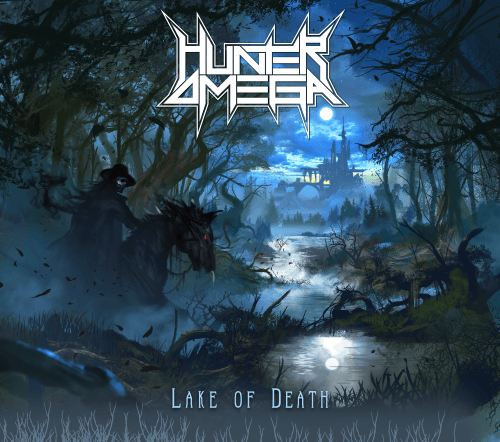
The title ‘Lake Of Death’ immediately creates a strong visual image.
If that lake existed as an actual place within the world of Hunter Omega, what would somebody find beneath its surface, something they fear, something they have lost, or perhaps something about themselves they would rather not discover?
Joost: “The lyrics are totally David’s domain. For me, the Lake is more like a boundary we must cross to get to what’s beyond. Not unlike the Styx in Greek mythology. It’s vast, it’s perilous and who knows what lies beneath the surface or awaits those who manage the crossing.”
David: “The lake of death is a place of mourning. When you lose someone, you lose their warmth. Not just literally, you lose their friendliness, the interest they take in you, their presence, their place in your life. Nothing replaces them really. They leave a cold void. That is to me the lake: emptiness. Death must be the same: a dark, cold, silent, timeless nothing.”
‘Knight Of The Black Rose Part 3’ completes a story that began on your first album as Hunter.
Why was it important to finish that saga now, at precisely the moment when the band itself is leaving one identity behind and entering another?
Joost: “The song was in the making long before we considered the name change. We just felt we had to finish the tale. As mentioned earlier, we are not disowning our past as Hunter, on the contrary. The story needed telling in its entirety. Live we will play all three parts as one integral suite.”
David: “I like the Lord Soth character from Dragonlance and the first songs are about what barely anyone reads if you stick to the original trilogy. So I did want to sing about him ages after, and when he met Kitiara. That’s the fitting ending for me, because that’s where I met him first.”
There is something almost symbolic about concluding an old narrative on the first release under a new name.
When you finished ‘Knight Of The Black Rose Part 3’, did it feel like you were only saying goodbye to a fictional character, or also closing a door on part of Hunter’s own history?
Joost: “Not really. Personally, I was relieved that we managed to conclude the tale, as I don’t like unfinished business. There’s too many TV shows that are cancelled on a cliffhanger, I definitely did not want to feel that. The tale had to be told.”
David: “I’ll just have to find another fantasy character now.”
‘F.A.F.O.’ closes the EP in a particularly direct and forceful way.
The expression behind those initials is essentially about actions eventually producing consequences.
Is that idea also relevant to the position Hunter Omega are in now, where every decision made during the Hunter years has somehow contributed to what the band has become?
Joost: “I hadn’t even looked at it like that myself but yes, that’s an interesting interpretation.”
You describe the new music as heavier and more intense, with a broader range of influences.
‘Heavier‘ is often reduced to tuning, distortion or aggression, but what does heaviness actually mean to Hunter Omega when you are writing a song?
Joost: “I don’t believe you can make a crappy riff sound heavy by tuning down. A heavy riff sounds heavy in every tuning. Heavy is an attitude. I have a new song in the works where I really wanted to go next level and I use inverted power chords a lot, which immediately transform a riff into a darker version of itself. It’s interesting from a songwriting point of view. I only started really writing songs when we began Hunter. So I like to think I’m still learning and growing.”
David: “I think, I sing more venomous now than I ever have. Maybe I said that about previous record too. But every time we start a new song, some evil voice inside me grinds its teeth and seethes ‘sing more thrashier’ and I comply.”
You chose only four songs to introduce Hunter Omega.
With such limited space, every track inevitably carries responsibility for defining the new band.
Was there a song you deliberately left off because it revealed too much about where Hunter Omega might go next?
Joost: “We didn’t leave anything off. We are not the fastest band when it comes to songwriting… We decided we needed a release to remind people we are still around and we recorded the four songs we had that were completely finished rather than do a rush job. I think that in today’s climate, it’s better to have regular releases in shorter intervals than to expect the fans to wait several years between each full album. There was no deliberate attempt to hide the evolution, on the contrary I would say. We want people to be as excited as we are with where the band is going.”
Existing Hunter listeners inevitably arrive at this EP carrying expectations, while somebody discovering Hunter Omega today has none of that history.
Which listener is more difficult to surprise, the fan who thinks they already know you, or the stranger you have to convince within the first few minutes?
Joost: “Both present their own challenge. I think we didn’t change too drastically to scare away the existing Hunter fans. If anything, we finally managed to get the production right, so what they are getting is the ultimate Hunter release so far. A new listener will take it at face value. I do believe the new EP is the best thing we’ve done (and the best recording I ever did in my entire career) so it should be able to convince more people rather than fewer.”
Imagine that several albums from now somebody listens backwards through the Hunter Omega catalogue until they finally reaches ‘Lake Of Death’.
What would you like them to hear in these four songs, a band that had already discovered its new identity, or the sound of five musicians still in the fascinating process of discovering what Hunter Omega could become?
Joost: “Definitely a band that’s evolving and sailing into new territory. As already mentioned, I do think we will always remain recognisably the same band, but I also firmly believe that we will bring ever more ingredients to the table to make the mix ever more interesting.”
David: “I already think Bram and Manu are adding much of their own craft to our sound right now. Even if it may sound the same or ‘nothing new’ to outsiders, I think we can push them further to stop thinking about who we were and help us turn into something we are together with them.”
‘Lake Of Death’ does not present Hunter Omega as a band that has suddenly severed every connection with Hunter.
In many ways, it demonstrates the opposite.
A story begun on the first Hunter album finally reaches its conclusion, musical foundations remain recognisable and the four songs themselves largely originated before the lineup change.
What has changed is the perspective surrounding that history.
Hunter Omega can acknowledge where the band came from without allowing the past to determine where it must go next.
That future appears likely to become darker and more aggressive, but Joost rejects the idea that heaviness can simply be manufactured through lower tunings or more distortion.
For him it begins with the riff and with attitude, while David finds himself pushing his vocals toward an increasingly venomous and Thrash influenced delivery.
Their evolution is therefore not about chasing a contemporary trend but about expanding possibilities within an identity that should remain recognisable even as new influences enter it.
Perhaps the most significant transformation will only become clear with the music still to come.
Bram and Manu have entered a band with an established history, but both Joost and David already see their contributions opening new possibilities.
Hunter Omega are not trying to disguise that process of discovery.
The intention is to allow five musicians to gradually determine what this incarnation of the band can become together, making ‘Lake Of Death’ less a definitive destination than the point where Hunter Omega begin sailing into unfamiliar waters.
by Fok ‘bs‘
Belgian Heavy Metal Force
HUNTER OMEGA
Released EP
‘Lake Of Death‘
track-list:
Ghost Of Anarchy
Lake Of Death
Knight of the Black Rose part 3
F.A.F.O.

Hunter Omega are:
David Walgrave – vocals
Manu Van Poeck – guitars
Joost Vlasschaert – guitars
Jeroen Wauters – bass
Bram Van Collie – drums
discography:

album
(as HUNTER)

album
(as HUNTER)
Belgian heavy metal outfit Hunter Omega released their new EP, ‘Lake Of Death‘, on September 9th, 2026.
The four track self released record is the band’s first release under the Hunter Omega name and serves as an introduction to a new chapter in their sound.
Formerly known simply as Hunter, the band have undergone more than a change of name.
With two new members in the lineup, their music has evolved as well, leading to the decision that a new identity should reflect that development.
What remains is the energy, integrity and attention to songwriting that defined Hunter, while Hunter Omega brings greater intensity, a broader range of influences and an expanded sonic palette.
‘Lake Of Death‘ was deliberately conceived as a first calling card for that transformation.
Rather than distancing themselves completely from their past, Hunter Omega use the four songs to connect what the band was with what it is becoming.
Opening track ‘The Ghost Of Anarchy‘ retains the solid, driving heavy metal character associated with Hunter before leading into the title track, ‘Lake Of Death‘.
‘The Knight Of The Black Rose Part 3‘ provides perhaps the strongest connection with the band’s previous era, concluding the epic saga that began on Hunter’s debut album.
The EP then closes with ‘F.A.F.O.‘, bringing the record to a short and forceful conclusion.
That combination of continuity and change is central to ‘Lake Of Death‘.
Hunter Omega have kept the foundations that established their identity while allowing the arrival of new musicians and influences to push the music into heavier and more intense territory.
With ‘Lake Of Death‘, Hunter Omega introduce themselves without denying where they came from.
Four tracks are enough to establish the intention behind the new name, this is not simply Hunter renamed, but the beginning of the band’s next step.