When History Presses Play Again
Canadian Thrash Metal Outfit
FORESHADOW
interviewed by Fok ‘bs’
“In the 80s music fans were far more partitioned and we were kind of being provocative by blending genres that much.”

“I personally would not release anything on my part from then while being able to do better now.”
“I sometimes have no choice, but to immerse myself in something else, and that something more often helps indirectly.”
“The process to create that material by itself provides some recreation and mental break.”
“War can be either glorious or miserable, necessary or condemnable.”
“What changed with time is how obvious and in your face some dynamics have become.”
“Those lyrics illustrate what bothered me in the 1980s, and the same bullcrap is back to the letter.”

“Parts of humanity do progress… which immensely triggers other parts whom this progress makes insecure.”
“It was depressing then, and it is currently depressing to realize how ‘now’ feels like ‘then’, that also sometimes feels like the 30s.”
“It feels extremely awkward to see how 56 yrs old me conclusions meet 21 yrs old me’s premises, but in a more crude teenage way on this album…”

“It is indeed depressing to see us being cyclically evolutionary forced back by primitive forces.”
There is something deeply unsettling about revisiting the convictions of your younger self and discovering that the world has given you very little reason to abandon them.
The passing of thirty five years should offer perspective, perhaps even reassurance that some of the fears which once dominated our imagination have become distant memories.
But what happens when those fears return, when the political tensions, destructive tendencies and social divisions that troubled a young musician decades ago begin to look disturbingly familiar again?
For Canadian Thrash Metal act Foreshadow, this is no abstract philosophical question.
Guitarist and vocalist Patrick Loisel finds himself confronting ideas that have accompanied him since childhood, from environmental destruction and political oppression to the recurring attraction of authoritarianism and the contradictions of human behaviour.
What began as the concerns of a young musician has developed into a lifelong engagement with subjects that remain painfully relevant.
The passage of time has changed his perspective, but it has not necessarily changed the world he was questioning.
Yet this conversation reaches considerably further than the familiar territory of political lyrics and musical aggression.
Patrick reflects on the personal consequences of the 1989 École Polytechnique massacre, the relationship between warfare and emotional expression, the rigid divisions that once separated different Metal communities and the strange experience of discovering that musical tastes can become more open with age.
His observations are often provocative, occasionally humorous and frequently marked by the frustration of someone who has watched history repeat patterns that should have been left behind.
In this interview by Fok ‘bs‘, Patrick Loisel discusses the uncomfortable relationship between memory and progress, the creative challenges of confronting music written by his younger self and the possibility that humanity’s technological achievements have done remarkably little to eliminate its oldest destructive instincts.
And somewhere between the anger, irony and disillusionment emerges another question:
whether bringing the past back to life might also open the door to an entirely new chapter.
You wrote these songs when you were around 21, looking at nuclear war, political oppression, environmental destruction and intolerance.
More than three decades later, you have said that the world sometimes makes you feel 21 again.
What is more disturbing, that your younger selves understood these problems so well, or that your generation failed to make those songs obsolete?
“It is indeed depressing to see us being cyclically evolutionary forced back by primitive forces. Before we decided to formally resurrect this act, the topic was already a lifetime mainstay in all my public outlets. It was my bread and butter since childhood alongside ecology, and I earn a living teaching a slightly more rigid version of it. It was depressing then, and it is currently depressing to realize how ‘now’ feels like ‘then’, that also sometimes feels like the 30’s. Old people will understand: like someone rewinded the VHS and pushed ‘play’ again. It feels extremely awkward to see how 56 years old me conclusions meet 21 years old me’s premices, but in a more crude teenage way on this album…”
You deliberately chose not to restore the 1991 recordings but to record the songs again.
Where is the line between finally giving an old song the sound it always deserved and allowing the experienced musicians you are today to rewrite the instincts of the young musicians who created it?
“We stayed very true to the core and initial meaning of the songs and lyrics, but provided them with a better envelope or finishing layer if I can speak this way. The performance from the rhythm section was identical to 1991 save for the strings tuning; it’s my performance that got sharper relative to 1991, because I had much less occasions to jam with other people in previous years than them, thus I stuck to noodling for a while and took long to learn how to lock with other musicians. I am a slow learner! I personally would not re-release anything on my part from then while being able to do better now.”
Moving the songs from E flat all the way down to B fundamentally changes their physical weight.
Did you ever reach a point where the new heaviness began changing the emotional meaning of the compositions themselves, even though the notes and ideas came from the same songs?
“I think it did bring that emotional meaning much further, more intensively in the same direction. We would have recorded them lower if we did them in 94 instead of 91.”
‘Y?’ imagines humanity surviving nuclear destruction underground only to gradually devolve.
When you wrote it, nuclear annihilation was still deeply embedded in the Cold War consciousness.
Hearing the song in 2026, do you experience it as a piece of your past or are you uncomfortable with how easily it has become contemporary again?
“It is even worse than you can imagine. Back 40 yrs ago, a lot of humor still made fun of cold war paranoia, and I bought plenty of satirist mags with articles like ‘How to live in a bunker ed # 46: Cooking the cat’, all with burned folks hunting glow in the dark mutants loosing body parts. Is till have some of them!!! Simply bringing back that literature recently appeared tasteless. Reading those lyrics again, then scrolling down hawkish truckers on FB does feel awkward. But, again, those lyrics illustrate what bothered me in the 1980’s, and the eame bullcrap is back to the letter.”
‘Decreței’ deals with the consequences of Nicolae Ceaușescu’s natalist policies and was also the first piece originally assembled as Foreshadow.
Looking back, what made young Canadian metal musicians choose such a specific and distant human tragedy as the foundation for one of their earliest songs rather than writing about something closer to home?
“Well, when we assembled it, the topic was the big thing going on, and it fitted the music since the riffs sound militaristic. Also, the big local event (Polytechnique, i.e a masculinist militant there gunned down 14 female ingeniors 1989/12/6) did not come to mind because it was way close to home. I was myself an university student and was on my way there to register at that very place when it occurred; I got stuck in traffic while watching the university turn into a Christmas tree from a far. Learned that one of the first officers to enter found his own daughter. That kind of stuff. It indeed shaped some convictions.”
Patrick’s environmental activism began during childhood, long before ‘This Harvest That You’ve Sown’ was written.
Environmental issues have since become far more prominent in public discussion, yet many of the underlying problems remain.
After caring about something for that long, how do you prevent concern from turning into exhaustion or even cynicism?
“I sometimes have no choice, but to immerse myself in something else, and that something more often helps indirectly. I produce music, texts, and direct them at various causes, but the process to create that material by itself provides some recreation and mental break. How ironic!”
‘As Heroes Die’ grew partly from an antimilitary atmosphere and the influence of ‘Jacob’s Ladder’.
Metal has always been fascinated by war imagery while simultaneously producing some fiercely antiwar music.
Why do you think a genre that so often looks and sounds like warfare can be such an effective language for questioning it?
“Wow, ‘Jacob’s ladder’ IS my favorite movie from that very period of my life, and an all time masterpiece!!! The imagery and ambiance make sense because metal is for most a very emotional form of music, and warfare is a huge generator of emotions. As a soldier, you can either be proud to serve on a very useful mission, like you are on your way to free innocent folks from a dictator or reclaim a lost land. This while some others will indeed morally question their unecessary mission and will be mentally torn apart. War can be either glorious or miserable, necessary or condemnable. Most bands who addressed wars questioned both sides of XYZ military event. So, not only the atmospheres fit, but such a very simple subject can branch out in a vast array of more specific topics.”
The artwork deliberately revisits the original demo cover, again combining violence, pollution and intolerance.
If you had recreated that artwork using only problems that did not exist, or were not yet visible, when the original was made, what would have to appear on the 2026 version?
“It’s easy: As soon as we moved to recordings 2 through 4, our topics were shifting toward human rights, psychology or street-level social issues. What changed with time is how obvious and in your face some dynamics have become. In the past, it was hearsays, urban legends,’reading between the line’. What I thinkered that people called ‘parano’ is now common kitchen knowledge.”
Between the original recordings and ‘Here Down On Earth’, members of Foreshadow accumulated decades of experience through bands including Augury, Vantablack Warship, Arseniq33 and Clearwater Deathblow.
Was there anything technically possible for you today that you deliberately refused to do because the 1991 version of Foreshadow would never have imagined it?
“Mmmm, it is not a question of technicality but of compatibility. When we ended the band in the beginning of 1996, we were radially heading in opposite directions. I was me being more and more of a speed freak with the others calming down and heading toward simpler and groovier things. Nowadays, we have far more common tastes than ever before. For example, we are collectively big fans of Imperial Triumphant, while we all would probably have hated them back in 1996. Pat K and I are big fans of Dark Funeral and other high speed stuff.”
The EP moves through death metal, thrash and groove rather than behaving like a perfectly obedient genre record.
When you revisit music written before extreme metal became divided into so many increasingly precise categories, does it remind you of a time when musicians had more freedom simply because nobody had yet written all the rules?
“Well, back then the perspective was exactly the opposite: In the 80’s music fans were far more partitioned and we were kind of being provocative by blending genres that much. We recorded funk or country songs that degenerated in grindfest!!! I had a handful of friends who liked both Rush and Maiden, but most were in hermetic clans. They were like ‘don’t play that’ or boasted that humour had no place in metal. Thanks for inspiring my daily rants !!! It was trad metal vs speed metal vs prog vs glam; no wonder my favorite song then was ‘Subdivisions’ (Rush). My Maiden fans friends were disappointed to learn that I liked Kreator. I would have to stick to Maiden. Sounded like ideology or politics. People wanted exclusive adhesion…1995 to 2015 = a relaxation of gatekeeping; now some brought back gatekeeping, so we brought back that music!”
‘Here Down On Earth’ ultimately asks why destructive human behaviour keeps repeating despite enormous technological progress.
Do you think humanity actually progresses morally, only much more slowly than technologically, or have we simply become more sophisticated at committing the same ancient mistakes?
“Parts of humanity do progress… which immensely triggers other parts whom this progress makes insecure. So they put a dictator power to bring back ‘the good ole’ days’ and so on. Parts of society wants it to remain competitive and mutually destructive. Both Napoleon and Mussolini boasted that peace threatens nationalism, since youth from various countries are less isolationist and tend to blend their cultures than maintaining clear borders. I studied anthropology down to animals and cannibals, and this reflex emerge: When a society validates anyone else than its most physically strong, some get into ‘reset mode’.”
Imagine you could hand the finished 2026 EP to the four young musicians who made that demo in 1991, but you were forbidden to tell them anything about the intervening 35 years.
What do you think would surprise them more, what Foreshadow eventually sounded like or the fact that the world still gave those lyrics a reason to exist?
“I can answer very fast: Back then, telling us that we would travel to the Moon or Mars would probably have made more sense to us. Especially how I had spent years reading and hearing how metal would disappear before year 2000! 1985-95 so many celebrated the oncoming disappearance of metal the same way they would if you told them you beat cancer.”
These songs have now received the recording you feel they deserved more than three decades ago.
Does that finally close an unfinished chapter for Foreshadow, or has bringing those songs back to life created something more dangerous, a reason to start writing about what is happening ‘Here Down On Earth’ all over again?
“I leave this one open. Simply, when we say ‘never’ or ‘it is impossible’, it keeps happening later. I don’t know. I was a hell of an effort. We’ll see later. Thanks again for everything!!!”
Perhaps the most disturbing revelation in this conversation is not that Foreshadow’s early concerns remain relevant, but that Patrick Loisel has spent much of his life watching the same destructive tendencies reappear in different forms.
His reflections suggest that progress is neither universal nor irreversible.
While some parts of society move towards greater understanding and cooperation, others respond by retreating into familiar patterns of fear, division and authoritarian thinking.
The resulting conflict between advancement and regression makes the distance between past and present feel considerably smaller than the calendar would suggest.
There is also a personal dimension to this perspective that gives the interview particular weight.
Patrick’s recollection of the École Polytechnique massacre reveals how political violence can suddenly cease to be an abstract subject and become something frighteningly immediate.
His longstanding environmental concerns, meanwhile, demonstrate the emotional demands of remaining committed to a cause across decades of disappointment.
Music becomes more than a means of communicating those convictions.
The act of creating it also provides a necessary refuge from the very subjects that inspire it.
His memories of the Metal scene offer another revealing contrast.
Rather than remembering the past as an era of unlimited artistic freedom, Patrick recalls a musical environment often divided by rigid loyalties and narrow expectations.
The willingness to cross stylistic boundaries was not necessarily celebrated, and experimentation could be regarded as provocation.
That perspective challenges the temptation to romanticise earlier decades and reminds us that musical independence has always required a certain resistance to conformity.
Ultimately, Foreshadow’s return raises a question that extends beyond the future of the band itself.
Can revisiting the past offer genuine closure when the circumstances that inspired it remain unresolved?
Patrick does not provide a definitive answer, and perhaps that uncertainty is entirely appropriate.
The songs may have found a new voice, but the questions behind them remain open.
Whether this chapter leads to further music or stands as a singular return, its underlying message is difficult to ignore:
time alone does not guarantee progress, and remembering the past means little unless we are prepared to recognise its warnings in the present.
by Fok ‘bs‘
Canadian Thrash Metal Act
FORESHADOW
Released EP
‘Here Down On Earth‘
track-list:
Y?
Decretei
This Harvest That You’ve Sown
As Heroes Die
Here Down To Earth
mixed by Patrick Knup
mastered by Alberto De Icaza

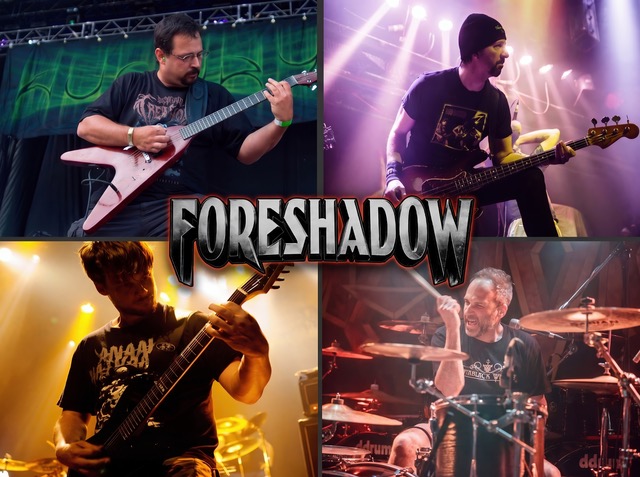
Foreshadow are:
Patrick Loisel – vocals, guitar
Kurtis Clifford – bass
Patrick Knup – guitar
Pierre Pitre – drums
show dates 2026:
Oct17th O’Sim Irish Pub Salaberry-de-Valleyfield/QC
Oct24th Turbo Haus Montreal/QC
discography:

album
More than three decades after the songs were first recorded, Canadian metal veterans Foreshadow have returned to some of their earliest material with ‘Here Down On Earth‘, released on October 2nd, 2026.
Rather than restoring their 1991 demo, the band completely recorded the material again, giving five songs written around the end of the 1980s the weight and aggression they originally wanted them to have.
That distinction is important to ‘Here Down On Earth‘.
This is not simply an archival release or an exercise in nostalgia.
The compositions remain rooted in the period in which they were created, but Foreshadow approach them with decades of additional musical experience and a considerably heavier sonic foundation.
The original recordings were made in E flat, while the new versions are tuned down to B, immediately changing the physical character of the music.
The result moves between death metal, thrash and groove driven aggression, while still carrying traces of the band’s broader musical interests.
Guitarist and vocalist Patrick Loisel describes his own writing as more dramatic and classically influenced, while bassist Kurt Clifford brings much of the groove, a contrast that helps explain why the material refuses to remain within a single corner of extreme metal.
What makes ‘Here Down On Earth‘ particularly striking is how little its lyrical concerns appear to have aged.
These are songs written by young musicians looking at nuclear war, political oppression, environmental destruction, militarism and intolerance at the end of the 1980s.
More than thirty years later, Foreshadow found themselves returning to the material in a world where many of those fears still felt disturbingly familiar.
“Things are so similar now that I feel like I am 21 again,”
Loisel explains.
The opening ‘Y?‘ takes the listener into the aftermath of nuclear war, imagining survivors retreating underground and gradually devolving.
Its death metal character establishes the darker side of the EP immediately, before ‘Decreței‘ turns towards the consequences of the natalist policies imposed under Romanian dictator Nicolae Ceaușescu.
The song was the first piece originally assembled as Foreshadow, with its music written by Clifford.
Environmental destruction provides the focus for ‘This Harvest That You’ve Sown‘.
Written by Loisel, whose environmental activism began during his childhood, the song transforms a subject that has accompanied him for most of his life into one of the EP’s central statements.
‘As Heroes Die‘, meanwhile, grew from the antimilitary climate surrounding the band at the time, with the film ‘Jacob’s Ladder‘ and local metal bands providing part of its original inspiration.
Everything eventually converges on the title track.
‘Here Down On Earth‘ looks beyond individual conflicts towards the patterns behind them, questioning why violence, intolerance and destructive behaviour continue to repeat themselves regardless of how technologically advanced society becomes.
Musically, it is also one of the record’s most collaborative pieces, making it an appropriate conclusion to an EP concerned with both where Foreshadow came from and how much of the world they wrote about has remained unchanged.
The artwork follows the same principle.
Conceived as a new version of the original demo cover, it once again brings together images of violence, pollution and intolerance, visually connecting the concerns of the band’s younger selves with the present.
Foreshadow themselves also provide that connection.
Patrick Loisel, Kurt Clifford, Pierre Pitre and Patrick Knup went on to become involved with acts including Augury, Vantablack Warship, Arseniq33 and Clearwater Deathblow.
On ‘Here Down On Earth‘, however, they return to music created before those later chapters and finally give it the recording they believe it deserved.
“These songs were written in the late ’80s and first recorded in the early ’90s. We were already aiming for a heavier sound relative to that era’s standards. I listen to current bands that are similar, and we sound as aggressive as if we were 35 years younger.”
That may ultimately be the most interesting aspect of ‘Here Down On Earth‘.
Foreshadow have not rewritten their younger selves to make them fit 2026.
They have taken the original ideas, preserved their anger and concerns, and finally given them the heaviness that was missing from the 1991 recording.