Looking Back At The 80s Without Becoming A Nostalgia Project
Interview with the International AOR Outfit
FIRESKY
By Fok ‘bs’

Mika had a very specific and elegant sonic direction, classic Melodic Rock and AOR, but he knew that to make it special, he needed the right musical personalities.

Saal Richmond
“Everyone brought their own identity, enriching Mika’s initial idea without distorting it.”
“This, combined with the fact that we didn’t overuse vocal tuning or extreme quantization, kept the record human, vibrant, and deeply alive.”
“We wanted the attention to detail typical of Toto or Foreigner, but filtered through these gems and the natural saturation of our tape recorders, without slipping into pure revival clichés.”
“We don’t see it as a limitation, but as a stepping stone to tell timeless stories.”
“When you miss an old love story, you are often missing the illusion of what you wanted it to be, not the reality.”
“Working remotely might seem like a disadvantage, but in our case, it turned out to be an incredible strength.”
“This proves that Firesky has a very solid central songwriting core, but at the same time, loves to open up to an inspiring musical network.”
“Modern AOR has a duty to remind people that an album is a journey.”
“That track gave us the spark, but the album ignited a true creative wildfire.”
“We don’t want to rest on our laurels; evolution is the only way to keep a band alive.”
When we brought together exceptional musicians like Samuli Federley on guitar, Time Schleifer on bass, and the stunning vocals of Davide Merletto, the Firesky sound was born naturally.

“For the next step, I would love to experiment even more from a production standpoint, perhaps introducing unexpected sonic solutions while keeping our melodic streak intact.”
In this interview by Fok ‘bs‘, keyboardist and producer Saal Richmond talks about the creative philosophy behind Firesky, the importance of preserving human emotion in a highly polished genre, the role of analog tape, the inspiration of the 80s, international collaboration, and the challenges of taking AOR into new territory.
Firesky brings together musicians from Finland and Italy who already have strong connections to the European melodic rock scene.
When Mika first imagined the project, was the idea to build a band around specific musical personalities, or around a very specific sound that the right musicians then had to fit into?
“When Mika Brushane first told me about the project, the main goal wasn’t to force musicians into a predefined mold, but rather the exact opposite. Mika had a very specific and elegant sonic direction in mind (classic Melodic Rock/AOR), but he knew that to make it special, he needed the right musical personalities. When we brought together exceptional musicians like Samuli Federley on guitar, Time Schleifer on bass, and the stunning vocals of Davide Merletto, the ‘Firesky sound’ was born naturally. Everyone brought their own identity, enriching Mika’s initial idea without distorting it.”
AOR is often associated with precision, polished production and carefully constructed melodies.
How do you make sure that all that craftsmanship does not remove the human imperfections and emotional spontaneity that make a song feel alive?
“This is one of the biggest challenges when you sit behind the mixing desk for an AOR album. It is a genre that demands millimeter precision and lavish production, but the risk of a ‘plastic effect’ is always just around the corner. In my studio, Harmonia Recording Work Studio, we made a very specific technical choice to preserve this spontaneity: during the mixing and mastering phases, we used tape recorders. Running the tracks through tape gave all the songs that natural saturation, warmth, and compression typical of analog, which purely digital technology cannot replicate. This, combined with the fact that we didn’t overuse vocal tuning or extreme quantization, kept the record human, vibrant, and deeply alive.”
Your influences include Journey, Foreigner, Def Leppard, Giant and Toto, yet Firesky is not presented as a nostalgia project. What is something you deliberately refused to do because it would have made the album sound too much like an attempt to recreate the 1980s?
“We deeply love the giants of the ’80s, but right from the start, we agreed that this album shouldn’t be a sterile exercise in nostalgia. Having written practically 8 out of 10 songs and co-written the ninth (‘Like Brothers’), I handled the entire sound design and songwriting phase for Firesky. This allowed me to give the band a strong, defined sonic identity from the very beginning. In this regard, I avoided overusing dated synthesizers, making a targeted exception for only a few legendary machines: the Roland D-50, Roland JD-800, Roland JX-8P, and Yamaha DX7. In my opinion, these keyboards still manage to convey that unique warmth and character that very few next-generation synths can replicate. We wanted the attention to detail typical of Toto or Foreigner, but filtered through these gems and the natural saturation of our tape recorders, without slipping into pure revival clichés.”
The three singles approach nostalgia in very different ways:
‘A Stone In Time’ looks back through classic melodic rock, ‘Can You Feel Me?’ deals with memory and loss, while ‘Chasing The Dawn’ literally transports its characters back to 1986.
Why does the past seem to be such a powerful creative space for Firesky?
“The past is a powerful creative space because it is an emotional and artistic goldmine. The ’80s represented the golden age of songwriting: the melodies were huge, and the lyrics spoke of love, loss, and dreams in a direct way. For Firesky, tapping into that imagery through songs like ‘A Stone In Time’ or ‘Can You Feel Me?’ means reconnecting with a compositional purity that is often lost today. We don’t see it as a limitation, but as a stepping stone to tell timeless stories.”
‘Chasing The Dawn’ uses a portal, a muscle car, Route 66 and a fictional festival to turn 1986 into almost a parallel universe.
If Firesky could actually open that portal for one night, which real 1980s rock event would you want to experience, and why?
“If we could turn the key of that muscle car and cross the portal for one night… well, as a keyboardist and producer, I’d tell you that I would love to have been in the audience at one of Journey’s historic concerts during the ‘Escape’ or ‘Frontiers’ tours, or backstage at a Toto studio session to see Jeff Porcaro and David Paich at work. Events like those redefined the way music is made, and experiencing them live would be an indescribable inspiration for all of us.”
‘Can You Feel Me?’ deals with the danger of idealized memories, where someone reconstructs a lost relationship according to how they want to remember it.
Do you think nostalgia can sometimes be a form of self deception?
“Absolutely, yes, and that is precisely the lyrical core of ‘Can You Feel Me?’. The human mind tends to erase the negative sides of old memories, leaving only a golden glaze. When you miss an old love story, you are often missing the illusion of what you wanted it to be, not the reality. Musically, we tried to reflect this duality: an immersive, dreamy atmosphere, but with a strong emotional tension underneath.”
Firesky is an international project, but the album was produced and mixed in Italy while several of the musicians are based in Finland.
Did the geographical distance create any unexpected advantages in the creative process, perhaps allowing each musician to contribute without everyone being physically in the same room?
“Working remotely might seem like a disadvantage, but in our case, it turned out to be an incredible strength. I took care of the production, mixing, and mastering here in Italy at Harmonia Studio, while Mika and the guys recorded their parts in Finland. This modus operandi gave each of us crucial ‘breathing room’. Without the pressure of time ticking away in a shared room, every musician could process the songs, experiment in their own studio, and send over only their best, most heartfelt performances. Modern file-sharing shortens distances when there is total trust among the members.”
With Davide Merletto on lead vocals and several distinguished guest vocalists contributing to the album, how did you decide when a song needed another voice?
Was the choice purely musical, or were some collaborations driven by friendships within the European AOR community?
“Davide Merletto is Firesky’s vocal centerpiece; he has an amazing tone and an innate versatility. However, the beauty of the AOR community lies precisely in collaborations. When we felt that some tracks needed different nuances or massive backing vocals, we tapped into a network of true heavyweights. For instance, we had Davide ‘Dave Rox’ Barbieri on backing vocals for ‘Stone In Time’ and ‘Can You Feel Me?’, and the great Alessandro Del Vecchio on ‘Chasing The Dawn’. This choice was driven both by purely musical reasons to give the tracks dynamics and depth and by the deep respect and friendship that binds us within the European melodic rock scene. Not to mention that I was part of Alessandro Del Vecchio’s writing team for Frontiers Records for 5 years, as well as working as a session musician on albums like T3nors’ ‘Naked Soul’ and the Michael Bolton tribute album titled ‘Steel Bars’.”
The song ‘Like Brothers’ was co written by Pierpaolo ‘Zorro’ Monti and Dave Zublena, while other tracks involve musicians from different parts of the melodic rock scene.
Does Firesky represent a kind of musical network as much as it represents a single band?
“The song ‘Like Brothers’, co-written by me along with Pierpaolo ‘Zorro’ Monti and Dave Zublena, is the perfect example of this philosophy. Out of ten total tracks on the album, I wrote eight by myself, and this is the ninth one we developed together. This proves that Firesky has a very solid central songwriting core, but at the same time, loves to open up to an inspiring musical network. Today’s Melodic Rock scene thrives on synergies. Collaborating with outside writers of this caliber enriches the album’s value, and having handled the production and songwriting for almost all the tracks allowed me to ensure that the Firesky identity remained consistent, cohesive, and powerful from start to finish.”
Keyboard and synthesizer textures are essential to classic AOR, but they can easily dominate a production.
How did Saal Richmond approach the balance between keyboards, guitars and vocals so that the synthesizers enhance the songs rather than simply announce their 1980s credentials?
“This question gets right to the heart of my daily bread! Having written almost all the songs and being the keyboardist, producer, and sound engineer for the album, having total control over the soundscape allowed me to balance every element right from the song’s birth. The danger of letting the synths dominate was there, but the secret was working on frequencies during the arrangement phase first, and then in the mix. I used the keyboards to build the atmosphere and fill the spaces, letting the guitars dictate the power in the riffs. Furthermore, the final mix printed to tape blended the synthesizers, guitars, and vocals incredibly well, providing a sonic cohesion where the keyboards decorate the song without ever being intrusive or sounding like a generic, messy ’80s style.”
The album was released in 2026, yet many of its musical ingredients come from a time when the album was still the central format and songs were expected to survive without algorithms, playlists or social media.
What do you think modern AOR can learn from the songwriting discipline of that era?
“Today we are slaves to streaming platform algorithms, social media, and playlists, which dictate very short songs with choruses that have to explode within the first 15 seconds, otherwise the user moves on. Modern AOR has a duty to remind people that an album is a journey. The discipline of that era teaches us to take care of the structure: the intro that builds anticipation, the verses that tell a story, the bridges that set up the explosion of the chorus, and the sacred space for the guitar or keyboard solo. We wanted the listener to take the time to hear the record from start to finish, without rushing.”
‘To Be The Number One’ appeared publicly before the album itself, as part of the ‘We Still Rock… The World’ compilation.
Looking back, does that track feel like the blueprint for Firesky, or did the album ultimately become something much larger than the original idea behind that first release?
“That track, originally released on the compilation ‘We Still Rock… The World’, was our calling card. It served as a testing ground to see if our chemistry could work on an international level. Looking back, it was definitely our blueprint, our statement of intent, but the full album evolved into something much broader, more mature, and multifaceted. That track gave us the spark, but the album ignited a true creative wildfire.”
Firesky already has a remarkably complete identity after only one album.
If there were a second Firesky record, what would you be most interested in challenging: the songwriting formula, the production aesthetics, the international collaboration itself, or perhaps the boundaries of what people expect from an AOR album?
“If and when we start working on a second chapter, I think the most exciting challenge will be pushing the boundaries of what people expect from an AOR album even further. We have proven that we master the classic formula and the international aesthetic. For the next step, I would love to experiment even more from a production standpoint, perhaps introducing unexpected sonic solutions while keeping our melodic streak intact. We don’t want to rest on our laurels; evolution is the only way to keep a band alive.”
With Firesky, the past is not treated as something to be copied, but as a foundation from which something new can grow.
Saal Richmond’s approach to songwriting, production and sound design gives the project a strong connection to classic AOR while allowing it to remain firmly rooted in the present.
The result is an album built on melodies, musicianship, atmosphere and genuine respect for the genre, but also on the willingness to evolve.
If Firesky’s first chapter has established the project’s identity, Richmond’s vision for its future suggests that the next one could take that identity considerably further.
by Fok ‘bs‘
FIRESKY
An International AOR Project
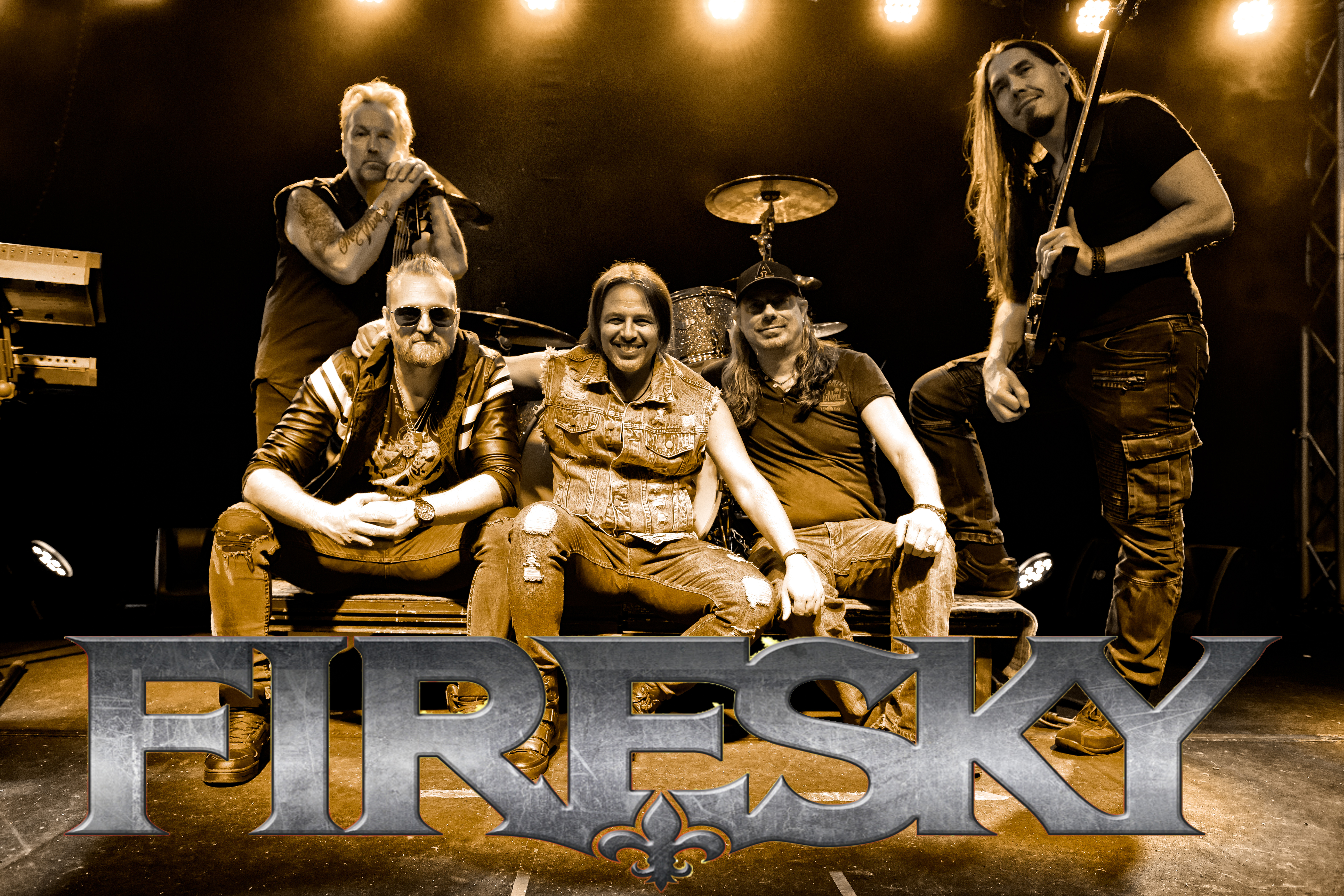
Firesky are:
Davide Merletto – lead vocals
Mika Brushane – drums, backing vocals
Samuli Federley – lead guitars, backing vocals
Time Schleifer – bass, backing vocals
Saal Richmond – keyboards, synthesizers, programming, backing vocals
discography:
album
Firesky is an international melodic rock and AOR project created by Finnish drummer Mika Brushane of Imperium, bringing together musicians from Finland and Italy with a shared passion for the golden era of melodic rock.
The self titled debut album was released on March 13, 2026 through Art Of Melody Music and Burning Minds Music Group, introducing a band deeply rooted in the sound and spirit of the 1980s while giving that tradition a contemporary studio treatment.
The project made its first official appearance in 2025 with the previously unreleased track ‘To Be The Number One‘, which was included on the compilation ‘We Still Rock… The World‘.
Brushane then assembled an international lineup featuring Italian vocalist Davide Merletto of Lace and formerly of Planethard, guitarist Samuli Federley of Mirka Rantanen’s Circus Of Rock, bassist Time Schleifer of King Company and formerly of Mirka Rantanen’s Circus Of Rock, and keyboardist, producer, and sound engineer Saal Richmond of In Side.
Firesky’s musical identity is firmly connected to the classic melodic rock and AOR tradition.
The band draws heavily from legendary 1980s acts such as Journey, Foreigner, Def Leppard, Giant, and Toto, emphasizing strong melodies, polished arrangements, expressive vocals, and the kind of songwriting that puts memorable hooks at the center of each composition.
Production, mixing, and mastering were handled by Saal Richmond at Harmonia Recording Work Studio in Giaveno, near Turin, Italy, giving the album a polished and detailed sound while preserving the character of its classic influences.
The physical CD edition also includes exclusive liner notes written by Fabio Vellata of Truemetal.it.
The album campaign began with ‘A Stone In Time‘, released as the first single and accompanied by an official music video.
The track also features Davide ‘Dave Rox‘ Barbieri of Wheels Of Fire, Shining Line, and Room Experience on backing vocals, adding another familiar voice from the Italian melodic rock scene.
Firesky subsequently followed with ‘Can You Feel Me?‘, released on February 4, 2026.
The song features additional backing vocals from Barbieri and explores the emotional boundary between memory, dreams, and loss.
Its cinematic video follows a protagonist attempting to reconstruct a vanished love through idealized memories, only for fragments of reality to gradually expose the pain beneath the illusion.
The third single, ‘Chasing The Dawn‘, arrived on February 24, 2026 and features Alessandro Del Vecchio on backing vocals.
The song takes a more adventurous visual approach, following two rockers on a nocturnal journey toward the fictional Desert Roar Festival.
Their journey through a portal transports them back to 1986, eventually placing them on Route 66 in a classic muscle car and leading them to an enormous festival that represents the enduring spirit of live rock music.
The album also features the song ‘Like Brothers‘, co written by Pierpaolo ‘Zorro‘ Monti, known for his work with Shining Line, Charming Grace, Raintimes, and Room Experience, and Dave Zublena of Soul Seller and Kastadian.
The collaboration further underlines the strong connections between Firesky and the wider European melodic rock community.
With its international lineup, polished production, and unapologetic affection for classic AOR and melodic rock, Firesky arrives as a project that understands exactly what makes the genre so enduring.
Rather than simply reproducing the past, the band uses the familiar ingredients of soaring melodies, powerful guitars, prominent keyboards, and carefully crafted vocal arrangements to create a fresh chapter in a musical tradition that continues to attract new generations of listeners.