Sci-Fi, Survival And The Future Of Humanity
Joe McAnaney Of
American Death Metal Outfit
VOIDMAKER
Interview By Fok ’bs’
“After the second song, I realized this wasn’t just an album anymore – it was becoming a universe.”
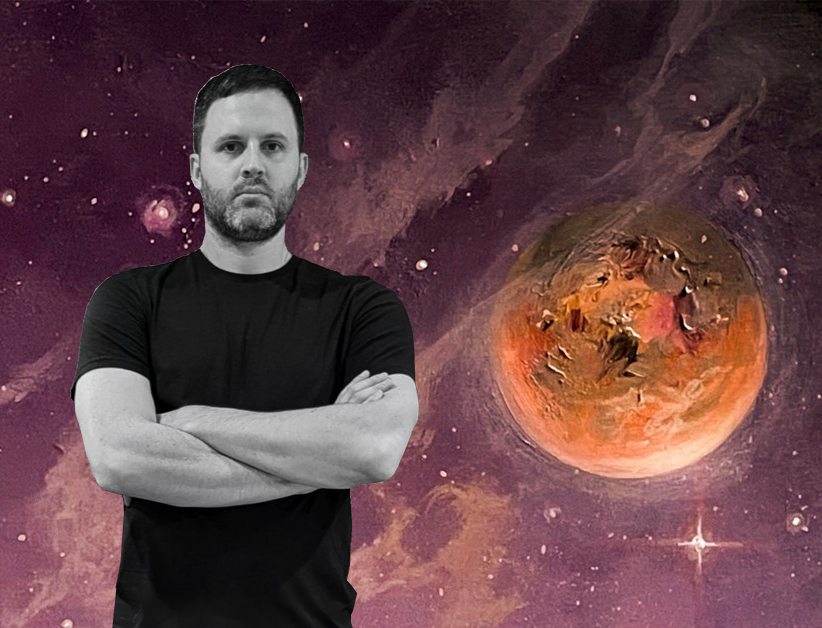
“Tom took my vocal ideas and made everything a hundred times better.”
“Some songs focus on a single isolated individual, while others span entire civilizations and epochs.”
“As a guitarist, the riffs usually come first, but atmosphere quickly becomes just as important.”
“I wanted every song to have its own landscape, its own tone, and its own place in the larger story.”
“Science fiction allows us to ask very human questions on a cosmic scale.”
“Metal should be heavy, but it should also be fun.”
“If humanity evolves beyond itself, it risks losing the emotions that make us human.”
“We wanted listeners to care about humanity, not just the spectacle surrounding it.”
“Despite everything, I still believe humanity has enormous untapped potential.”
“We’re really just a metal band – the labels aren’t the most important thing.”
“Even an infinite universe can feel claustrophobic when you’re trapped inside a spaceship or a research station.”
“Art requires a living, thinking, organic mind.”
Science fiction and extreme metal have always shared a fascination with the unknown, but few bands merge those worlds as seamlessly as Voidmaker.
On their debut full-length, ‘A Cold, Unyielding Universe‘, the band creates a vast narrative that stretches across dying civilizations, rogue artificial intelligence, interstellar exploration, and the uncertain future of humanity itself.
Yet beneath the cosmic scale lies something deeply human:
questions about identity, technology, isolation, hope, and survival.
What could have been a simple collection of sci-fi inspired songs instead unfolds as an expansive universe where personal stories and galaxy-spanning events collide.
In this conversation with Fok ’bs’, Voidmaker mastermind Joe McAnaney discusses world-building, the influence of classic science fiction, the relationship between atmosphere and aggression, the limits of technological progress, and why even the coldest corners of the cosmos still leave room for hope.
‘A Cold, Unyielding Universe‘ feels less like a traditional album and more like receiving a distress signal from a dying civilization.
At what point did the project become a full universe rather than just a collection of sci-fi inspired songs?
“I think it was probably a couple songs in. The first song I wrote for the album was ‘The Post-Human Emergence’, and at that point I didn’t really know that there would be an album. After I wrote ‘Terraforming the Red Planet’ next, I thought that it would be cool to do this interconnected, sprawling, expansive universe. Successive songs kept adding more depth to the setting and the rest is history.”
Extreme metal often deals with death, chaos, and destruction on a human level.
Voidmaker push those ideas into a cosmic scale.
Does making things ‘larger than humanity‘ somehow make them feel more real?
“I’m curious to see what our listeners think! Some songs describe a very small piece of the whole, like ‘Ganymede, The Outpost’, where you have this one scientist who’s slowly going crazy in isolation on this small moon. Then, there are other songs like the title track that are huge in scale, both in space and time. I think both give a cool perspective and help flesh out the entire universe.”
Your music balances ruthless aggression with surprisingly cinematic atmosphere.
When writing, do you think more in terms of riffs, or in terms of scenes, environments, and narrative movement?
“That’s a great question, and as primarily a guitarist, I think the riffs probably came to me first. I’d usually start off with the rhythm guitar and maybe one lead part, but as I started thinking more about the overall tonality of each song for each concept, then I built in more harmonies and the solos. I definitely did want to create an atmosphere for each song with contrasts in tone and scene so that things would stay interesting.”
The album explores rogue AI, post-human evolution, and interstellar collapse.
Do you see these themes as pure science fiction, or as distorted reflections of the direction humanity is already moving toward?
“I love all those sci-fi themes, and I’ve been reading all the great authors since I was a kid. I wanted to incorporate some of those themes as an homage, and also just build something that I thought was really cool. Not having my own super-advanced future prediction AI, I can’t really say if we’ll see anything like this in the future, although we’ve already all seen the headlines about AI and recent technological advances. It can be a useful tool in my experience (in endeavors that don’t involve human creativity and ingenuity), but only time will tell whether or not it’s ultimately a good thing.”
There’s a very cold emotional tone running throughout the record, almost devoid of hope.
Was avoiding catharsis an intentional creative decision?
“I tried to incorporate a little bit of positivity into the album, but you’re right that by and large things may seem a bit bleak. I think the lyrics in the title track, for example, start off with the big question of ‘Can we co-exist with other intelligent life in the universe?’ I was very inspired by ‘The Three-Body Problem’ for this one, especially the Dark Forest theory, but towards the end of the song write that maybe humanity can try to ‘make something good’ of learning that we’re not alone. In the second half of ‘Wormholes/Lightchaser’, I tried to have the lyrics portray humanity expanding and exploring the universe, and that this endeavor doesn’t necessarily have to end in disaster. I even changed the tonality of the last chorus in the ‘Lightchaser’ section to use the melodic minor as opposed to the harmonic minor, so that things would end on a more enigmatic/potentially positive note.”
Tracks like ‘Terraforming the Red Planet‘ and ‘Of Digital Creation‘ suggest humanity trying to transcend its limits, yet the album constantly implies failure or corruption.
Are you skeptical of technological ‘progress‘?
“I think my view on technology may be a bit more nuanced than most. In my work outside of Voidmaker (as a software engineer), I use some of the more advanced tools/technology that are out there. I’ve grown up around it, and I use it daily, so I recognize its utility. However, on the musical/artistic side of things, I don’t think that any tech can ever replace a human being. In my opinion, you need something with a thinking, organic brain to really make art, and I don’t think that will ever change.”
The oppressive atmosphere of the album feels almost claustrophobic despite taking place in deep space.
How did you create that sense of confinement within something supposedly infinite?
“I don’t exactly know! I might guess that it’s the lyrics for some of the songs – where they take place in a small spaceship, an underground research station, etc. A lot of the good sci-fi seems to convey that even a huge generation worldship or something like that can feel very small awfully fast. Probably without realizing I internalized some of that and incorporated it into the music.”
You are handling guitars, bass, and drums, while Tom delivers the vocal identity of the band.
Does Voidmaker feel more like a collaboration between two perspectives, or two halves of the same vision?
“I think we were always aligned on vision. Tom and I come from the same place musically – we grew up listening to the same bands, trade listening recs every few days, and even enjoy playing videogames together, so all the shared influences are there. Plus, Tom has an amazing, instinctive feel for how the vocals should sound, which lines would need doubling and emphasis, and what the timing of each line would be like. I demoed vocals as part of the pre-pro process after writing the lyrics, and Tom took it from there and made everything 100 times better.”
Sci-fi and death metal can both become obsessed with spectacle.
How important was it for Voidmaker to keep emotional weight beneath all the cosmic imagery?
“I think there was some degree of balance there that we had to be aware of. We did try to create something that the listener would think was huge and grandiose and awe-inspiring, but at the same time would be invested in. We want the listener to root for the human race in the end, so I tried to write lyrics that would accomplish that goal.”
‘The Post-Human Emergence‘ raises an interesting idea:
if humanity evolves beyond itself, what exactly is lost in the process?
“I’m going to borrow from author Alastair Reynolds and his Revelation Space universe for this one (although he’s by no means the only author to deal with this). In short, I think you lose a lot. His universe is populated with undying post-humans who have done everything there is to do. Eventually the thing that they mostly feel is boredom. All the easily identifiable emotions that humans today experience are gone – in their place are lives dominated by spectacle and a yearning for new experiences, eventually replaced by despair. Those people bear little enough resemblance to humans that they might as well be a different species. That’s what I think that would look like as well.”
The album artwork and music feel deeply interconnected, almost inseparable.
How important is visual world-building to the identity of Voidmaker?
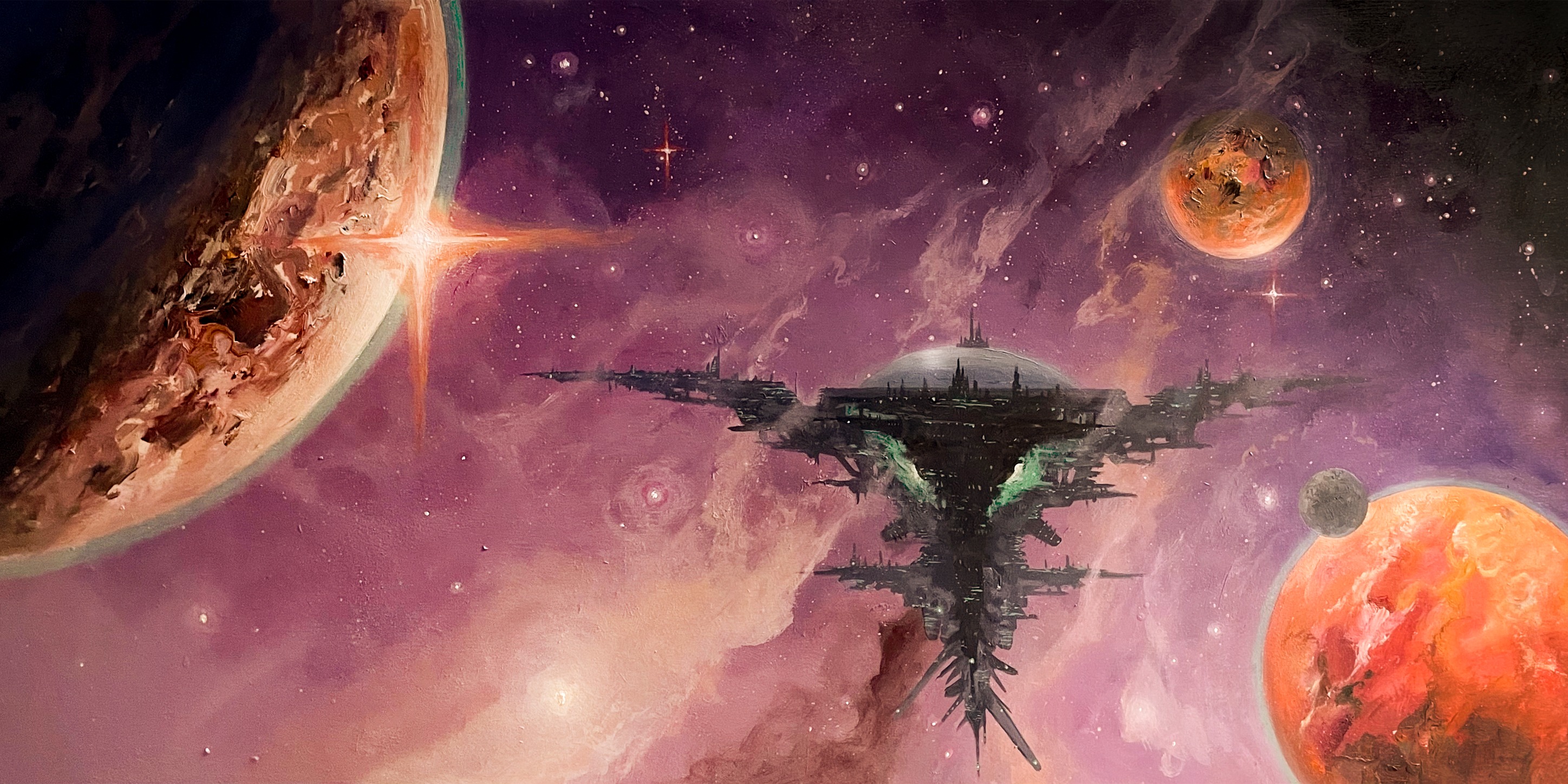
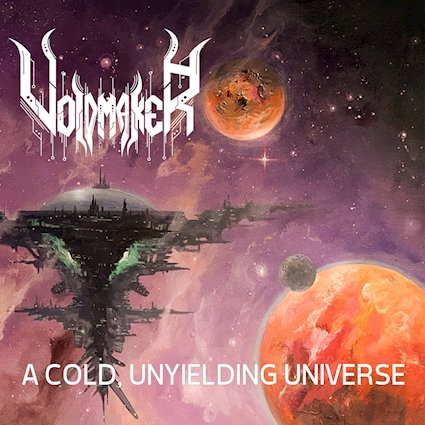
“Adam Burke did an amazing job with the artwork. He is so in-demand today and it’s super easy to see why. He is able to realize incredible things on canvas (all his art is an actual painting that lives somewhere, our album artwork is in my garage), and it was incredibly important to me to get that aspect of the album right. For each song, I’d start off with the concept and title first. I wanted to have a clear image in my mind before recording a single note. I wanted to be able to slot each song into a unique place in our universe, and to make sure that the imagery for that concept would be conveyed to the listener. I also pulled liberally from various media for imagery and inspiration. Everyone from Isaac Asimov to Denis Villaneuve is in there in some capacity.”
Your sound pulls from blackened thrash, death metal, and progressive structures without fully settling into one genre.
Do you consciously resist musical categorization, or does the story simply demand different forms of extremity?
“I think we didn’t want to be limited to any one box. We’re really just a metal band; the labels aren’t the most important to us. We want everyone to be able to enjoy this album, because we think we’ve written some cool songs and want people to nerd out to them. So I would say we didn’t consciously set out to write something that defied genres, but the end result proves that every decision we’ve made is in service of the songs.”
‘A Cold, Unyielding Universe‘ paints a future shaped by collapse, isolation, and transformation.
After spending so much time inside that world creatively, did working on the album change the way you personally view humanity’s future?
“Despite being something of a futurist, I’m surprisingly a bit of a humanist and optimist as well. I loved being able to write this tribute to sci-fi and I had fun doing it. I think at the end of the day, metal is cool and can be very heavy, but it should also be fun. Despite some current events, I think that we, as humans, have so much untapped potential, and that things in the future might actually turn out ok. Time will tell, but I have hope!”
While ‘A Cold, Unyielding Universe‘ explores some of the darkest possibilities imaginable – from rogue artificial intelligence to interstellar collapse and post-human transformation – it is ultimately not a story about despair.
Beneath the towering concepts and cosmic imagery lies a surprisingly human perspective, one that remains fascinated by curiosity, creativity, and the possibility of growth.
Joe McAnaney’s vision for Voidmaker demonstrates that extreme metal can be both intellectually ambitious and emotionally engaging, combining the grandeur of classic science fiction with the visceral power of modern metal.
The result is an album that invites listeners to explore distant galaxies while reflecting on questions much closer to home.
For all its darkness, ‘A Cold, Unyielding Universe‘ leaves the door open to possibility.
And perhaps that lingering sense of wonder – alongside the crushing riffs and apocalyptic imagery – is what makes Voidmaker’s debut feel less like an ending and more like the beginning of a much larger journey.
by Fok ‘bs‘
American Death Metal Act
VOIDMAKER
is set to Release Album
‘A Cold, Unyielding Universe’
track-list:
Starfall
The Post-Human Emergence
Terraforming the Red Planet
Project Infinity
Ganymede, the Outpost
Epsilon Orionis
Terminus
Of Digital Creation
A Cold, Unyielding Universe
Wormholes – Lightchaser

Voidmaker are:
Joe McAnaney – guitars, bass, drums
Tom McRann – vocals
Boston, Massachusetts and Washington, D.C.-based sci-fi thrash death metal outfit Voidmaker are preparing to launch their debut full-length album ‘A Cold, Unyielding Universe‘ on May 25, 2026 via Witches Brew Records – and the record looks set to deliver far more than straightforward extremity.
Across ten tracks, the band fuse blackened thrash aggression, razor-sharp death metal precision and progressive ambition into a sprawling concept release that feels as cinematic as it is punishing.
At the core of ‘A Cold, Unyielding Universe‘ lies a bleak futuristic narrative shaped by rogue artificial intelligences, unstable Jovian scientists and ancient extraterrestrial forces hidden deep within the void of space.
Rather than functioning as a loose collection of songs, the album unfolds like a transmission from a collapsing civilization, where survival and evolution become inseparable from destruction.
Voidmaker channel that atmosphere through relentless riff work, savage vocal delivery and a cold, oppressive sense of scale that mirrors the emptiness of deep space itself.
The project was founded by multi-instrumentalist Joe McAnaney, who handles guitars, drums and bass, alongside vocalist Tom McRann.
Together, the pair have crafted a sound designed for listeners who want extreme metal with both intensity and substance.
Music that balances raw violence with ambitious storytelling and progressive dynamics.
While the album leans heavily into blackened thrash and death metal territory, there is also a strong sense of movement and atmosphere running throughout the material, giving the record a wider scope than genre conventions alone might suggest.
Adding another layer to the album’s immersive presentation is the striking cover artwork created by artist Adam Burke of Nightjar Illustrations, whose cosmic visual style perfectly complements the album’s themes of isolation, collapse and interstellar horror.
The record was mixed and mastered by Rob Kukla at Obsidian Studios, while the instrumental composition ‘Starfall‘, contributed by Sarah McAnaney-Knight, expands the album’s narrative depth even further.
With ‘A Cold, Unyielding Universe‘, Voidmaker are not simply introducing themselves with a debut album.
They are building an entire dystopian universe around their music, one driven by crushing heaviness, progressive ambition and a fascination with humanity’s darkest possible futures.