Creating The Shows Others Cannot Offer
Beyond The Agent Lists
ROCK HARD FESTIVAL GREECE 2026
Organiser Sakis Frangos interviewed
by Fok ‘bs’
“Everything has to work according to your budget spreadsheet.”

Rock Hard Festival Greece 2025
“We like difficult things, that is a given.”

“Every conversation with Michael Ivarsson was like a lesson, and I tried to absorb all the knowledge he gave me.”
“What I was not prepared for was just how flawlessly our festival would operate organisationally.”

“The fact that we often even sing the melodies of the guitar solos is something you rarely encounter in other countries.”
“The Greek audience is passionate, but many times they demand things that simply cannot be done.”
“Superficial knowledge is worse than ignorance.”
“Rock Hard was never simply a print magazine or a website, but much more than that.”

“The festival was not created to be something independent from the magazine, but as an extension of it.”
“We want to give domestic bands a platform so that they can present their work to as many people as possible.”
“Last year we managed the impossible, reuniting Heavens Gate after they had not played live for 26 years.”
“Nobody could have prepared me for how I would feel when Messiah Marcolin finally stepped up to sing with Candlemass.”
“If all of that, together with the love of the audience and their positive energy, is combined with financial success, then we will be talking about a blessing.”
“It is another way of showing that we are not just another festival, but that every choice we make is very carefully considered.”
“We do not simply want to look at agents’ lists and choose bands. We go deeper, making the fullest possible use of our connections.”
“The surest recipe for failure is to bring bands that you personally love rather than those the audience would like to see.”
“We always want to take it one step further and create those special shows ourselves.”

“There is no reason for us to create just another festival when there are already so many others in Greece.”
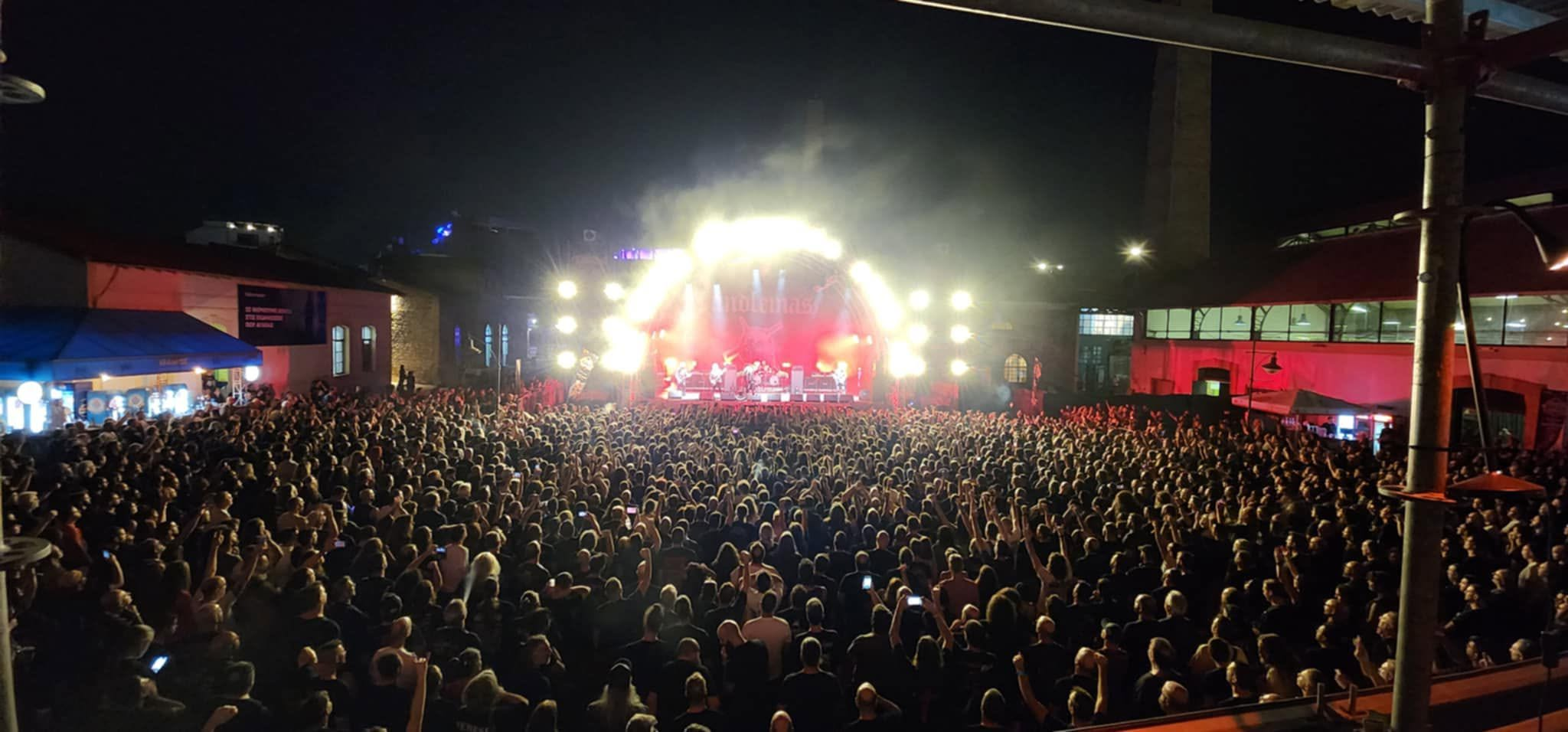
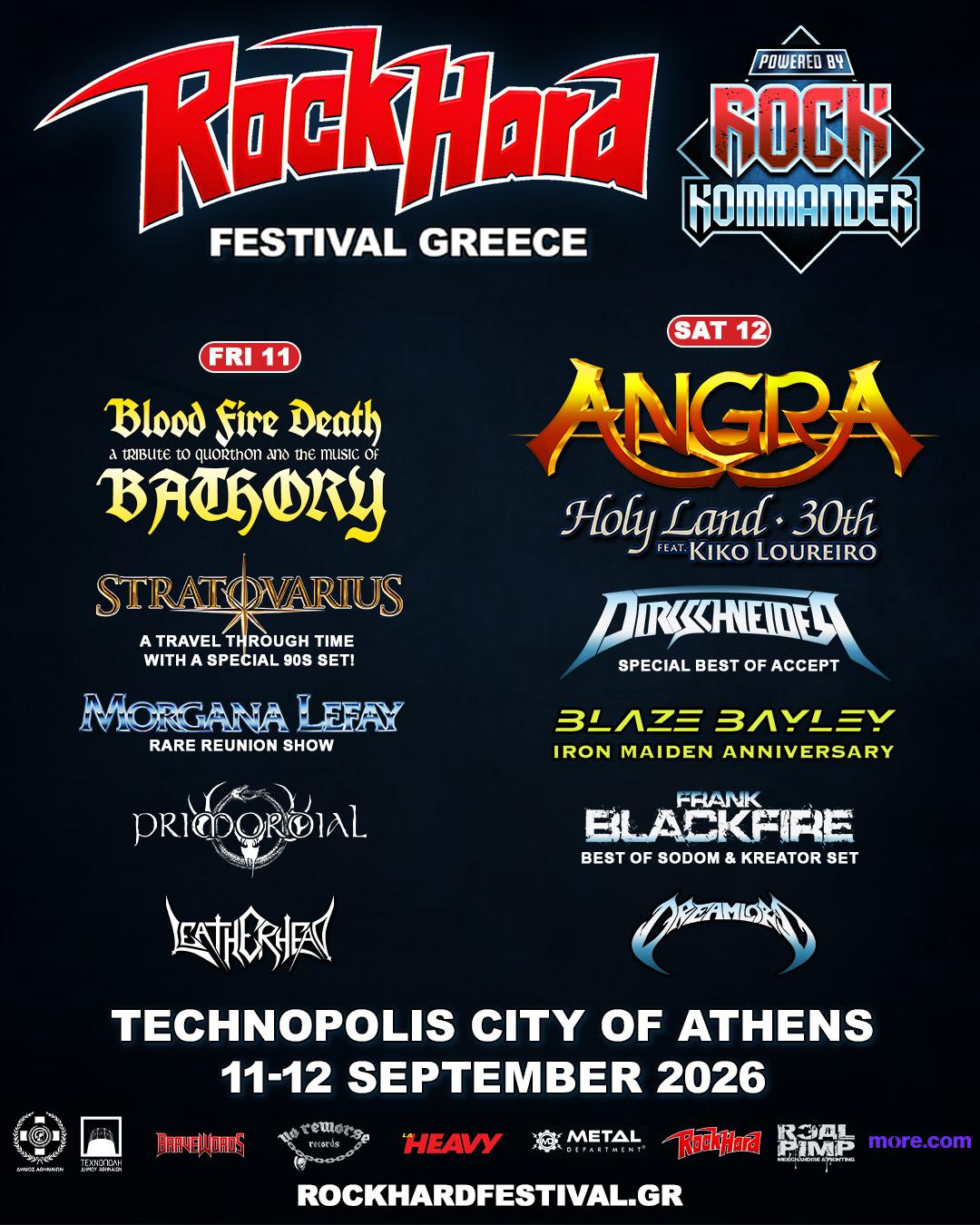
Rock Hard Festival Greece returns to Technopolis City of Athens on September 11 and 12, 2026, and its second edition makes one thing immediately clear:
this is not a festival interested in simply placing familiar names on another Metal bill.
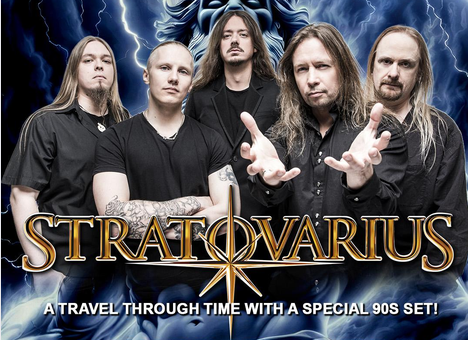
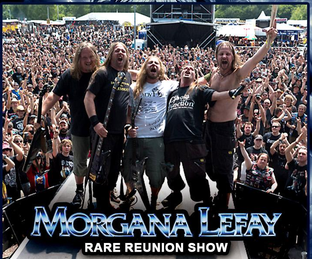
Angra celebrate 30 years of ‘Holy Land’ with Kiko Loureiro, Stratovarius travel back to their defining 90s era, Morgana Lefay return for their only international show of 2026, Blood Fire Death bring together an extraordinary cast of Extreme Metal musicians to honour Quorthon and Bathory, while Udo Dirkschneider, Blaze Bayley and Frank Blackfire revisit defining chapters of Heavy Metal history.
Alongside them, bands including Primordial, Leatherhead and Dreamlord complete a programme that deliberately combines history, exclusivity and the present.
But behind those names lies a philosophy that may ultimately be more important than the billing itself.
For organiser Sakis Frangos, Rock Hard Festival Greece is not about working through agents’ lists and booking whatever happens to be available.
It is about creating performances that cannot easily be experienced elsewhere, sometimes even bringing bands back together, giving deserving Greek artists a larger platform, and developing an identity strong enough to make the festival recognisable before the audience has even read the names on the poster.
In this interview by Fok ‘bs‘, Sakis Frangos talks about the ideas and difficult decisions behind Rock Hard Festival Greece, the balance between a Metal fan’s passion and financial reality, the peculiarities of the Greek audience, the lessons learned from the festival’s first edition, and why there is simply no point in creating just another festival.
Looking at this year’s line up, what is striking is the fact that you have not simply booked big names, but specific and, in several cases, rare versions of these bands.
Angra are celebrating 30 years of ‘Holy Land’ with Kiko Loureiro, Stratovarius are presenting a special 90s set, Udo Dirkschneider is focusing on Accept, and Blaze Bayley on his era with Iron Maiden.
Was it your goal from the very beginning to create a festival featuring performances that people cannot easily see again elsewhere?
“That is exactly the goal every year. To bring bands that we do not get to see, bands that no longer exist but that we reunite, but also bands that we have seen several times, presenting a show with something special, something unique and exclusive that people cannot easily or frequently see, thereby making the festival more attractive to the average fan. We do not simply want to look at agents’ lists and choose bands. We go deeper, making the fullest possible use of our connections.”
There is a fine line between celebrating the history of heavy metal and nostalgia.
When planning a line up like this, how do you make sure that the past functions as a living experience rather than as a museum?
“Almost all the bands that are playing are active, apart from Morgana Lefay, who reunited. Stratovarius, for example, have a new generation of fans who do not necessarily seem to prefer their 90s period, and this is an opportunity for them to discover that era as well. Blaze has been releasing records continuously for years. As for Udo, what can we say, considering that he has three bands!!! It is the classic case of ‘letting the older ones remember and the younger ones learn’. Blood Fire Death, meanwhile, consist entirely of active extreme metal musicians who are very popular nowadays. So the acts performing are not nostalgia acts, but active artists who will perform something different from what they usually do.”
Angra with ‘Holy Land’ and Kiko Loureiro are obviously one of the festival’s most important attractions.
When the possibility of this appearance arose, was it a case where you immediately thought, ‘This has to happen in Athens‘, regardless of the difficulties that might be involved in making it happen?
“Greece and France were Angra’s biggest markets when ‘Holy Land’ was released. So it is no coincidence that these are the only countries where they are playing in Europe. What made me say that ‘they have to play in Athens’ is the fact that, after many years of trying, we managed to convince them to let us release this particular album on vinyl for the first time. Yes, that makes their appearance even more special and important, without overlooking the fact that ‘Holy Land’ is one of my favourite albums of all time. But if you book concerts according to that logic, you are not making deals, you are signing your own death sentence.”
Blood Fire Death’s tribute to Quorthon and the music of Bathory is a different case, because here we do not have a reunion or an anniversary tour, but musicians who are being asked to keep alive the work of someone who can no longer be on stage.
For you, at what point does a tribute go beyond nostalgia and acquire genuine artistic value?
“There are tribute bands that were created to exploit the name of an artist and others that genuinely honour them. Watching videos of Blood Fire Death, you will realise that in their case, they do not simply honour Bathory and Quorthon, but do everything they can to show how they imagine a Bathory live show would look today. We are talking about accomplished musicians, with a stable core but also a great many guests, with a total of 9 to 11 participants at each concert. What we see on stage, the way it is presented, the stage show and so on, is something exceptional, artistic and in no way something mundane or routine. Just come and you will see it with your own eyes…”
Morgana Lefay are appearing in a rare reunion show.
With a booking like this, how different is the process from booking a band that is already on tour?
Is there greater satisfaction when the festival does not simply host a performance, but actually helps make something rare happen?
“We like difficult things, that is a given. Last year we managed the impossible, reuniting Heavens Gate and even without a fee, despite the fact that they had not played live for 26 years!!! We tried to do something similar with other bands, and we are very happy that we managed it in the case of Morgana Lefay, whom we love very much and who will play their only international show of 2026 in Athens. They played a few days ago in their hometown of Bollnäs, Sweden. It is another way of showing that we are not just another festival, but that every choice we make is very carefully considered.”
The line up combines historic international names with Leatherhead and Dreamlord from the Greek scene.
When choosing a Greek band for a line up like this, are you more interested in how large an audience they already have, or whether you believe they can stand on that particular stage and win over people who may not know them yet?
“All the Greek bands that have played at our festival have what it takes to play in front of even larger audiences, and there are many such bands. It is a given that a Greek band, particularly when opening the festival, will have difficulty bringing people to the festival, but that is the least of our concerns. We want to give domestic bands a platform so that they can present their work to as many people as possible and, why not, gain greater recognition through it. With that philosophy, last year we had Gus G and InnerWish, more established Greek artists, but also Battleroar with their history and the younger Ganzi Gun. This year, we went with two other relatively young bands, Leatherhead and Dreamlord, who we believe deserve to be heard by a larger audience and to receive the opportunity they deserve.”
The Greek metal audience has a reputation for being particularly passionate, but also particularly demanding.
After so many years within the scene, is there something you believe the Greek audience understands or appreciates differently compared with audiences in other European countries?
“The Greek audience is passionate, but where you say ‘demanding’, I would often say that they ‘demand’ things that simply cannot be done. Many times, it seems to me that Greek fans see festivals as management games, where somebody invests ‘invisible’ money, and their demands are often excessive, to say the least. They think they know things in depth, aka insiders, but superficial knowledge is worse than ignorance. Every country has its own peculiarities, favourite bands and so on, and the same applies to Greece. However, the fact that we often even sing the melodies of the guitar solos is something you rarely encounter in other countries, that is the truth.”
Rock Hard Greece began in 2005 as the Greek edition of the historic German magazine and, twenty years later, that journey led to the creation of Rock Hard Festival Greece.
Now, with only the second edition of the festival, do you feel that it has already begun to develop its own identity, independent from that of the magazine, or is it important to you that it always remains recognisable that the philosophy of Rock Hard stands behind the festival?
“The festival was not created to be something independent from the magazine, but as an extension of it. Many times, even in the print edition, we used the hashtag #morethanamagazine, something the Germans have also adopted. Rock Hard was never simply a print magazine or a website, but much more than that, and with the festival we show that the brand can go one step further. I think that in both of its forms, we have demonstrated a clear identity, a character that can be recognised from a distance as Rock Hard, and that is what we want to continue doing.”
Last year, about a month and a half before the first Rock Hard Festival Greece, we happened to meet completely by chance on a flight to Germany, while you were continuing on to Scandinavia to attend another festival.
You told me then, half seriously and half jokingly, that apart from inside information, you also needed a little ‘psychological support‘ from people who knew very well what it means to put together a festival.
One year and one edition later, which piece of advice from that trip proved truly valuable, and what did you ultimately discover that nobody could have prepared you for?
“Our team includes people with a great deal of experience in events of this kind, most notably Michael Ivarsson, who, apart from being a co owner of the franchise, was also the founder of the great Sweden Rock Festival, so he has organised MUCH bigger festivals than ours! Every conversation with him was like a lesson, even though I have been involved in the concert business for many years, and I tried to absorb all the knowledge he gave me in every conversation we had. Believe it or not, what I was not prepared for was just how flawlessly our festival would operate organisationally when we set foot in Technopolis and started setting everything up. After so many months of work, and I mean an INCREDIBLE amount of work, once we arrived at the venue, everything worked flawlessly, always with the help of many good friends and experienced collaborators. Nobody could have prepared me either for how I would feel when Messiah Marcolin finally stepped up to sing with Candlemass, something I will be able to say we achieved for the rest of my life…”
A festival billing is always a combination of artistic vision and financial reality.
Was there a point while creating this year’s line up when your heart as a metal fan was telling you one thing, but the reality of being an organiser demanded something completely different?
“Artistic vision and financial reality are two concepts that are inseparably linked when it comes to a festival, as you very correctly point out. Everything has to work according to your budget spreadsheet. How much money do you have available for a band? How much is left? How much can you give to a headliner? Of course, there have been and will be countless cases where we thought about bringing a band, but the amount we heard was much higher than what we could afford, or, more simply, we believed there was no chance we could make the numbers work by paying that amount. As I said, perhaps somewhat indirectly, earlier, the surest recipe for failure is to bring bands that you personally love rather than those the audience would like to see. If you are going to do something like that, it is better to travel abroad to see them than to lose a lot more money.”
Technopolis is located within Athens itself rather than at an isolated site outside the city.
How important is it to the identity of Rock Hard Festival Greece that heavy metal takes over such a recognisable venue in the heart of the capital for two days?
“Technopolis City of Athens is a magical venue, and the people who manage it are extremely easy to work with. Its easy accessibility is very important to us, as is its capacity, which is exactly what we wanted for the budget we have available, and its multiple spaces, which allow us to do things such as a Metal Market, with vinyl and CDs, signing sessions, food stands, cafés, proper toilets rather than chemical ones, and many other things. However, I think the incredibly easy access to the venue is the best thing of all, and the fact that very few metal concerts have taken place there has made people eager to come. Especially those who were there last year.”
If, after the two days were over, you were told that the festival had been financially successful, but you personally felt that something was missing from the experience or its identity, would you consider it a success?
In other words, what is your personal criterion for being able to say on September 13, ‘Yes, this was the Rock Hard Festival we wanted to create’?
“Of course, financial success or failure is the culmination of every festival. Before you reach the final result, however, identity comes first. In our case, we have established our identity during both of these years. We hope that this year, organisationally, things will go at least as well as they did last year, so that we can be satisfied with that aspect too. If all of that, together with the love of the audience and their positive energy, which I consider very important, is combined with financial success, then we will be talking about a blessing…”
If Rock Hard Festival Greece develops into an institution over the coming years, what would you like to be the one element that someday makes a metal fan look at a line up and, before even reading the names of the bands, say, ‘This is clearly a Rock Hard Festival‘?
“Even from the first Rock Hard Festival, people who know me were telling me that the line up was clearly something that reflected me. The same happened with the second one. Already, many agents are suggesting artists to us who fit our style, meaning exclusivities and special shows. But the thing is, we always want to take it one step further and create those ourselves. Wherever and whenever we can, that is how we will continue. There is no reason for us to create just another festival when there are already so many others in Greece…”
What emerges from the conversation with Sakis Frangos is that Rock Hard Festival Greece is being built as much around an identity as around a line up.
Rare reunions, exclusive performances and special sets may attract attention, but behind them lies a deliberate attempt to create moments rather than simply book bands.
Even the inclusion of younger Greek acts such as Leatherhead and Dreamlord is part of that philosophy, giving domestic bands the opportunity to stand in front of audiences they might otherwise struggle to reach.
At the same time, Sakis makes no attempt to romanticise what it takes to turn those ideas into reality.
Artistic vision eventually meets the budget spreadsheet, personal taste cannot be allowed to dictate every booking, and even the most passionate Metal fan has to think like an organiser when the numbers have to work.
Yet somewhere between those realities and the ambition to create performances that cannot simply be found on another festival poster, Rock Hard Festival Greece is beginning to define what it wants to become.
And perhaps Sakis himself provides the best explanation for why that matters:
with so many festivals already taking place in Greece, there would be little reason to create just another one.
by Fok ‘bs‘