Symphonic Metal With A Portuguese Soul
Female-Fronted Band
MALIGNEA
interviewed by Fok ’bs’

“’A Aldeia’ became our way of exploring those spaces where memory, superstition and reality begin to overlap.”
“We’re not interested in sounding like we could come from anywhere. We want people to immediately recognize that Malignea could only come from Portugal.”
“I never approach vocals as a demonstration of technique. I approach them as emotional architecture.”
“’A Aldeia’ was about expanding our foundations.”
“Sometimes a subtle detail can be far more powerful than an overwhelming arrangement.”
“Doom taught us to embrace space and weight. Gothic metal taught us atmosphere and emotional depth.”
“We are often building environments rather than songs.”
“Portuguese is not an obstacle. It is one of the reasons Malignea exists in the first place.”
“Malignea is meant to be experienced, not simply heard.”
“Culture is not a prison; it is a foundation.”
Rooted in Portuguese folklore, ancestral memories, and the mysterious connection between myth and reality, Portuguese Symphonic Metal band Malignea create a world where darkness, beauty, and emotion exist side by side.
With ‘A Aldeia‘, the band explores the invisible forces that shape communities – inherited fears, forgotten stories, traditions, and the atmosphere of places where history still echoes.
Rather than simply creating songs, Malignea build immersive experiences where music becomes a doorway into another world.
In this interview with Fok ‘bs‘, Isabel Cristina (vocals) talks about Portuguese identity, cinematic songwriting, emotional storytelling, the power of the Portuguese language, and why authenticity remains at the heart of their artistic vision.
‘A Aldeia‘ feels deeply rooted in Portuguese folklore.
Was there a specific story or legend that sparked the concept, or did it grow from a broader cultural atmosphere?
“It was born from an atmosphere rather than a single story. We were fascinated by the idea that entire communities can be shaped by invisible forces: inherited fears, unwritten rules, and stories passed from one generation to the next. Rural Portugal still carries traces of that world. ‘A Aldeia’ became our way of exploring those spaces where memory, superstition and reality begin to overlap. In many ways, the village itself became the main character.”
Your music carries a strong sense of place.
How important is it for you to reflect Portuguese identity rather than adopting a more universal metal language?
“It’s fundamental. We believe that authenticity has become more valuable than universality. Metal is a global language, but the most memorable voices are often the ones that remain deeply connected to their origins. We’re not interested in sounding like we could come from anywhere. We want people to immediately recognize that Malignea could only come from Portugal. That sense of place is our greatest strength.”
Isabel, your vocal delivery moves between fragility and command.
How consciously do you shape those emotional contrasts when telling a story?
“Very consciously. I never approach vocals as a demonstration of technique. I approach them as emotional architecture. Some moments demand vulnerability, almost like a whispered confession. Others require a more commanding presence, almost ritualistic in nature. The contrasts exist because human emotions are never linear. Fear, grief, wonder and resilience often coexist in the same breath. I simply allow the songs to dictate who is speaking.”
Many symphonic metal bands lean heavily on grandeur.
Malignea often feels more intimate and haunting.
Was that a deliberate artistic choice?
“Absolutely. We are more interested in proximity than spectacle. The fears we explore are not epic battles or distant fantasy worlds. They are intimate, familiar and deeply human. We prefer the discomfort of silence over excess. Sometimes a subtle detail can be far more powerful than an overwhelming arrangement. There is great beauty in restraint.”
The album explores rural mythology and ancestral fear.
Do you see these themes as something distant, or still alive in modern society?
“They are very much alive. Technology changes, societies evolve, but human beings still need stories to explain uncertainty. Superstitions may have changed their appearance, but they never truly disappeared. Ancestral fear simply adapts to every generation. That’s one of the reasons ‘A Aldeia’ feels contemporary despite being rooted in ancient traditions.”
Coming from backgrounds in gothic and doom metal, how do those influences still shape your songwriting today?
“Those genres taught us patience. Doom taught us to embrace space and weight. Gothic metal taught us atmosphere and emotional depth. Even when we move beyond those influences, their philosophy remains present: music should make people feel something before they even begin to analyse it. Emotion always comes before technique.”
There’s a cinematic quality to your sound.
Do you think in visual terms when composing, almost like building scenes rather than songs?
“Very often, yes. We frequently discuss imagery before we discuss notes. What time of day is this happening? Is there fog? Is there fire? Is this a gathering, a confession or a ritual? We are often building environments rather than songs. The music simply becomes the architecture that allows those visions to exist.”
Writing in Portuguese gives your music a unique texture.
Does it ever feel limiting internationally, or is it essential to your identity?
“Never limiting. If anything, it has become one of our greatest assets. People may not immediately understand every word, but they understand sincerity. The emotional weight of a language transcends translation. Portuguese is not an obstacle. It is one of the reasons Malignea exists in the first place.”
Compared to your debut, ‘A Aldeia‘ feels more layered and conceptual.
What changed in your creative process between the two records?
“We became more confident in trusting our instincts. The debut album was about establishing our foundations. ‘A Aldeia’ was about expanding them. We stopped asking ourselves what a Malignea song should sound like and started asking what the story itself required. That changed everything. The album became less a collection of songs and more a living ecosystem.”
Your live performances emphasize atmosphere and visual detail.
How important is it for the audience to ‘feel‘ the story rather than just hear it?
“It’s absolutely essential. We don’t see concerts as moments of consumption. We see them as moments of immersion. If people leave remembering only the songs, we have done half our job. If they leave remembering how those songs made them feel, then we have succeeded. Malignea is meant to be experienced, not simply heard.”
The balance between beauty and darkness is very present in your work.
Do you see those as opposing forces, or as something that naturally coexist?
“They coexist naturally. Darkness gives beauty its meaning, and beauty makes darkness bearable. One cannot fully exist without the other. Our music simply inhabits the space where those two forces meet. Perhaps that’s where the human experience lives as well.”
In a genre that often revisits similar themes, how do you ensure your storytelling remains personal and not just archetypal?
“By staying close to ourselves. We never begin with archetypes. We begin with emotions, memories and questions. Folklore is simply the vessel we use to communicate something deeply human. As long as we remain honest, the stories will always remain personal. Authenticity is the best antidote to repetition.”
As Malignea continues to evolve, do you see yourselves going deeper into cultural storytelling, or breaking away from it into entirely new territory?
“Probably both. Culture is not a prison; it is a foundation. We don’t see ourselves abandoning our identity, but neither do we want to become predictable. The most exciting thing about Malignea is that we still feel we are standing at the entrance of a much larger world. ‘A Aldeia’ was never meant to be an ending. It was the opening of a door.”
With ‘A Aldeia‘, Malignea prove that Symphonic Metal can be more than grand arrangements and dramatic atmospheres.
Their music becomes a place where folklore, personal emotion, and collective memory meet.
By embracing their Portuguese roots while creating something deeply personal, Malignea build a sound that feels both ancient and new.
A reminder that the strongest stories are often the ones that have been carried through generations and given a new voice.
by Fok ‘bs‘
MALIGNEA
A Female-Fronted
Symphonic Metal Band from Portugal


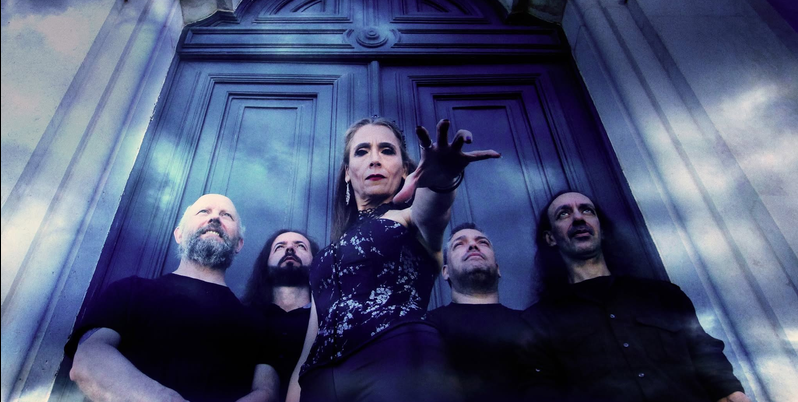
Malignea are:
Miguel Sampaio – bass
Luís Abreu – drums
Luís Possante – guitars
João Pedro Ribeiro – guitars
Isabel Cristina – vocals
discography:

album

album
Emerging from Portugal’s rich but often understated metal underground, Malignea have quickly positioned themselves as one of the scene’s most compelling and distinctive voices.
Formed in 2021, the band brings together experienced musicians with deep roots in gothic and doom metal, channeling their collective background into a sound that feels both atmospheric and emotionally resonant.
In just a few short years, Malignea have crafted a musical identity where dark elegance, theatrical storytelling, and Portuguese-language lyricism converge with influences that range from doom-laden heaviness to touches of dark folk.
From the outset, Malignea embraced a clear artistic vision.
Their music is built on dense, immersive soundscapes, layered with melancholic melodies and a strong sense of narrative.
This approach, combined with a striking aesthetic, sets them apart within the Portuguese metal landscape, giving their work a cinematic quality that extends beyond the music itself.
Their self-titled debut album, ‘Malignea‘, released in early 2023 via Ethereal Sound Works, marked a confident introduction.
Tracks like ‘Morte Vermelha‘, ‘Universo 25‘, and ‘Farol dos Malditos‘ showcased a band already in control of its direction, blending classic gothic metal influences reminiscent of acts like Paradise Lost and Tristania with a more focused, contemporary approach.
Central to the album’s impact was the commanding presence of vocalist Isabel Cristina, whose expressive delivery guided listeners through a sound both melancholic and enveloping.
Critics responded positively, highlighting the band’s maturity and their ability to create an atmosphere that draws the listener in without descending into complete despair.
Two years later, Malignea expanded their artistic scope with their second full-length release, ‘A Aldeia‘ (The Village) in 2025.
Conceived as a concept album, it delves into themes rooted in rural mythology, ancestral fears, and the cultural memory of Portugal, weaving elements of folklore into their established gothic framework.
The result is a richer, more layered work that pushes their theatrical and compositional boundaries further.
Songs such as ‘A Dança‘, ‘O Moinho‘, and ‘O Rei do Inferno‘ stand out as defining moments, reflecting both creative ambition and a strong sense of narrative cohesion.
On stage, Malignea translate this vision into a powerful live experience.
Their performances are marked by intensity, attention to detail, and a carefully crafted visual dimension that enhances the music’s emotional depth.
The release show for ‘A Aldeia‘, held in September 2025 at República da Música in Lisbon alongside Outshine and Paula Teles, was widely praised for its immersive atmosphere and confident execution.
It also highlighted the band’s evolution between releases, with Isabel Cristina’s vocal performance and the band’s dynamic presence leaving a lasting impression.
As their reputation continues to grow, Malignea are increasingly recognized as one of the standout acts in Portugal’s modern metal scene.
Their ability to blend atmosphere, storytelling, and musical depth has not only earned them critical acclaim but also established them as a band capable of delivering a truly engaging live experience.
With a clear artistic direction and a steadily expanding audience, Malignea are shaping a path that feels both authentic and forward-looking – a rare balance in today’s metal landscape.