Unpredictable by Nature
Finnish Garage Rock Band
LE ZOK
interviewed by Fok ’bs’

“We didn’t think about making a ‘debut album’ – we just wanted to make the best songs possible.”
“Good albums don’t sound like debut albums.”
“Everything usually starts with a jam – that’s where the core ideas come from.”
“If something sounds good, we keep it – even if it feels unpredictable.”
“It’s simply fun to create a rough rock track and a soft ballad in the same evening.”
“We don’t follow fixed templates or traditional structures.”
“Simplicity comes from each instrument doing simple things that build something layered.”
“Our chemistry developed completely organically over time.”
“The balance between roughness and clarity came from working with what we had.”
With ‘Yksäs‘, Le Zok deliver a debut that feels anything but tentative – a record shaped by instinct, experimentation, and a refusal to follow predictable structures.
Rooted in a DIY ethos yet rich in atmosphere, their sound moves between raw garage energy, dreamlike textures, and an openness to the unexpected.
In this interview with Fok ’bs’, Le Zok talk about songwriting through improvisation, the balance between chaos and clarity, and why unpredictability is not just a stylistic choice, but part of their identity.
‘Yksäs‘ feels less like a debut and more like a fully formed statement.
Did the band consciously try to avoid sounding like a ‘first album‘?
“Thank you!
We didn’t consciously try to avoid sounding like a debut album. We didn’t really think about it from that perspective – we just wanted to write the best songs possible and record and produce them as well as we could within DIY conditions. The songs come from a longer period of time, kind of a collection of what we’ve created so far.”
Juho: “Good albums don’t sound like debut albums.“
Your music balances raw immediacy with unusual structures.
Do songs emerge more from instinctive jams or carefully constructed ideas?
“Usually everything starts with a melody or structure that comes out of a jam, which is then developed later. Sometimes melodies from different jams are combined if they fit well together, and in the best case, that can lead to interesting verse–chorus combinations.”
There’s a strong sense of unpredictability on the album.
Do you see that as a reflection of the world you live in, or purely a musical choice?
“Both. The unpredictability reflects our band’s style. We don’t use any fixed pop templates or traditional four-chord progressions. If an idea sounds good, we want to stick with it, even if it feels unpredictable. Sometimes the surrounding world or a small story has a strong influence on how a song turns out. The unpredictability might also come from the fact that we listen to and enjoy different styles of music, so almost anything can sound good in a jam. It’s simply fun to create a rough rock track and a soft romantic ballad in the same evening.”
Finnish alternative rock has a recognizable identity.
Were artists like Ismo Alanko or Risto a conscious influence, or is that connection more the listeners’ interpretation?
“They weren’t a conscious influence – we’ve just made our own music. Of course, everything you’ve listened to and liked may have had a subconscious effect. Those artists have mainly been mentioned by listeners as references.”
Your lyrics often move between concrete imagery and abstract storytelling.
Do you write from a clear narrative or do meanings emerge later?
“Very often a song already gets a name or theme during the first jam, which is then developed later. It helps if a melody or riff gets its own ‘identity’ early on, because it makes it easier to remember. That can be as simple as a single word or a sentence. Sometimes almost the entire set of lyrics comes together during a jam. Still, the story of the song is usually at the center.”
Garage rock is traditionally rooted in simplicity, yet your sound feels layered.
How do you avoid complexity diluting raw energy?
“Great questions, by the way! In the end, the simplicity comes from each player and instrument doing relatively simple things that together create a layered sound. For us, garage rock is also about production and approach, since songs are created spontaneously. Simplicity and rawness are partly based on repetition and a certain driving quality. And we don’t have any guitar solos at all – all instrumental solos are handled by the keyboards.”
The interplay between slide guitar, keyboards and rhythm section is very distinctive.
Did that chemistry develop naturally or was it shaped deliberately?
“It’s completely organic. It has naturally evolved the more we’ve played together.”
There’s a sense of post-pandemic confusion on the album.
Was that a conscious theme or something that emerged subconsciously?
“A very conscious choice. The whole band actually came together on a night when an entire region in Finland was isolated from the rest of the country – and I happened to be on the ‘wrong’ side without permission.”
Covering ‘Freestyler‘ is a surprising choice.
What made you pick that iconic track and how did you approach reinterpreting it?
“It was a hungover morning at a DIY festival where we played one of our first shows. Through the tent we heard a ‘Freestyler–Cha Cha Cha’ mashup. It stuck in our heads, and somehow the idea came up to cover it, since both our band and ‘Freestyler’ share the use of slide guitar. At first, we wanted to cover that mashup version, but we couldn’t get permission, so it ended up becoming a ‘Freestyler’ cover almost by accident. Live, it might still be possible to hear our original version someday!”
Some songs have a dreamlike atmosphere, as if reality slightly shifts.
Do you see your music as escapism or confrontation?
“Those dreamlike atmospheres also emerged purely from following the music – they simply felt right in the moment, and we wanted to preserve or recreate those moods in the final result.”
The Helsinki music scene is very diverse.
Do you feel part of a specific scene or consciously outside of it?
“We actually find it quite difficult to define which scene we belong to. We don’t really feel part of any specific scene. That’s partly intentional, since we haven’t aimed to create a particular kind of sound – but we’re also still a young band and may not have found our scene yet.”
The production sounds organic yet clear.
How important was it to maintain a balance between roughness and precision?
“That balance was something we were aiming for. Partly consciously, since we didn’t go into a proper studio – everything was recorded independently in different places. So in a way, the balance came from taking rough recordings and trying to get the best possible result by handing them over to professional production.”
If ‘Yksäs‘ explores boundaries and reshaping them, do you see the next step as pushing them further – or stripping things down?
“We’re actually already recording the next album. It’s going to be more dreamlike, maybe more serious, even a bit stranger. Less straightforward rock, a bit more atmospheric. In any case, we’re heading into new territory once again.”
Le Zok approach music as an open process rather than a fixed concept, allowing songs to emerge from instinct, interaction, and experimentation.
Instead of defining themselves through genre or scene, they embrace unpredictability as a core principle – both musically and creatively.
With new material already taking shape, their path forward doesn’t aim for refinement in a conventional sense, but for deeper immersion into atmosphere, contrast, and the unknown.
by Fok ‘bs‘
Finnish Garage Rock Quartet
LE ZOK
Is Set To Release Album
‘Yksäs’

album cover by Vivi Tarkka
track-list:
Tatu (intro)
Pastori
Juoksuhiekka
Radio Day
Skuutin tarina (ei saatana)
Kärpäsvaikutus
Joulupukin tervehdys
Shamaani
Kauppa on auki
Freestyler
(Bomfunk MC’s cover)
Löysää göysiin
Nuuksio
Tatu ei suosittele
mixed by Martin Granö
mastered by Risto Ylihärsilä
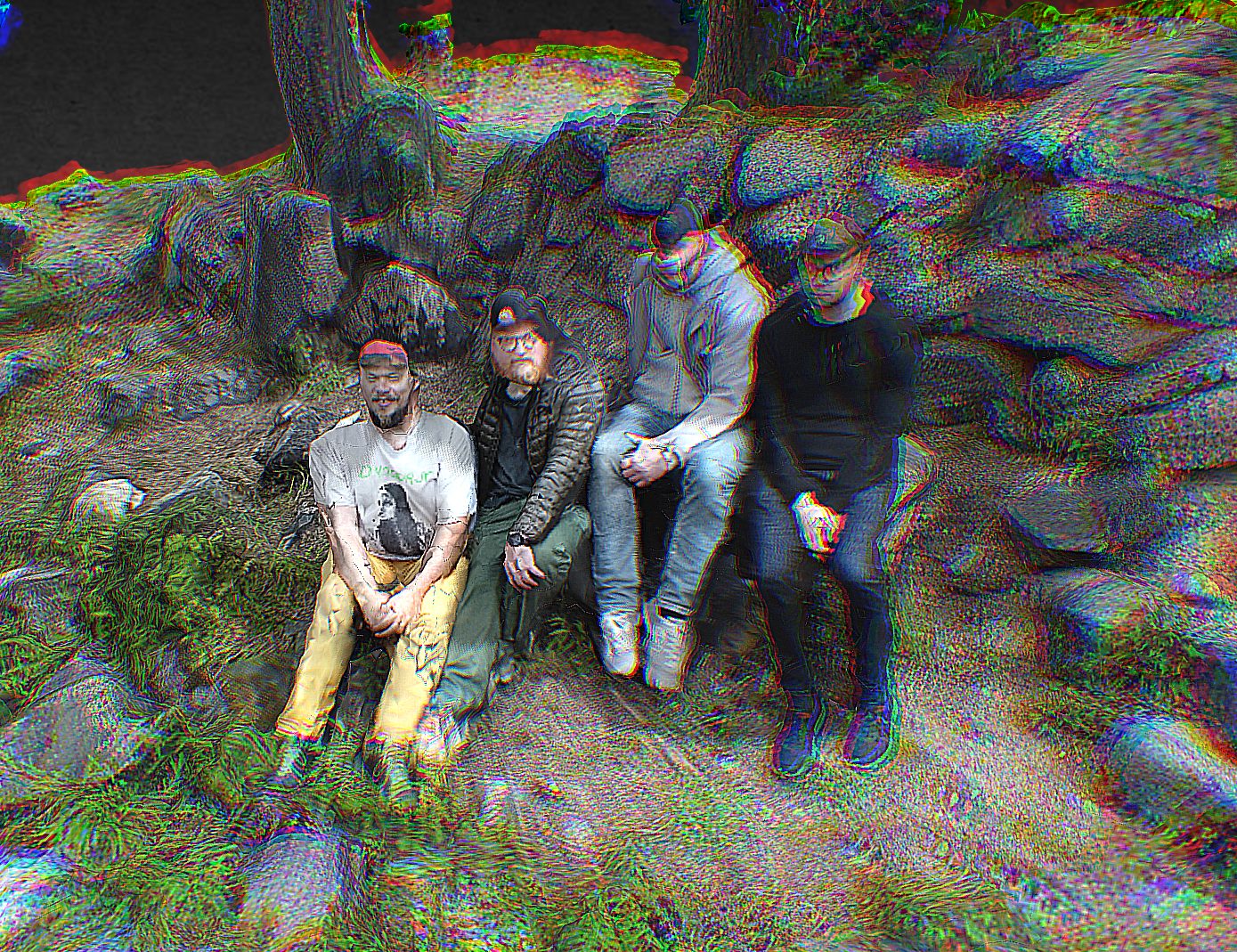
Le Zok are:
Tommy Tienhaara – guitar
Tuomas Tavi – bass, vocals
Roope Heinonen – drums
Juho Noro – keyboards
Helsinki-based four-piece Le Zok operate in a space where alternative rock resists easy definition.
Drawing from a wide spectrum of influences, the band blends experimental immediacy with unconventional structures, creating a sound that feels both instinctive and carefully shaped.
There’s a raw, organic quality running through their music – gritty without losing clarity – while elements of garage rock, psychedelia, grunge, and even traces of 1970s new wave quietly surface beneath the surface.
Their approach has drawn comparisons to key figures in Finnish alternative music such as Ismo Alanko and Risto – a connection that becomes even more fitting given that members of the latter were involved in mastering the band’s upcoming debut album, ‘Yksäs‘.
At the core of Le Zok’s sound lies a distinctive interplay of textures:
blues-rooted slide guitar lines weave through melodic bass and keyboards, all anchored by tight, expressive drumming.
Above it all, the vocals take center stage – powerful and often enigmatic, guiding the listener through lyrics that drift between the concrete and the abstract, sometimes opening the door to more elusive, almost dreamlike narratives.
With ‘Yksäs‘, Le Zok present a collection of songs that deliberately sidestep traditional rock conventions.
The material remains direct, yet unpredictable, shifting between grounded songwriting and unexpected turns.
Some tracks echo the lingering disorientation of the pandemic era, while others focus on the individual – lost, searching, and trying to make sense of a fractured environment.
One of the album’s more surprising moments comes in the form of a loose, free-spirited reinterpretation of a well-known millennial-era hit, reimagined through the band’s unmistakable lens.
Familiar in fragments but ultimately singular in execution, Le Zok’s debut suggests a band less interested in fitting into a scene than in quietly reshaping its edges.