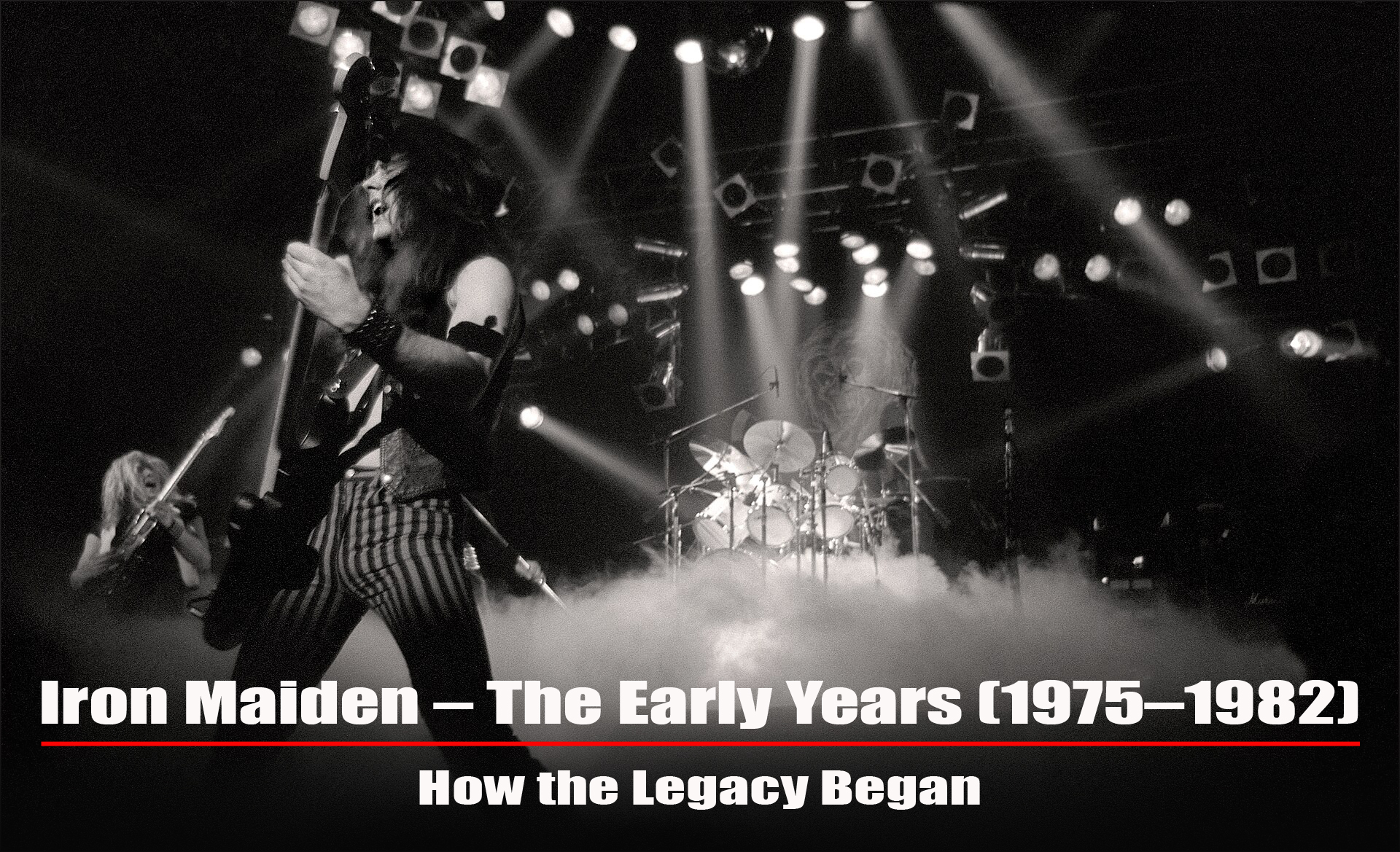
The early years of Iron Maiden tell a story of chaos, determination, and raw ambition.
From the smoky pubs of East London to the rise of the New Wave of British Heavy Metal, this is where the foundations were laid – long before the stadiums, the legends, and ‘The Number of the Beast’ changed everything.
Origins – A Different Kind of Beginning
The story of Iron Maiden in their early years is more than just the formation of a band – it is a chronicle of musical awakening, born out of frustration, ambition, and a clear vision.
In the mid-1970s, as rock music increasingly settled into predictable patterns and many of its biggest names had passed their peak, a new generation of musicians emerged in London’s East End.
They wanted the exact opposite:
more intensity, more speed, more honesty.
At the center of this movement stood Steve Harris.
When he founded Iron Maiden in 1975, his goal was never fame or commercial success.
Instead, he set out to build a band that would uncompromisingly realize his musical ideas.
Influenced by Deep Purple, Uriah Heep, and Black Sabbath, Harris developed a signature style defined by galloping bass lines, twin guitar harmonies, and narrative songwriting.
The reality of those early years, however, was far from glamorous.


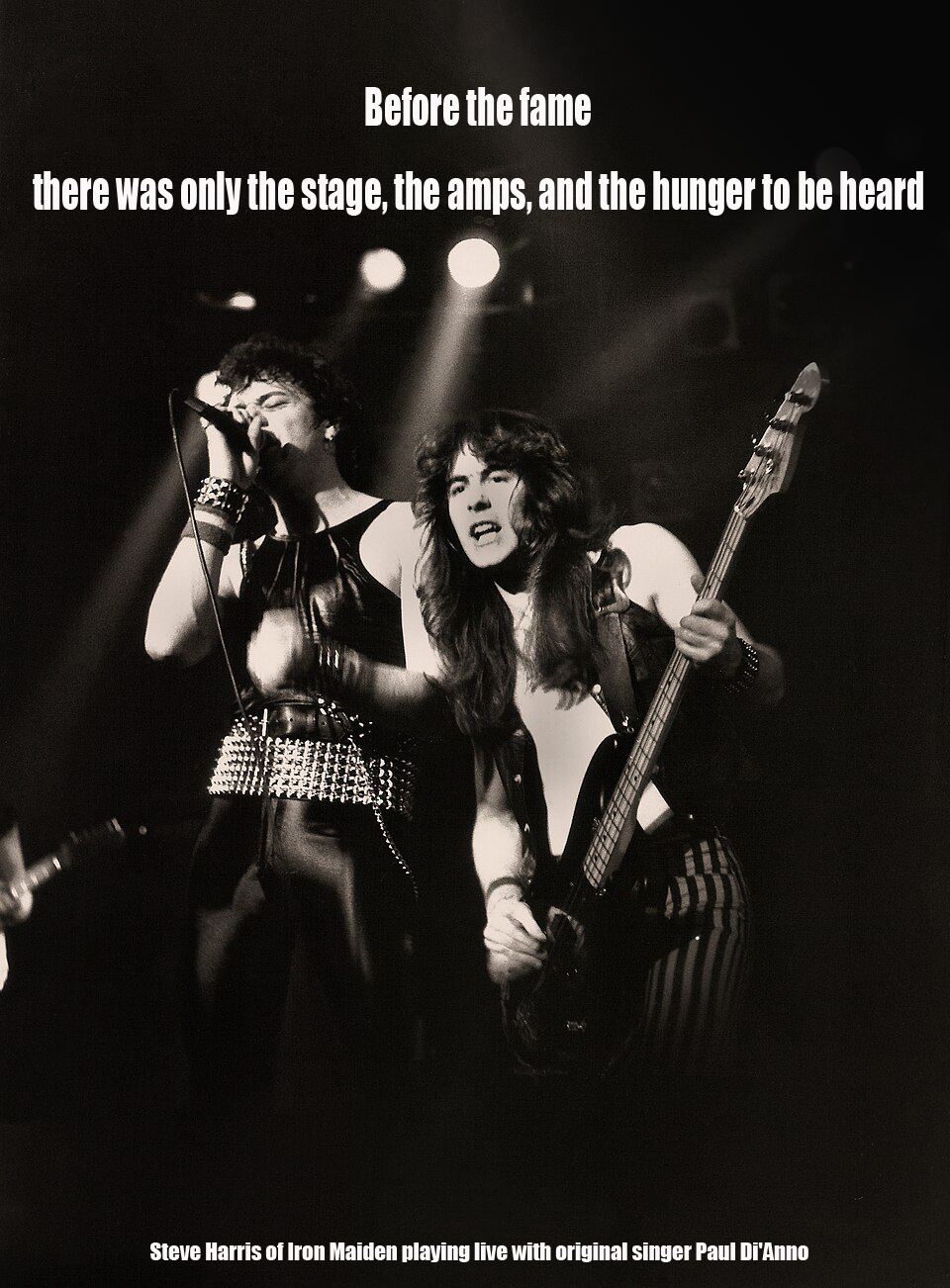
The early years were built on sweat, noise, and endless nights in small clubs.
– Struggle & Identity
The Club Years –
NWOBHM & DIY Spirit
By the late 1970s, Iron Maiden’s attitude aligned perfectly with a broader movement:
the New Wave of British Heavy Metal.
Bands began organizing themselves independently, releasing their own material and building audiences without major label support.
Iron Maiden fully embraced this DIY mentality.
In 1979, they released ‘The Soundhouse Tapes‘, an EP that quickly became an underground sensation.
Sold mainly at concerts and spread through word of mouth, it perfectly captured the spirit of the time.
The music grew fast
because the passion was already there
1980 – Raw Power Unleashed
As industry attention grew, Iron Maiden secured a record deal.
In 1980, they released their self-titled debut album ‘Iron Maiden‘, featuring Paul Di’Anno on vocals.
The album remains a powerful document of their early phase:
raw, direct, and full of energy.
Songs like:
Running Free
Prowler
Sanctuary
reflect a strong punk influence, while ‘Phantom of the Opera‘ already hints at the epic scope that would later define the band.
Iron Maiden initially existed in a near-constant state of flux.
Lineups changed frequently, with singers and guitarists coming and going at a rapid pace.
Stability was hard to achieve, but over time, a core began to form – driven by Harris’s relentless determination.
Performances took place in small clubs, often under difficult conditions.
One of the most important locations was the Cart and Horses, now widely regarded as the band’s birthplace.
It was here that their identity took shape:
Iron Maiden did not want to be just another rock band – they wanted to provoke, to stand out, and to push boundaries.

The London underground
was their first arena,
and it never slept
Before the world knew their name, they already knew their identity
Every night was a test
and they never backed down

Paul Di’Anno – The Raw Voice
Paul Di’Anno was a crucial element of this era.
His voice was rough, aggressive, and carried a street-level attitude that perfectly matched the band’s sound.
He embodied everything early Iron Maiden stood for:
unpredictable, intense, and authentic.
But that same unpredictability became a problem.
While Harris pushed forward with discipline, Di’Anno’s lifestyle increasingly spiraled out of control.
The road was long, the gear was heavy,
and the ambition never faded
The Turning Point – Di’Anno Out
By 1981, the situation became unsustainable.
Missed commitments, inconsistent performances, and internal conflict made a change inevitable.
Paul Di’Anno was dismissed.
His replacement:
Bruce Dickinson, formerly of Samson.
The sound was forged in cramped rooms and crowded stages

A New Era Begins
With Dickinson, Iron Maiden entered a new dimension.
His voice was:
powerful
versatile
technically refined
He also brought a commanding stage presence that transformed the band’s live shows.
This change opened the door to more complex compositions, broader dynamics, and ambitious songwriting.
1982 – The Breakthrough
In 1982, Iron Maiden released ‘The Number of the Beast’.
The album marked:
their commercial breakthrough
a decisive stylistic evolution
Tracks like:
Run to the Hills
Number of the Beast
Hallowed Be Thy Name
showcased a band at the peak of its creative power.
Legacy – The End of Innocence
For many early fans, this album marked a turning point.
The raw, unpolished energy of the Di’Anno era gave way to a more structured and accessible form of heavy metal.
What some saw as evolution, others saw as a loss.
With ‘The Number of the Beast‘, Iron Maiden left behind their raw beginnings.
Whether driven by Dickinson’s vocal range or a conscious artistic decision, one thing became clear:
The small band from East London had transformed into a global force.
The early days – chaotic, raw, and uncompromising – were over.
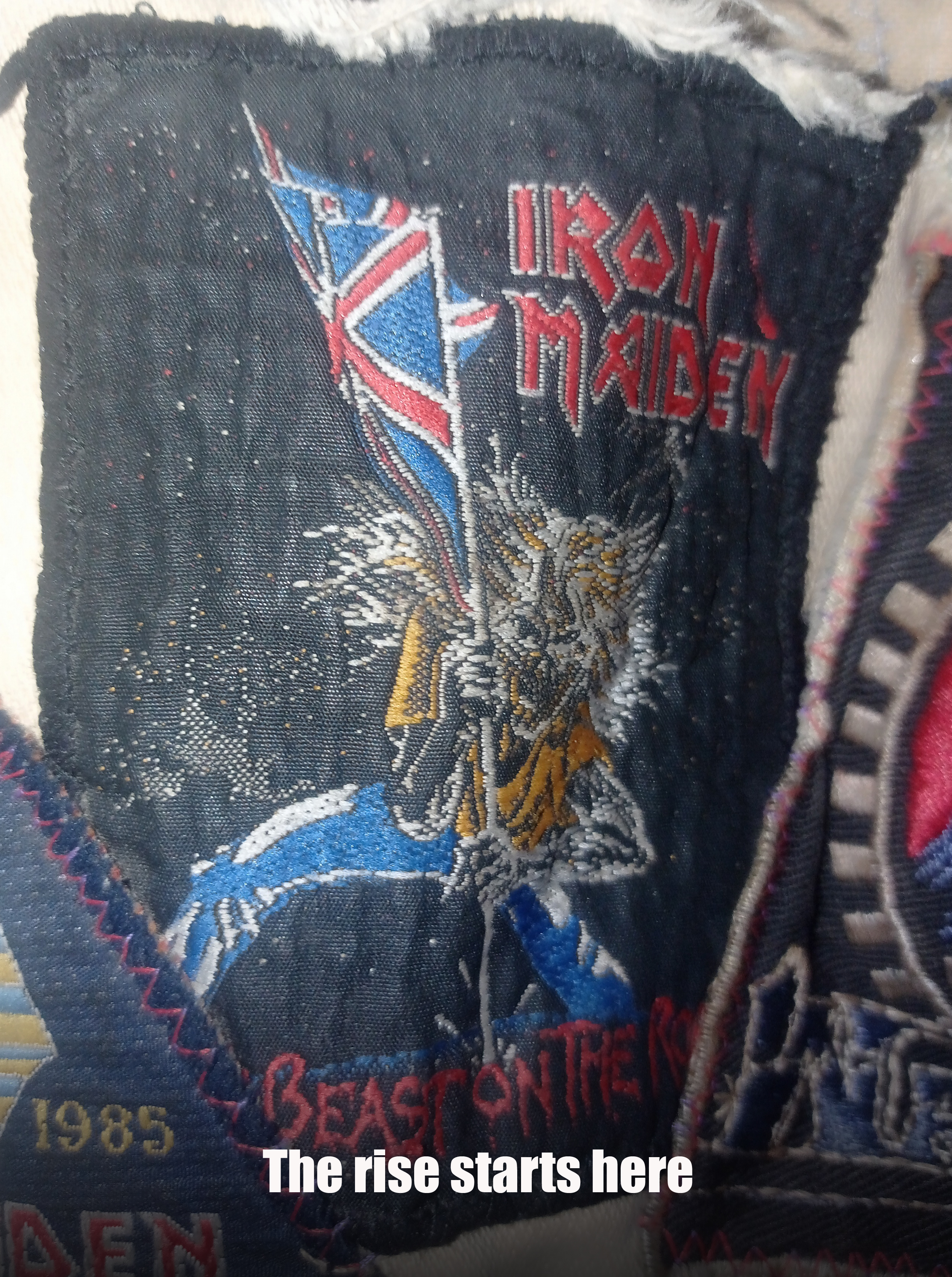
Within just a few years, Iron Maiden evolved from a struggling underground act into a stadium-filling powerhouse.
But for many fans, the Di’Anno era remains something unique:
a moment in time where everything felt dangerous, unpredictable, and real.
by Fok ‘bs‘
IMAGE CREDITS
License: CC BY 2.0
Author: Harry Potts
Image 1 (1)
Iron Maiden – Steve Harris, Manchester Apollo, 1980
Source: Wikimedia Commons
Original file: https://commons.wikimedia.org/wiki/File:Iron_Maiden,Steve_Harris–Manchester_Apollo–1980.jpg
Image 2 (2)
Steve Harris of Iron Maiden performing live with original singer Paul Di’Anno
Source: Wikimedia Commons
Original file: https://commons.wikimedia.org/wiki/File:IRON_MAIDEN–Manchester_Apollo-_1980.jpg