Questioning Reality
João Pedro Freitas from
Portuguese Progressive Metal Outfit
FREITANÁS
Interviewed by Fok ‘bs’

“Every song begins with a question, not an answer.”
“The most meaningful art should never give people answers. It should encourage them to ask better questions.”
“Music became the language I use to explore everything I cannot easily explain with words.”
“Progressive music has no boundaries. The only real limitation is the one you place on yourself.”
“If someone finishes the album with more questions than they had before listening, then I have achieved exactly what I wanted.”
“Growth only happens when you are willing to challenge your own beliefs.”
“Every composition begins with emotion. Technique only exists to serve that emotion.”
“I never wanted to create music that fits inside a genre. I wanted to create music that feels honest.”
“The album is not about certainty. It is about accepting uncertainty.”
“Every listener brings a different story into the music, and that is exactly how it should be.”
“Complexity means nothing if people cannot feel something underneath it.”
“Music should never tell people what to think. It should invite them to think.”
“The greatest journey is always the one that happens inside ourselves.”

Portuguese progressive metal project Freitanás is not interested in following formulas or staying within genre boundaries.
Driven by the creative vision of João Pedro Freitas, the project combines progressive metal, atmospheric textures, and emotional depth into music that constantly evolves while remaining deeply personal.
Rather than offering easy answers, Freitanás invites listeners into a world where introspection, experimentation, and storytelling exist side by side.
In this interview by Fok ‘bs‘, João Pedro Freitas reflects on artistic freedom, songwriting without limitations, and the philosophy behind one of Portugal’s most intriguing progressive metal projects.
The title ‘Ergo Sum‘ immediately evokes one of philosophy’s most famous statements.
At what point did ‘I think, therefore I am‘ stop being a quotation for you and become something deeply personal?
“The notion of identity and self were always something on my mind, growing up. What made me who I am, what I wanted to achieve, who I wanted to become. Those ideas mutate throughout the years, specially in particularly turbulent times like college or entering the work life. The greatest realization is that our thinking self is almost like a separate entity, that judges us and guides us to a model of perfection we can’t ever match. Dealing with those expectations and self-criticism is something I have been trying to work a lot on, like with this album.”
Many of the songs were originally written for Aoidos but ultimately found their home in Freitanás.
Looking back, do you think those songs were rejected by the band, or were they simply waiting for the right version of yourself to exist?
“The main example for that is ‘Synergy’. There were other songs that were eventually saved for a later date since new ones were born with urgency to be released. Those older songs were never rejected by the band, but I realized they were meant for something different, something I didn’t what it was, at the time. Turns out it was a solo project called ‘Freitanás’.”
Creating an album almost entirely alone gives you complete artistic freedom, but it also removes the creative friction that often produces unexpected ideas.
Did you ever miss having someone challenge your decisions?
“I didn’t, since I already have that with Aoidos. This was an exercise in complete artistic freedom, with the self imposed restriction of having me on the drums (except for ‘Synergy’ with Chris Barber and ‘Guilt-Ridden’ with Gaspar Ribeiro). That restriction alone was enough help the process, which I let be guided by the most intense introspection of my life. Dealing with myself created enough friction…hahahaha.”
‘Ergo Sum‘ explores adulthood not as stability, but as an ongoing process of questioning who we are.
Do you believe people ever truly ‘arrive‘, or are we all permanent works in progress?
“I don’t believe we ever ‘arrive’ anywhere. Our body grows older, but our mind is always learning. Supposedly, being an adult should be when one has their shit together. But I realize that that’s not the case. There’s a YouTube channel called ‘Dry Creek Wrangler School’ run by 60 year old Dewayne that put it into words like I never could. He says, in the video ‘When you just ain’t got it all together’, that he is still figuring things out, and he probably will never ‘got it all together’. And that is something we have to be ok with and cherish, since life would be pretty boring without it. If a 60 year old man that seems pretty content and happy with his life is still working on himself, I believe it’s ok to be wandering.”
The phrase ‘From Filth, Beauty Grows‘ suggests that even difficult experiences can become something meaningful.
Looking back at your own life, have your greatest creative breakthroughs usually emerged from moments of clarity, or moments of chaos?
“A bit of both, since moments of clarity seem to only occur after moments of great chaos. Sometimes there’s an item you can only find after turning your house upside down. And from that ruckus is when the greatest work comes from, because you uncover feelings and ideas beyond a first layer of expression, beyond looking for approval or to meet certain expectations by listeners or fans. This whole album came from me exploring and investigating the most tumultuous moments of my life, and the process of making it brought me a clarity I couldn’t achieve, otherwise.”
Progressive music often celebrates complexity, yet the emotions on this album feel remarkably direct and honest.
Was it important that listeners connect with the person before they notice the musician?
“Music, as an art form, is an emotional experience. Beyond the complex riffs and weird time signatures, a listener will connect with the vibe and the message the song conveys. Most of the times, that message is personal and completely different than the one the musician wanted to express, and that’s what makes art so interesting, because the same thing can be interpreted in so many ways. So, I feel that, more than connecting with me as a person or as a musician, it’s more important that the listeners connect with themselves through the songs, and with what they make them feel.”
One of the album’s most touching moments is your collaboration with your grandfather on ‘O Primo da América‘.
Beyond the music itself, what do you hope that recording will mean to your family many years from now?
“My grandfather was a musician all his life, yet never a recording one. There wasn’t the opportunity, of course, but I don’t think it was his goal, either. He always played music for music’s sake, to honour it. Playing music was enough for him, and I think that this recording is a great capsule of that spirit, that love for music that would always live on beyond his years, but one we can now play back sonically.”
Because Freitanás is entirely your own vision, every decision ultimately reflects you.
Was there a moment during the recording process when you realized that creating a solo album also means confronting parts of yourself you cannot hide behind a band?
“Oh yes. The whole process begun with that idea in mind, but it became more intense as the process went on. My work with Aoidos is deep but more reactive, more about the world and those around me. This, however, was a different beast. Introspection was the name of the game. Never before have I felt more naked when writing, recording and showing music to someone. I was so scared about the reaction, feeling that I went to deep, too vulnerable. Yet I was completely surprised, as I had the same people I thought wouldn’t like this work tell me it’s my best. And I couldn’t be prouder of the album and of myself.”
The album moves naturally between progressive metal, melodic rock, orchestral textures, and intimate songwriting.
Do you think genres are still useful creative tools, or have they become labels that listeners care about more than musicians do?
“For me, genres are useful if used like colour palettes. Especially subgenres of metal. I associate different feelings, vibes and colours with each one, like blue, cold, despair and nostalgia with black metal, and red, heat, anger and rebellion with death metal. Thrash is yellow, I think. Grind is, most certainly, green. But, synesthesia aside, this is the way I use genres, even with Aoidos, which has a tighter genre definition (although there’s still the ‘progressive’ label in there). Some feelings require certain textures and sounds that come from different cultures and styles. I think that’s what keeps the ball rolling, and keeps us from being stuck in stagnation.”
Several songs deal with memory, identity, and personal evolution.
If your twenty-year-old self could hear ‘Ergo Sum‘ today, which song would probably confuse him the most, and which one would he understand immediately?
“I think ‘Árvore Sombra’ would be the confusing one. It’s about loss, especially the loss of friends of our own age. There’s a specific pain that comes from that. Losing an older family member hurts in indescribable ways, but losing someone who is in the same phase as you destroys your sense of youthful immortality. We are all going to die, one day. My twenty-year/old self didn’t think about that. He still hadn’t experienced that loss. Life was still a giver on all accounts, but it wouldn’t be for long. I’m grateful for him, and for what I’ve gone through. Hopefully I’m worthy in his eyes. He would have understood ‘Guilt-Ridden L.B.K.’ easily, if only because of its crushing riffs. He was all about the metal, the speed and the heaviness that track brings to the album. He would be astonished by the work of Gaspar Ribeiro, that’s for sure. I’m still astonished, and I worked with the man!”
Home studios give artists unprecedented independence.
Do you think recording in your own environment made the album more honest, or did it sometimes become difficult to know when to stop refining your ideas?
“A bit of both. It is the most honest representation of my abilities as a musician, mixer and producer. And made me work under the ‘better done than perfect’ philosophy. Perfection is non-existent, and when working on art, the end is, most of the time, subjective. There’s always one more layer to add, one more frequency to notch, another compressor to tweak, but compromise and commitment is necessary, things that are only learned through years of experience and hundreds of songs written.”
Your lyrics often invite reflection rather than offering conclusions.
Are you more interested in giving listeners answers, or leaving them with better questions than the ones they had before pressing play?
“The goal is always to make people question things, to reflect, to feel something and to enjoy themselves. That’s art, to me. My interpretation is mine alone, some may agree with it, but others might find it completely wrong. My purpose is not to give a lesson, but to invite discussion.”
Finally, if ‘Ergo Sum‘ eventually becomes only the first chapter of a much larger Freitanás journey, what do you hope future listeners will recognize as the one defining idea that began with this debut album?
“It will be the first of many, hopefully, since it is a part of me that will always need to express itself. The main idea I hope it transpires is one of freedom, be it emotional or artistic, and the idea of self-improvement. Life is a long journey, and if we are blessed to find something we love to do, we should cherish it and learn as much as we can about it, never forgetting about our well-being. Absorb that thing, but don’t let it absorb you. Thank you for having me! Hope you enjoy the album!”
Progressive music has always rewarded curiosity, and João Pedro Freitas fully embraces that tradition without becoming trapped by it.
Rather than writing songs that simply impress through musicianship, Freitanás creates compositions that invite reflection and personal interpretation.
In a musical landscape often driven by instant gratification, that willingness to challenge both himself and his audience feels increasingly rare.
If this conversation proves anything, it is that the most memorable journeys are often the ones that leave the destination open to interpretation.
by Fok ‘bs‘
Portuguese Progressive Metal Project
FREITANÁS
Released Album
‘Ergo Sum’
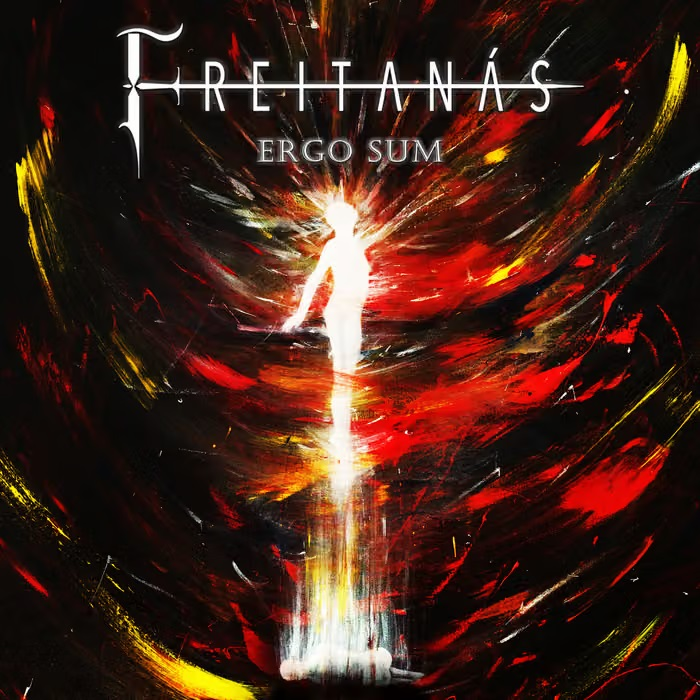
track-list:
Synergy
Cogito
From Filth, Beauty Grows (feat. Ana Amado)
Guilt-Ridden L.B.K. (feat. Gaspar Ribeiro)
Dead Sympathies
Quantum Immortality
A Música Não Pode Parar
Ninguém
Árvore Sombra
O Primo da América (feat. Américo Freitas)
Re-Bloom
Soon
music, lyrics and production by João Pedro de Freitas
drums on track 1 Chris Barber
vocals on track 3 Ana Amado
drums on track 4 Gaspar Ribeiro
trumpet on track 10 Américo Freitas

Freitanás is:
João Pedro Freitas

Portuguese progressive metal musician João Pedro Freitas has stepped into the spotlight with the release of ‘Ergo Sum‘, the debut album from his solo project, Freitanás.
Released on June 26, 2026, the independently produced record was recorded, mixed and mastered by Freitas in his home studio, offering an intimate yet ambitious introduction to a project that has been years in the making.
Freitanás was born in Castanheira de Pera, Portugal, as the creative outlet of the Aoidos vocalist and guitarist.
The project’s distinctive name, coined by close friend Rui Martins during a memorable gathering at the legendary Taberna 58, eventually became the banner under which Freitas could explore ideas that extended beyond the musical boundaries of his main band.
‘Ergo Sum‘ brings together songs originally written after the formation of Aoidos that never quite fit the band’s direction, alongside newer compositions created specifically for this solo venture.
The result is a diverse and deeply personal collection that blends progressive metal with melodic rock, drawing inspiration from artists such as Zakk Wylde, Nevermore, Ornatos Violeta and, most notably, Devin Townsend.
Rich orchestral arrangements, expressive clean vocals and inventive guitar work give the album its own distinctive identity while reflecting Freitas’ wide-ranging musical influences.
Lyrically, ‘Ergo Sum‘ explores the often-overlooked challenges of adulthood.
Rather than focusing solely on the responsibilities that come with independence, the album examines the emotional process of personal growth, identity, difficult choices and the lasting impact of life’s defining experiences.
Freitas describes the record as an attempt to ‘excavate the fossils’ left behind by those turbulent years, transforming reflection, vulnerability and self-discovery into cathartic music.
The album was introduced by the singles ‘Ninguém‘, released in February 2026, and ‘Dead Sympathies‘, which followed in May, offering listeners an early glimpse into the project’s musical direction.
Although Freitanás is fundamentally a solo project, ‘Ergo Sum‘ also features several notable guest musicians.
Portuguese vocalist Ana Amado, now based in London, contributes her voice to ‘From Filth, Beauty Grows‘, acclaimed drummer Gaspar ‘Animal‘ Ribeiro delivers a powerful performance on ‘Guilt-Ridden L.B.K.‘, and Freitas’ grandfather, lifelong musician Américo Freitas, appears on ‘O Primo da América‘, a heartfelt tribute celebrating both family and a lifelong passion for music.
With ‘Ergo Sum‘, Freitanás delivers an emotionally honest and musically adventurous debut that successfully bridges progressive metal’s technical ambition with deeply personal storytelling.
It is an impressive first chapter for a project that embraces both introspection and artistic freedom while establishing a distinctive voice within Portugal’s modern progressive metal scene.