‘Open Roads’ a journey without arrival
Ina Salaj of the German Psych/Prog Band
CRIMSON ROOTS
Interview by Fok ’bs’
“We wanted to create a state of being rather than tell a fixed story with a clear beginning and end.”
“The road is not just a physical place – it’s also an inner space.”

“I always start intuitively – I need to feel where a song hurts, where it breathes.”

“The traveler belongs to us, but hopefully also to everyone who listens.”
“You can travel far and still feel stuck – or stay in one place and change completely inside.”
“Some emotions need time to grow – the space between notes can say as much as the notes themselves.”
“We didn’t want the album to sound perfect – we wanted it to feel real.”

“On stage, the songs stop being memories – they become something that happens in real time.”
“We didn’t want to give answers – we wanted the road to continue beyond the album.”

“We want to grow without losing the emotional honesty at the core of our sound.”
With ‘Open Roads‘, the German psychedelic/progressive/blues quintet Crimson Roots craft an album that feels less like a destination and more like an ongoing journey – one shaped by movement, uncertainty, and inner transformation.
At the center of this sonic landscape stands vocalist Ina Salaj, whose performance channels both fragility and strength, guiding the listener through shifting emotional terrain.
In this interview with Fok ’bs’, Ina Salaj reflects on intuition, storytelling, and why the most meaningful journeys rarely offer clear resolutions.
‘Open Roads‘ feels like a journey that never truly arrives.
When writing, was it more important to tell a story or to create a certain state of mind?
“I think it was more about creating a certain state of mind. Of course, there is a story within the album, and the figure of the traveler gave us a kind of red thread. But we never wanted it to feel like a fixed narrative with a clear beginning, middle, and end. ‘Open Roads’ is more about movement, uncertainty, searching, and the feeling of becoming a different person through what you experience.
For us, the road is not just a physical place. It’s also an inner space. Sometimes you move forward without really knowing where you’re going. That feeling was very important for the album. We wanted listeners to travel with the songs, rather than simply being told what happens.”
Your voice carries much of the album’s emotional depth.
Do you approach vocals intuitively, or do you consciously develop them along the narrative?
“It starts very intuitively. I usually need to feel the emotional weight of a song before I can really sing it. If I think about it too technically, the performance becomes too controlled and loses something honest. The first connection is always instinctive, almost like asking myself: ‘Where does this song hurt? Where does it breathe? Where does it open up?’
After that, I become more conscious. Since ‘Open Roads’ has this journey-like structure, I tried to understand where each song stands emotionally. Some songs needed a more fragile voice, some needed more strength, and others needed that feeling of being lost or close to breaking. I didn’t want every song to sound emotionally ‘big’ in the same way. The voice had to follow the inner movement of the album.”
The figure of the ‘traveler‘ feels both personal and universal.
Do you see yourself in that role, or more as an observer?
“I definitely see myself in that role, but not only myself. I think all of us in the band found something personal in that figure. The traveler can be someone leaving a place, changing their life, searching for meaning, or simply trying to get through a difficult time while continuing to move forward.
For me it’s personal, because I know what it means to start over, to leave familiar things behind, and to build a new life while still carrying parts of the old one. At the same time, I think almost everyone knows that feeling. We all go through phases where we don’t yet know who we are becoming. That’s why the traveler became such a powerful image for the album. It belongs to us, but hopefully also to the people listening.”
Many songs move between external motion and internal change.
How consciously do you play with that duality?
“Very consciously, but in a natural way. The idea of movement is everywhere on the album: roads, steps, departure, falling, searching. But the real journey often happens within. A person can travel far and still feel stuck emotionally, or stay in one place while going through a huge internal change.
This contrast became one of the central feelings of ‘Open Roads’. The outer world gives the songs their imagery, but the emotional core lies in the transformation beneath. We liked this duality because it keeps the songs open. A road can be a real road, but it can also be a decision, a memory, a wound, or a new beginning.”
Your music feels organic and almost ‘breathing‘.
How important is it for you to give songs space to unfold rather than getting straight to the point?
“That’s very important to us. We’re not really interested in forcing every song into a short, polished format where everything has to happen immediately. Some emotions need time. Some parts only make sense when they’re allowed to grow slowly. And sometimes the space between the notes says as much as the notes themselves.
As a band, we like it when music feels alive. That means it can expand, pull back, become heavier or softer, or take a turn you might not expect at the beginning. Especially in progressive and psychedelic rock, there’s a lot of beauty in letting a song breathe. It gives listeners time to immerse themselves in the atmosphere rather than just consuming it quickly.”
You combine blues as a foundation with progressive and psychedelic elements.
What does blues give you emotionally that other genres cannot?
“Blues gives the music a human foundation. There’s something very direct and honest about it. Even when a song becomes more progressive or psychedelic, the blues element keeps it grounded in something real, something you can feel physically. It brings warmth, tension, pain, and soul without needing to explain too much.
For me, blues is not just a style. It’s a way of expressing emotions without hiding them. It allows imperfection, and that’s exactly what makes it beautiful. Blues can sound raw, vulnerable, strong, and melancholic all at once. That emotional honesty was something we wanted to keep at the center of ‘Open Roads’, even as the arrangements became bigger and more expansive.”
The album’s analog warmth contrasts with many modern productions.
Is that an aesthetic choice or more of a mindset?
“It’s both. Aesthetically, we love warm, organic sounds. We like it when you can feel the instruments, the room, the dynamics, and the human touch behind a recording. We didn’t want the album to sound too clean or too perfect, because that wouldn’t have fit the emotional world of the songs.
But it’s also a mindset. We wanted ‘Open Roads’ to feel like a band playing together, not like separate parts edited into something flawless. In that analog warmth – or at least in that way of thinking – there’s a certain honesty. It leaves room for character. It lets the music breathe and reminds you that real people are behind the sound.”
With ‘Falling Through‘, there’s a moment of breakdown on the album.
Was that also one of the most emotionally intense points in the process?
“Yes, absolutely. ‘Falling Through’ feels like the moment when the traveler can no longer pretend to be strong. It’s not just about sadness, but about losing control – about that moment when everything you’ve been holding together slowly falls apart. Emotionally, that’s a very intense place to sing from.
During the process, it was one of the songs where we had to be careful not to over-dramatize the feeling. The intensity had to come from the truth of the moment, not from trying to make it sound bigger on the surface. For me, it’s one of the emotional centers of the album, because breakdown is also part of change. Sometimes you have to fall through something before you can move forward again.”
As the frontwoman, you are at the center of perception.
Do you experience that more as an opportunity for expression or as a responsibility toward the band?
“It’s both, and I think that balance is very important. On stage and in the songs, the voice naturally becomes a focal point because it carries the words and a large part of the emotion. That gives me a lot of freedom to express myself, and I’m very grateful for that. Singing these songs feels very personal.
But I also feel a responsibility. I’m not standing there just for myself. I represent the energy of the whole band, the work we’ve put into the music, and the connection between us. Crimson Roots is not built around a single person. The band comes from the chemistry of five people. Even if I’m visually at the center, I always feel like I’m carrying something that belongs to all of us.”
Your songs feel like chapters of a larger whole.
When writing, do you think in individual scenes or in the context of the entire album?
“At first, many songs emerge more like individual scenes. Each song has its own atmosphere, its own emotional place, its own color. But as the album developed, we began to understand more and more how these scenes connect. That’s when the bigger picture became important.
With ‘Open Roads’, we didn’t want a collection of unrelated songs. We wanted the album to feel like a journey through different emotional landscapes. Even if a song stands on its own, we still asked what role it plays in the whole. Is it a beginning, a turning point, a moment of doubt, a moment of strength? That helped us shape the flow of the album.”
Live, this music takes on a different energy.
Does the meaning of the songs change for you on stage?
“Yes, very much. In the studio, you capture a specific version of a song – maybe the most focused or consciously shaped one. But live, the songs become more immediate. They respond to the room, the audience, and how we feel that night. Some parts become more intense, others more fragile, and sometimes a song reveals a completely new side.
For me as a singer, the songs feel less like memories and more like something happening right now. You’re not just performing the emotion – you’re experiencing it again in front of people. That can be very powerful, especially with music that has space and dynamics. The songs continue to grow on stage.”
The album doesn’t end with a clear resolution.
Is that openness more appealing to you than a traditional sense of arrival?
“Yes, very much. A clear resolution can be beautiful, but for this album it wouldn’t have felt honest. ‘Open Roads’ is about movement, searching, and change – and those things rarely end in a clean, definitive way. In life, you don’t often arrive at a perfect point where everything suddenly makes sense. You might understand a little more, carry a little less, or find the strength to keep going.
That openness is important to us because it leaves space for the listener. We didn’t want to close the door and say, ‘This is the answer.’ We wanted the ending to feel like the road continues beyond the album. Maybe that’s more emotional than a final resolution, because it’s closer to real life.”
If ‘Open Roads‘ is a beginning, where could the next journey lead – further inward or outward?
“Maybe both. ‘Open Roads’ has already opened a door for us as a band. It helped us better understand our sound, our identity, and the kind of stories we want to tell. The next journey could go deeper inward, into more personal and darker emotional spaces, but also further outward, with bigger sounds, wider landscapes, and new influences.
What’s exciting is that we don’t want to simply repeat the same path. We want to keep the roots of Crimson Roots – the warmth, the blues feeling, the progressive structures, and the emotional honesty – but we also want to grow. If ‘Open Roads’ is the beginning, then the next step is about discovering how far this world can expand.”
For Ina Salaj and Crimson Roots, ‘Open Roads‘ is not about arriving.
It is about embracing the uncertainty of movement, the tension between outer journeys and inner change, and the quiet transformations that happen along the way.
By allowing their music to breathe, expand, and remain open-ended, the band have created a deeply human listening experience…
…one that continues long after the final note fades.
by Fok ‘bs‘
German Female-Fronted
Psychedelic/Progressive/Blues Quintet
CRIMSON ROOTS
to Release Physical Edition of
‘Open Roads’
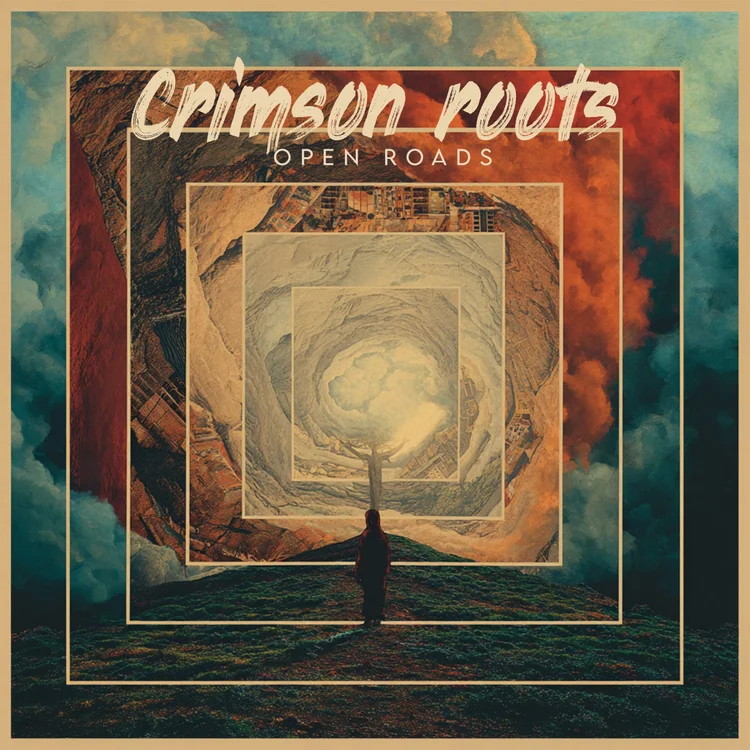
track-list:
Drifting
Open Roads
Steps
Clocks
Nowhere
Falling Through
When
The Tower
The Crossing
The Crossing – Part II
Mountain
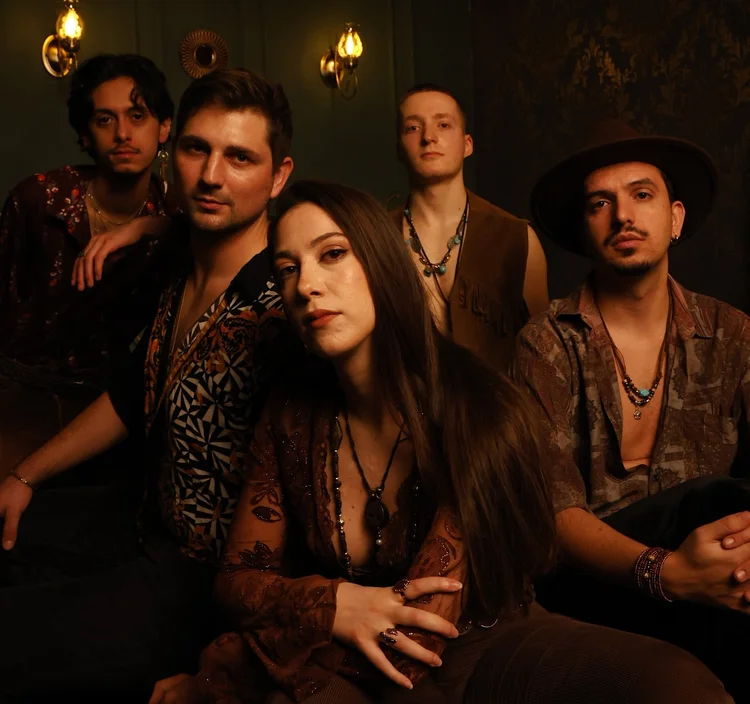
Crimson Roots are:
Ina Salaj – vocals
Kristi Dhimitri – guitar
Kolja Becker – bass
Idris Voegli – keyboards, organ
David Vinogradov – drums
Crimson Roots on tour 2026:
Apr18th Noisebox + Taihr Attendorn/DE
Apr24th Kult.9 München/DE
May8th Glashaus + Zoahr Bayreuth/DE
Jun6th JC Scheune Outdoor Session Festival Erlangen/DE
Jun9th Local Venue Gig (TBA) Rennes/FR
Jun10th Concert in Conservatoire de Rennes Rennes/FR
Jun26th Fairweilen Festival Freystadt/DE
Jul10th Bismarckstraßenfest Erlangen Erlangen/DE
Jul12th Fürth Festival (Church Stage) Fürth/DE
Jul18th Bright Mountain Festival Hellberg Weigendorf/DE
In September 2025, Crimson Roots introduced themselves with ‘Open Roads‘, a debut full-length concept album that feels less like a first step and more like the beginning of a long, unfolding journey.
Initially released digitally and set for physical release in May 2026 via Tonzonen Records (CD) and Cargo Records (LP), the album positions the band as storytellers as much as musicians – weaving narrative, atmosphere, and emotion into a cohesive whole.
At its core, ‘Open Roads‘ traces the path of a traveler moving through distance, change, and self-discovery.
But this journey is anything but linear.
Across tracks like ‘Open Roads‘, ‘Nowhere‘, and ‘The Crossing‘, the album shifts fluidly between external landscapes and internal states, blurring the boundaries between physical movement and emotional transformation.
The traveler becomes a symbolic figure – at once an individual, a collective experience, and a reflection of the listener themselves.
Written, recorded, and produced entirely by the band, the album captures a raw, almost live energy while embracing the warmth of an analogue sound.
There’s a tangible sense of authenticity in every note, as if each song has been allowed to breathe and evolve organically.
This approach mirrors the album’s central themes:
movement, impermanence, and the search for meaning in uncertain terrain.
Musically, Crimson Roots draw deeply from the blues, using it as a foundation to build expansive compositions where progressive structures and psychedelic textures intertwine.
Their sound is rich and evocative – soulful guitar work, expressive vocals, distinctive basslines, vintage keyboard tones, and dynamic drumming all contribute to a sonic landscape that feels both intimate and cinematic.
Influences from classic acts like Led Zeppelin, Deep Purple, and Pink Floyd can be felt throughout, yet the band avoids nostalgia by shaping these elements into something distinctly their own.
Each track on ‘Open Roads‘ functions as a chapter in a larger narrative.
The album opens with ‘Drifting‘, capturing the uneasy moment of departure, before the title track pushes the journey into motion.
Songs like ‘Steps‘ and ‘Clocks‘ explore perseverance and the weight of time, while ‘Falling Through‘ marks a breaking point where certainty collapses.
From there, the album moves through resistance (‘The Tower‘), vulnerability (‘When‘), and surreal transformation (‘Nowhere‘), culminating in the dual passage of ‘The Crossing‘ and the final ascent of ‘The Mountain‘.
By the time the closing notes fade, the destination feels less important than the transformation itself.
‘Open Roads‘ is not about arrival in the traditional sense – it’s about becoming.
In that way, Crimson Roots have crafted more than just an album;
they’ve created a reflective, immersive experience that resonates long after the journey ends.