Pulled By Gravity:
German Stoners
STARGO
On Jams, Space, And Subconscious Flow
Interview by Fok ‘bs’

“The new album feels like a journey through different landscapes. We always try not to get stuck on just one terrain.”
“The great machine can be everything that keeps you stuck in a grind you don’t want to be in.”

“Most of our songs aren’t planned – they just pop up from the subconscious.”
“There can’t be noise without silence. If you go full throttle all the time, you’re losing power.”

“Dortmund is a working-class town with a rough atmosphere – that’s probably where our DIY approach comes from.”
“If we can leave someone sitting still for two or three minutes after the last track ends, we are blessed.”

“We hope listeners move through calm, chaos, and trance when listening to our records.”
“For us, there is no real difference between writing for live shows and writing for the studio.”

“The ‘stoner’ label is worn out – it’s psychedelia that really keeps this scene together.”
Some bands write songs.
Others open portals.
For more than two decades, Stargo have been navigating the space between earth-heavy groove and cosmic drift, shaping long-form jams into immersive sonic journeys.
Rooted in Dortmund’s rough-edged DIY culture and fueled by subconscious improvisation, the trio continue to evolve without losing their gravitational pull.
With a new album on the horizon – spanning volcanic Martian plateaus, hypnotic machinery, and black-hole silence – we spoke to the band about landscapes, jams, psychedelia, and the emotional afterglow of a record well played.
Your sound often feels like a journey between earthbound groove and cosmic vastness.
If your next album were a landscape – volcanic, desert, ocean, or something else – what terrain would it be and why?
“One of those new songs is called ‘Tharsis’ which is a volcanic plateu on planet mars. So for that particular song the answer is quite clear. But looking at the new album in its entirety it feels more like a journey through all those different landscapes you mentioned in your question. We always try to not get stucked on just one terrain.”
Stoner music can be hypnotic and transcendent.
How do you balance groove, heaviness, and emotional resonance when composing?
“That is a quite natural process in this band, as we mostly don‘t compose in the classic way. We jam together for 20 years now, and the vast majority of our tunes have emerged from a jam. So these different states you mention are most times not planned, they just pop up from the subconscious.”
Your earlier work includes long, evolving instrumental pieces.
What role does silence or space play in the way you structure those tracks?
“It‘s a wise old saying that there canˋt be noise without silence. If you‘re going only full throttle all the time you‘re loosing power at some point. Except you‘re a Thrash or Death Metal band maybe.”
The single ‘Abazali’ ‚The Great Machine’ has a distinctive vibe.
What themes or experiences inspired its creation, and how does it connect to the rest of the upcoming album?
“All the three of us are not full time musicians. We all are stuck in the great machine called regular jobs, holding us off from musical world domination. But ‘the great machine’ can of course be everything that keeps you in a grind that you actually don‘t wanna be in. This song is quite unusual for us. It‘s the shortest song we ever made and has this special good old early QOTSA/Monster Magnet feeling, in my opinion.”
Dortmund has a rich musical and cultural history.
In what ways does your origin influence the music you make – musically, philosophically, or emotionally?
“Dortmund has always been a working-class town with a quite rough atmosphere. Maybe that‘s where our strong DIY approach comes from. And since the 80s there is a very vivid Metal and Punk scene here that we grew up with. And you can definitely recognize that in our sound.”
Stoner rock often encourages a certain looseness – improvisation, cosmic jamming, hazy texture.
How do you decide when to let a part breathe versus tighten it with precision?
“Same as in the second question, for us a natural process, mostly fueled by our subconscoius.”
Your trio dynamic has remained consistent for years.
How does your creative interplay evolve when working on an album meant for release, compared to writing for live performance?
“To be honest, I don‘t know bands that write particular for live performances. Of course you can expand songs with jam parts and stuff when playing live. And we love to do that. But for us there is no particular difference between live and studio.”
Stargo blends heavy grooves with psychedelic elements.
Do you ever think about your music in terms of states of consciousness – calm, chaos, trance?
“Well, I hope we get our listeners into all of those states when listening to one of our records. We try to not just create one particular mood.”
If you could soundtrack a moment in film or literature (not necessarily metal culture), what scene or story would fit perfectly with Stargo’s music?
“Our bandname is inspired by an old 80‘s comic superhero. So I could imagine one of our tunes in some dark, futuristic comic movie. And I love the idea of one of our songs being featured in ‘The Boyz’…”
The album art and titles in your catalog often evoke imagery beyond words.
How consciously do you think about visuals when composing musical themes?
“We are bursting with ideas for visuals, videos and stuff like that. But its so hard to let those ideas come to life. We are a small underground band and don’t have the means to.”
In a world full of subgenres and niche labels, what does the word stoner mean to you today – and what would you want someone new to the genre to understand first?
“Honestly, for me the ‘Stoner’ label is totally worn out. When it all started in the 90s it may have made sense for quite some time, when lots of bands had that one typical approach to this music. But the scene today is so diverse and has developed so far…but in the end its the more or less touch of psychedelia, not Stoner, that keeps it all together. So if you like that and you like guitars, newbie, give it a try.”
If the new album were a cosmic event (eclipse, storm, black hole, supernova), which would it be and what emotional effect would it leave in its wake?
“I pick the Black Hole, sucking you and your mind with its gigantic gravitaton on the other side, where you wake up in total silence and try to understand what just happened to you…”
Finally – what’s the emotional place you want the listener to arrive at when the last track ends, and the speakers go silent?
“When I listen to a an album for the very first time, that totally blasts my mind, I‘m always keeping still for 2 or 3 minutes, feeling like I just returned from a little journey. If we manage to bring at least a couple of people in that state of mind, we are blessed.”
Stargo don’t chase trends, labels, or neatly defined genres.
Their music breathes, stretches, collapses, and regenerates – much like the cosmic imagery that surrounds it.
Whether channeling volcanic riffs, hypnotic machinery, or the silence after total sonic collapse, the trio remain guided by instinct, friendship, and the raw joy of jamming.
If the upcoming album truly behaves like a black hole, one thing is certain: once you cross the event horizon, there’s no quick way back – only that quiet moment afterward, trying to process where the journey just took you.
by Fok ‘bs’
German Stoner Trio
STARGO
Will Release Album
‘Violet Skies’
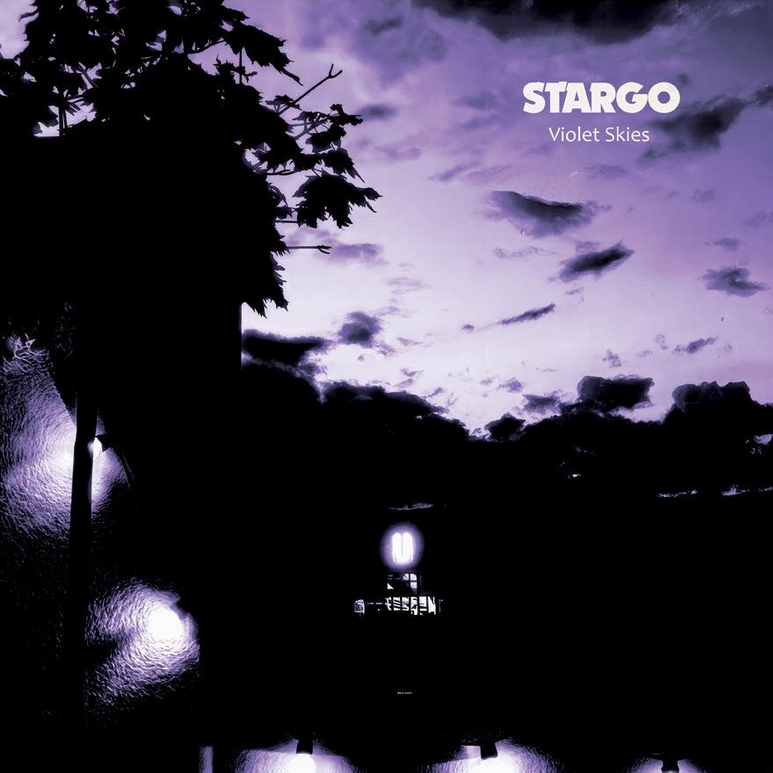
artwork by Anja Georges
track-list:
Interstellar
Shine Like Diamonds
Don’t Mind
Left For Dead
The Artist
Stargazer
Tharsis
The Great Machine
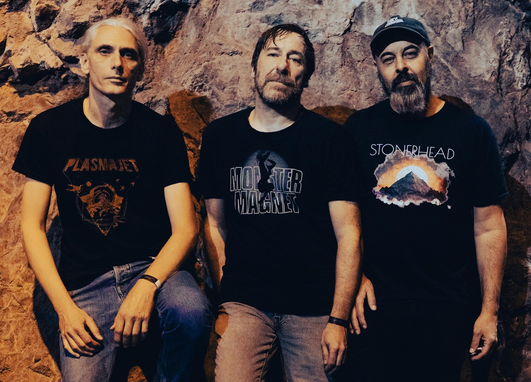
Stargo are:
Nordin – vocals, guitar
Stefan – bass, synths
Karsten – drums
discography:
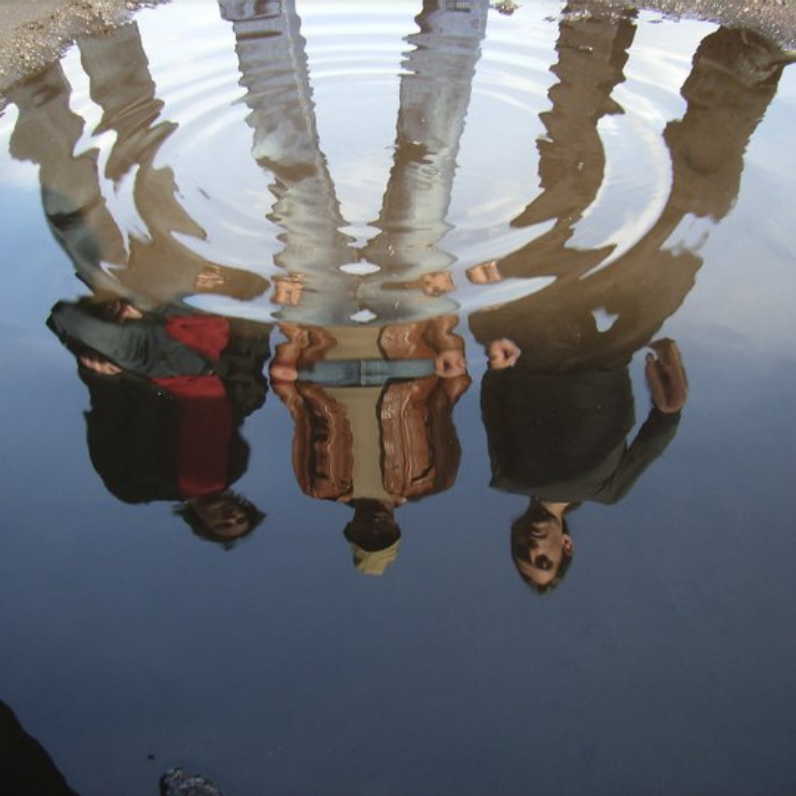
album
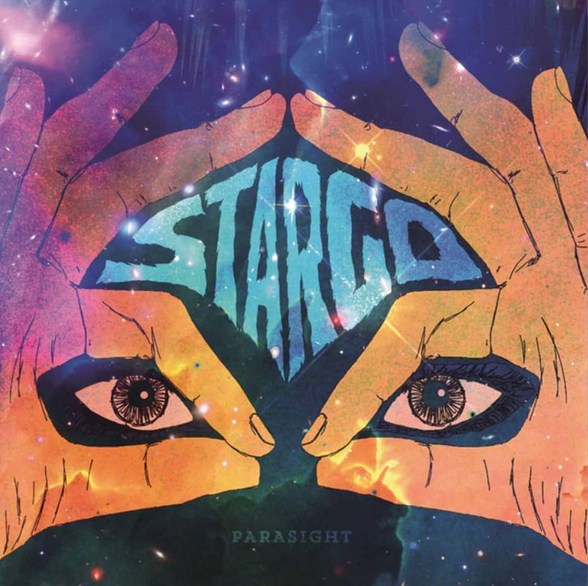
album
EP
From the industrial heart of Germany’s Ruhrgebiet, STARGO return with ‘Violet Skies‘, their fourth full-length album and a confident new chapter for one of the country’s most seasoned heavy stoner rock trios.
The record will be self-released on vinyl and digitally on February 13, 2026, reaffirming the band’s independent spirit and hands-on approach to their craft.
The first glimpse into this new era arrived with ‘The Great Machine‘ accompanied by a striking music video directed by Ansgar Wojahn.
The single signals both continuity and expansion:
unmistakably STARGO, yet more narrative-driven and dynamically layered than ever before.
Formed in Dortmund in 2008, STARGO have long occupied the fertile intersection of stoner rock and metal, forging a sound that appeals equally to psychedelic wanderers, fuzz-drenched riff devotees, and heavy metal purists.
Their music moves fluidly between crushing momentum and dreamlike, cosmic passages – sometimes grounded and direct, sometimes drifting into expansive, hypnotic terrain.
It’s a balance they’ve refined over years of writing, recording, and relentless live performance.
At the core of STARGO’s identity lies contrast.
Monolithic riffs give way to open-ended instrumental explorations;
compact song structures dissolve into sprawling, atmospheric sections.
Above it all sits a vocal performance rich in character and emotional range, shifting seamlessly from restrained and introspective to raw and commanding.
The result is a sound that resists genre confinement – heavy stoner metal that feels alive, unpredictable, and deeply expressive.
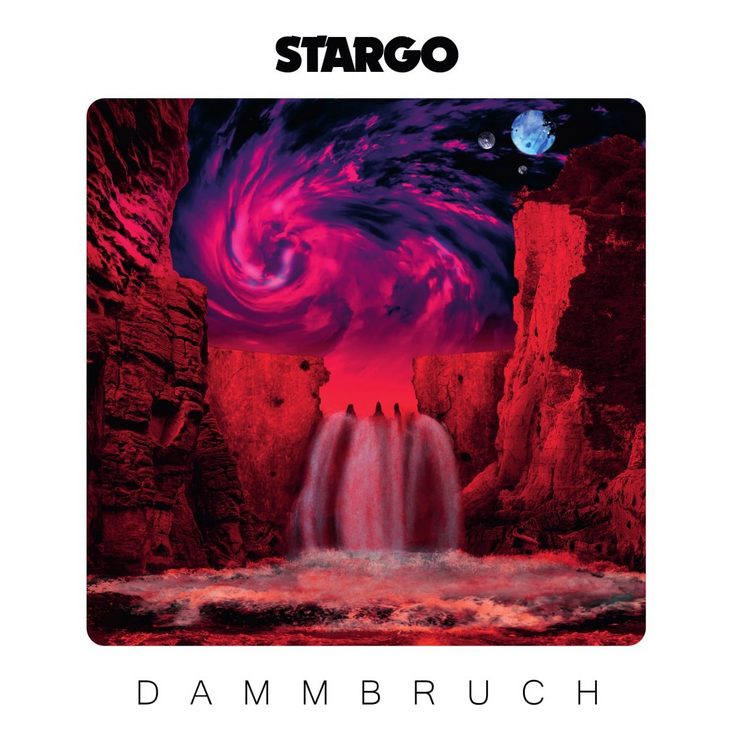
The band first drew wider attention within the stoner scene with their album ‘Parasight‘ and the instrumental EP ‘Dammbruch‘, releases that showcased their appetite for dynamic tension and sonic depth.
With ‘Violet Skies‘, STARGO push those ideas further.
Rather than simply stacking riffs, the new album places greater emphasis on storytelling, both lyrical and instrumental.
Songs unfold with unexpected turns, sometimes carried by vocals, sometimes driven purely by mood, texture, and movement.
On stage, STARGO have cemented their reputation as a formidable live act, sharing bills with genre heavyweights such as Kadavar, Colour Haze, My Sleeping Karma, and Castle Rat, while remaining deeply rooted in the European stoner underground.
It’s a scene the band doesn’t just belong to – it helps define.
With ‘Violet Skies‘, STARGO demonstrate that experience doesn’t lead to complacency.
Instead, it sharpens vision.
The album stands as a testament to a band still curious, still evolving, and still capable of pulling listeners into a collective headbang – whether under a lava lamp, in a crowded club, or somewhere far beyond the clouds.