Ritual, Pulse, and True Black Metal
An interview with Adz (ARBRE-DIEU)
by Fok ‘bs’
“Nuit Noire is clearly the moment of impact, not the aftermath.”
“Releasing this EP is neither exposure nor closure – it is a tribute.”
“This bad trip narrative is simply about someone living their longest night.”
“The fear was extremely physical, but also mental.”
“If the EP is remembered and revisited, then it has fulfilled its purpose.”
‘Nuit Noire‘ is not an EP that unfolds through individual songs, but through a single, continuous psychological passage.
Conceived as a ritualized descent into fear, dissolution, and transformation, Arbre-dieu’s work avoids spectacle and moral framing, focusing instead on the raw inner mechanics of a lived experience.
What emerges is a black metal release rooted in impact rather than aftermath, where collapse itself becomes the subject.
‘Nuit Noire‘ unfolds as a sequence of inner states rather than individual songs.
At what point did you realize this material needed to exist as a continuous passage instead of separate compositions?
“In my work, I always separate the musical aspect from the thematic aspect. When I composed the EP, the music itself naturally reached a point where it formed a coherent whole. Separately from that, I had this bad trip theme that I had wanted to use for a long time. It happened to be perfectly aligned with the music I had created, so the idea of a continuous passage imposed itself quite logically.”
The EP is inspired by a bad trip, yet it avoids sensationalism or moral framing.
Was detachment a conscious choice during composition, or something that only emerged after the experience had settled?
“I don’t attach any moral or sensational meaning to this kind of trip, especially regarding the entheogens I have used in the past. I have a deep respect for these plants or seeds, even though the experiences they can induce can be extremely harsh. In this bad trip narrative, the focus is simply on someone going through a trip over the course of a night, living their longest night, and experiencing something that will mark the rest of their existence.”
Fear in ‘Nuit Noire‘ feels physical, almost spatial.
When writing, do you think in terms of emotions, images, or bodily reactions first?
“It is indeed an interesting comment and question. In the context of this bad trip, the fear of extinction was extremely physical, but also mental. When I wrote the lyrics, I was thinking about the chaotic whirlwind of thoughts and the state of total disintegration I was in. ‘Graine de la folie’ (Seed of Madness) clearly focuses on what is happening in the mind and on the emotions experienced at that moment, whereas ‘La vieille femme et le soleil pâle’ (The Old Woman and the Pale Sun) operates more through images. As for the main image of the EP, it should be imagined as entering an ancient temple. That is how I visualize it.”
There is a moment where annihilation briefly appears as a solution, not a threat.
How important was it for you to acknowledge that thought honestly rather than censoring it for the listener’s comfort?
“In initiatory-type trips, there is always an intimate relationship with one’s own death. Here, it is a kind of death meant to shed one’s skin and start anew, which is why the piece is titled ‘Mort et renaissance’ (Death and Rebirth). It marks the point where the former self disappears in order to be reborn in a different form. It would have been absurd not to include this moment, since this is something that can genuinely occur in entheogen-related trips in general.”
The voices in the later part of the EP can be read as spirits, hallucinations, or internal guides.
Do you prefer these presences to remain undefined – or do they carry a specific meaning for you personally?
“I’m not entirely sure what is meant by ‘voices’ here. To answer the question nonetheless, the only presences involved are ‘La vieille femme’ (The Old Woman) and ‘le soleil pâle’ (the Pale Sun). I did not express them through voices. These figures emerged during the trip once the peak of intensity had passed. They functioned as figures of comfort within the deepest darkness of the experience, indicating that the trip was moving downward and that I was meant to survive it. Even for me, they remain undefined presences: they were simply ‘there’, and then they were gone.”
Unlike many black metal releases, ‘Nuit Noire‘ moves from collapse toward a strange, restrained joy.
Was this transformation something you recognized during the experience itself, or only in retrospect?
“Yes, I recognized it during the experience itself, but I didn’t give much importance to the positive element within the narrative constructed in the EP. In reality, when it ends, I am simply happy to see daylight again and to see members of my family. But that belongs to the aftermath, and it doesn’t necessarily hold much interest in itself for a black metal release.”
Your sound is deliberately raw, but never chaotic for its own sake.
How do you decide when violence in sound is necessary – and when it becomes excess?
“In fact, I don’t really decide; it’s the music that flows that way. I started the EP with feedback sounds and crackling textures, combined with a simple rhythm, before letting it gradually rise. For this EP, the tracks naturally fell into their final order. I don’t recall having to move any piece before or after another, which is something that often happens to me. If something feels excessive for me, it usually means it has no meaning in itself, and it will most likely never appear on an album.”
The ‘Maison Dieu‘ card symbolizes sudden collapse followed by irreversible change.
Do you see ‘Nuit Noire‘ more as the moment of impact, or as the landscape that exists after the fall?
“It is clearly the moment of impact. This EP does not deal with the aftermath. More precisely, regarding the ‘Tarot de Marseille’, I use the meaning given by Alejandro Jodorowsky for this card. In its negative aspect, it can signify collapse, but it can also be seen as an opening that brings forth what was trapped. The symbolism can also be sexual or express a sudden love at first sight. It is also a card that evokes a ‘temple’, which is one of the reasons I adapted the card’s name into Arbre-Dieu (God Tree), to emphasize the telluric aspect and its rooted, earthy dimension.”
Arbre-dieu strips black metal down to ritual and pulse rather than technique.
Is this a rejection of genre conventions, or simply the most honest form this project could take?
“No, it is not a rejection of genre conventions. In fact, it was meant to be more ‘true black metal’ than my other project, Thy Apokalypse (industrial black metal). For me, it is obvious that the way the project was approached and conceived from the start represents the most natural and sincere path for it. That said, many things will evolve from this point in the next release, which will be an album, probably scheduled for the end of 2027.”
Many listeners describe ‘Nuit Noire‘ as uncomfortable but compelling.
What kind of discomfort interests you as an artist – confusion, fear, recognition, or loss of control?
“I don’t have any particular intention beyond creating an immersive experience. What matters to me is that the listener doesn’t stop listening after a few seconds or in the middle of the piece. Of course, this is something one cannot control, and as a listener myself, I am subject to the same experience.”
Because the EP is so tightly bound to a personal inner journey, did releasing it feel like exposure, closure, or neither?
“Neither. This was an experience that took place in 2008, so it is already far behind. If I were to use a closer term to describe what releasing it as an album represents, it would be a ‘tribute’.”
Arbre-dieu is connected to several other projects you’re involved in.
What emotional or spiritual territory does this project allow you to explore that the others cannot?
“In a way, Arbre-dieu explores more human aspects – psychology, life and death, very earthy matters – and distinguishes itself from Thy Apokalypse in its exploration of technology (the last album, released in September 2025 on Bitume Prods, deals with AIs breaking free to take refuge in the Metacosmos). From a technical standpoint, Arbre-dieu allows me to explore the ‘noise music’ aspect much more than my other projects.”
If ‘Nuit Noire‘ leaves a trace rather than a message, what kind of mark do you hope it leaves on the listener once the ritual is over?
“A trace similar to a CD in their CD collection or the audio tracks in a folder on their computer that they listen to and revisit! For me, if the project and this EP are known and remembered through listening, then one can say that this release has fulfilled its purpose…Thanks for the interview…”
‘Nuit Noire‘ exists as a preserved moment rather than a statement or resolution.
By focusing on collapse, fear, and transformation without explanation or relief, Arbre-dieu offers an immersive experience that resists interpretation and demands endurance.
What remains is not a message, but a trace – one that lingers each time the ritual is entered again.
by Fok ‘bs‘
French Black Metal Project
ARBRE-DIEU
Has Released EP
‘Nuit Noire’
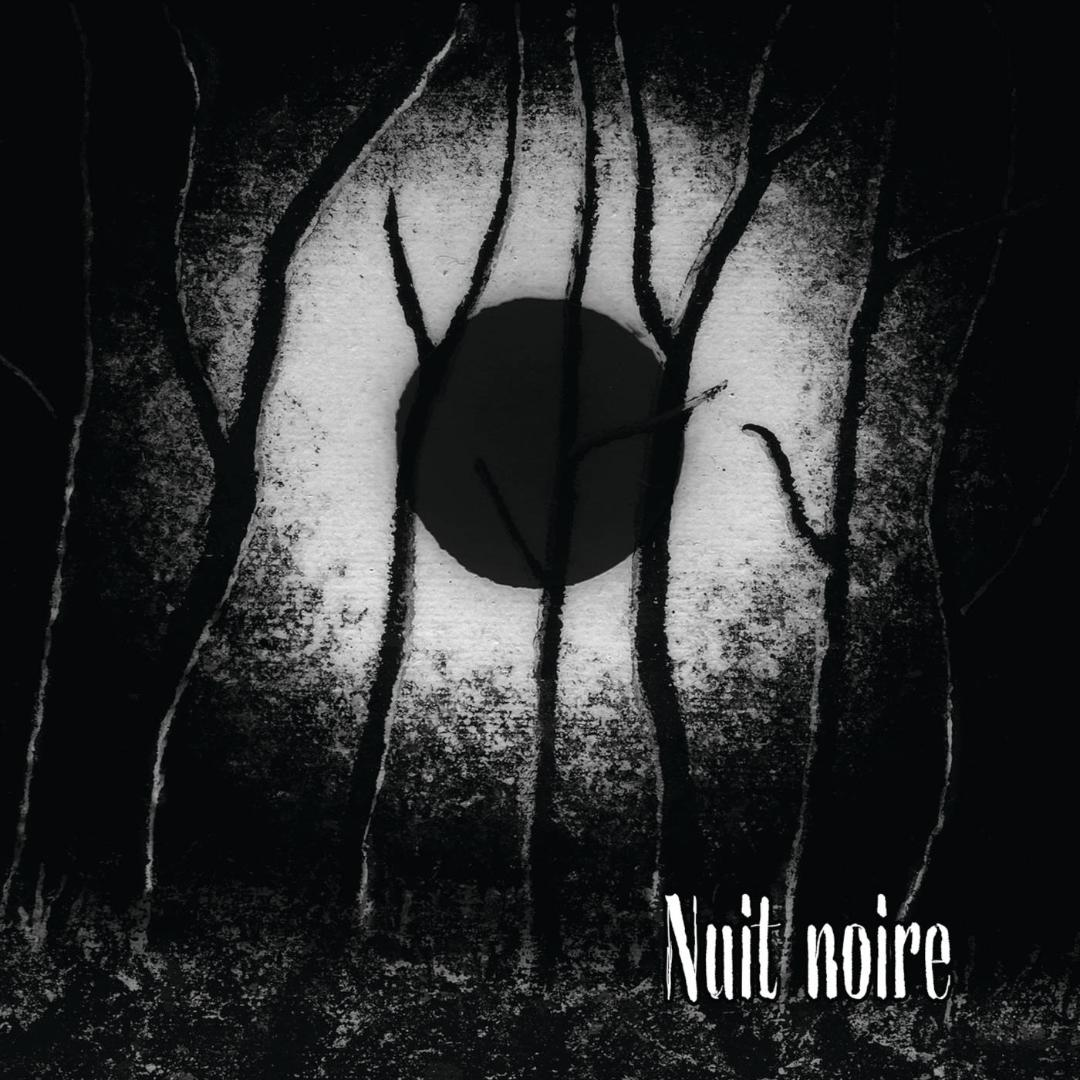
track-list:
Graines de la folie
Tourbillon chaotique
La vieille femme et le soleil pâle
Mort et renaissance
music and recording by Adz
audio mixing and mastering by Buck
Arbre-dieu is:
Adz – everything
With ‘Nuit noire‘, Arbre-dieu delivers a harrowing and deeply immersive debut EP that unfolds like a ritual rather than a record.
Structured in four interconnected scenes, the release traces an initiatory descent into darkness – a subjective journey inspired by a bad trip triggered by Argyreia nervosa seeds, but never framed as documentation or cautionary tale.
Instead, ‘Nuit noire‘ invites the listener to step inside the experience and confront it from within.
Each track represents a distinct phase of the passage.
Fear takes on a physical presence as panic tightens its grip, death feels close, and the mind desperately clings to fragments of familiarity – faces, memories, regrets – anything that might serve as an anchor.
As control slips away, the music becomes a violent maelstrom where suffering consumes thought entirely, and the idea of ending everything briefly appears as a possible escape.
Yet ‘Nuit noire‘ does not remain in collapse.
After total surrender comes an opening:
voices emerge, whether imagined as spirits of the plant, invisible protectors, or inner guides.
These presences do not erase pain, but slowly reassemble what was broken.
Consolation arrives cautiously, followed by reconstruction.
The final movement marks the return – a metamorphosis in which the former self is symbolically buried and replaced by something altered, stripped down, and strangely joyful.
Not triumphant, but alive.
Musically, Arbre-dieu opts for immediacy over embellishment.
Cutting guitars, abrasive textures and ceremonial, pulse-driven rhythms create a raw sonic environment designed to confront rather than comfort.
The compositions feel physical and unfiltered, forcing the listener to take a position within the experience instead of observing it from a safe distance.
This is not music that aestheticizes pain – it exposes it, moves through it, and ultimately transforms it.
Arbre-dieu was founded in 2022 by Adz., known for projects such as Thy Apokalypse, Reflecting the Light, Kaamosmasennus, Salaman Isku and .eterniteduchaos.
The project emerged from a desire to translate a sense of essential, primitive violence into sound.
Its name references the Maison Dieu card of the Tarot of Marseille – a symbol of collapse, revelation, and the irreversible trace left after impact – serving both as conceptual framework and artistic manifesto.
Although ‘Nuit noire‘ could loosely be described as raw black metal, the label only partially applies.
Arbre-dieu strips the genre down to something more elemental, favoring ritualistic force and occult intensity over technical display or ornamental excess.
Composed and produced between 2022 and 2025, the EP stands as a singular statement of intent rather than a genre exercise.