When Childhood Stories Become Metal Nightmares
British Female-Fronted
Symphonic Metal Quartet
WHITEABBEY
interviewed by Fok ’bs’

“By adding a deeper layer to a story, you’re not just telling a fun tale, you’re trying to teach the listener a lesson.”

“The best characters are the ones that are a mix of good and bad, because real people are never completely one or the other.”
“Bullying is a subject close to home for many people, and real life often bleeds into your art.”
“We don’t want to simply retell stories, we want to explore the uncomfortable truths hiding underneath them.”
“The narration sets the scene, while the song explores how the character feels about what is happening.”
“There is something magical about creating music and then realizing it feels like it has always existed.”
“Darkness and beauty can exist together. One gives the other meaning.”
“A song should not only tell a story, it should make people feel something.”
“The most powerful stories are often the ones where you recognise a piece of yourself inside them.”
“A familiar story can sometimes become more powerful when you look at it from a completely different angle.”
“If listeners replay the music because it touched something inside them, then we have achieved what we wanted.”
“Metal gives us the freedom to explore darkness without being consumed by it.”
“We are not interested in writing stories that are purely good or purely evil. The interesting space is somewhere in between.”
“Music has always been a way of exploring emotions that are sometimes too difficult to express in ordinary words.”
“Authenticity means being willing to reveal fears, regrets and weaknesses.”
“We are not trying to create perfect characters or perfect worlds, we are interested in the contradictions that make people human.”
British symphonic metal band Whiteabbey have always been fascinated by the darker layers hidden beneath familiar stories.
Instead of simply retelling well-known tales, the band transforms childhood memories, folklore, and classic characters into cinematic journeys filled with atmosphere, moral questions, and emotional depth.
With their ‘Trilogy‘ concept releases, Whiteabbey explore the space between beauty and darkness.
Where fairy tales become nightmares, heroes become flawed, and familiar worlds reveal unexpected shadows.
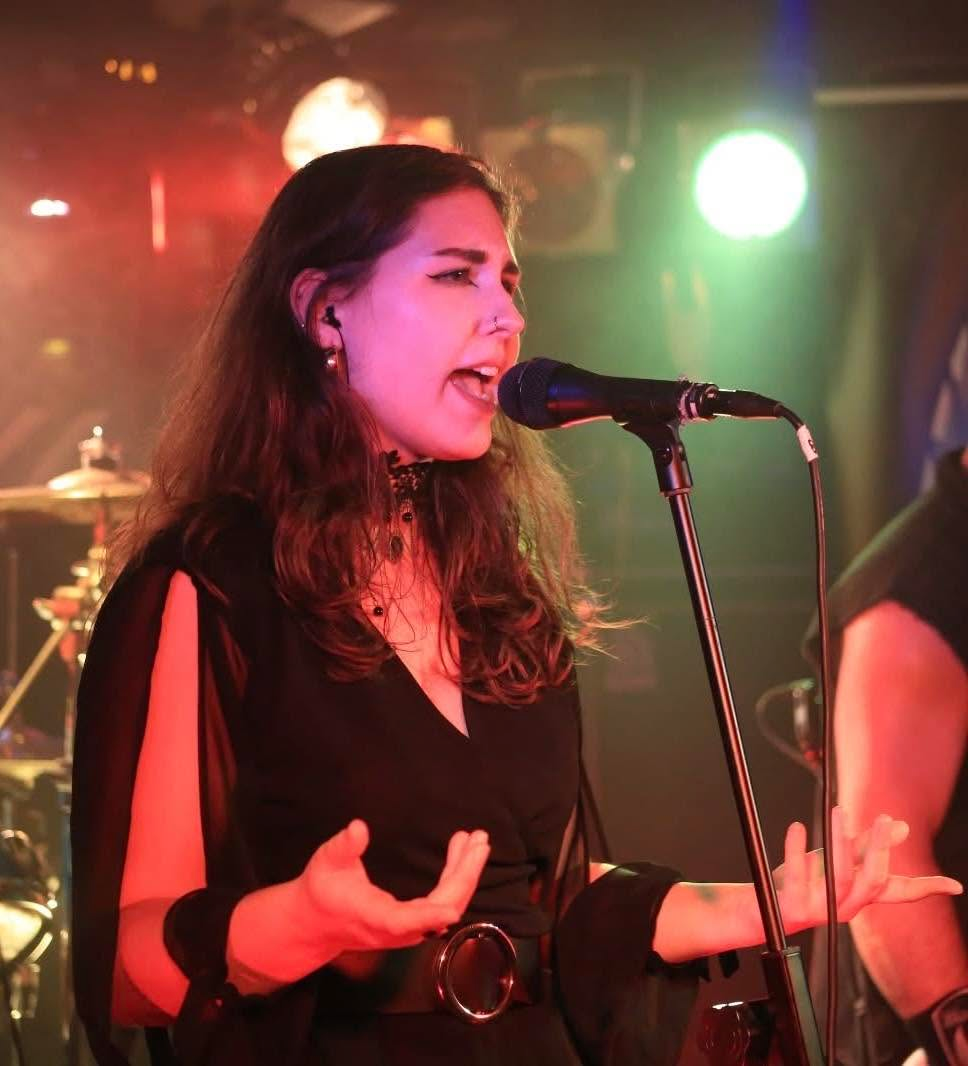
In this interview with Fok ’bs’, vocalist Tamara Bouwhuis and guitarist Steve Moore discuss the creation of ‘Sweet Revenge‘, the transformation of Willy Wonka into a darker figure, storytelling through metal, childhood influences, and why the most powerful stories are often the ones that leave questions behind.
Whiteabbey seem drawn to taking beloved stories and exposing the darkness hidden underneath them.
What fascinates you more:
the original tales themselves or the uncomfortable truths that might be lurking beneath them?
Tamara: “Both. I like stories with fairytale/supernatural elements, but by adding a deeper layer to the song, you’re not just telling a fun story, you’re also trying to teach the listener a lesson. Those songs are the ones that give me goosebumps. Not all of our songs are that deep, but some are. And I hope to achieve that same feeling when people listen to those songs.”
Steve: “All those fairytales and quirky classic children’s stories are already dripping in lessons about right and wrong, crime and punishment, life lessons and the importance of having morals. We just try to take it a little further and mix in some classic horror movie themes. I do love those stories as they are though, the Roald Dahl books were a staple of my childhood and bring back very fond memories of when I used to have the attention span to actually read a book…”
With ‘Sweet Revenge’, you transformed Willy Wonka from an eccentric dreamer into a deeply damaged architect of vengeance.
At what point did you realize that this character could carry an entire metal narrative?
Steve: “If you take a very literal view of the story, it’s about a slave-owning industrialist who devised a life-endangering scheme to weed out candidates in an interview process. I don’t think for a second that was the actual intention of the book, of course – it’s just a fun story, the moral being that if you’re a good person, good things will happen, and vice versa. But to give it a dark twist, we needed to think about the more literal view, and why Wonka might go to such extreme lengths to punish a handful of children. And from there, it wasn’t too much of a leap to make the link with Freddy Krueger, who took revenge on the children of the people who killed him. Bullying is a subject close to home for many people, myself included, and an increasing problem these days with the types and severity of bullying in a world that seems determined to become less and less tolerant. Real life bleeds into your art, and in this case, the two worlds collided and spawned our version of Wonka.”
Many concept albums focus on heroes or antiheroes.
Your version of Wonka exists somewhere in a morally grey area.
Do you find flawed characters more interesting because they force listeners to question their own sympathies?
Tamara: “Absolutely. In reality most things aren’t black or white either. It’s good to be reminded of that. There’s something good and bad in all of us. We all look at the world through our own glasses, thinking we’re doing the right thing. Wonka is convinced that she deserves to take revenge. Some may agree, some may question how she plans to do it and some will disagree completely.”
Steve: “Those are the best characters, the ones that are a mix of good and bad. It’s difficult to think of a character from any story that is purely good or purely evil, they’re always somewhere in between on that scale. And I suppose it comes down to how much you relate to the circumstances that led the character to be that way – it’s a little condescending and perhaps a failure of imagination on my own part, but watching a movie about a child in danger is a very different experience when you have children of your own. So, watching ‘Prisoners’ before I had children, I might have thought what the father was doing was unjustified, but as a parent it’s a very different thought process!”
Your music often balances beauty and menace.
Is it more challenging to write the symphonic, cinematic passages or to make the darker moments feel genuinely unsettling rather than simply heavy?
Steve: “Creating anything is a bit of a mysterious, magical process – like, listening to the songs after they’ve been around for a while, it’s like they’ve always existed, and it’s hard to think of a time when they didn’t. That has always fascinated me, how stuff just materialises out of nowhere! Technically speaking though, the music usually starts with some straight-ahead metal riffs and I try to layer instrumentation on top of that, sometimes with the aim of giving it a certain feel, and other times it just takes on a feel because that’s just how the song itself wants to go. My distinct lack of formal musical training probably necessitates a more trial-and-error process than others might manage, but the end result is usually to our liking nonetheless.”
The EP explores how childhood experiences can shape an entire lifetime.
Looking back at your own lives, do you think artists ever fully escape their younger selves, or do they simply learn how to transform those experiences into art?
Steve: “In our style of music, we can write about fantasy themes that are completely unrelated to reality (although ironically our song ‘DragonFire’ is actually about very real things) or you can use events in your own life to write about more worldly themes, which I’m going to loosely term ‘love songs’. We have plenty of both types, with the latter being a double-edged sword – as relatively private people who wouldn’t dream of putting their personal dramas on social media for example, to sit down and write a song about something painful that happened, it means exposing things that you wouldn’t normally share with anyone but your nearest and dearest. The concern of being judged for having fears and regrets and weaknesses, is especially strong for a man of a certain age, such as myself.”
The idea of revenge runs throughout the story, but revenge is often portrayed as both satisfying and destructive.
Do you see ‘Sweet Revenge’ as a story of justice, tragedy, or something in between?
Tamara: “It’s up to the listener to decide whether the story is about justice or tragedy. That’s something Steve did brilliantly with this story. We’re telling the story without judgement. People can form their own opinion.”
Steve: “I like to think of it as a movie – when the credits roll, the players take a bow and everything returns to normal, and there’s no manhunt to find the killer, no repercussions or lasting effect. So in that respect, I think it’s about justice, but in a very horror movie kind of way. I hope we told the story well enough that you feel some sort of sympathy for the Wonka character and at least some support for her actions. A real-world version would be very different, of course.”
Narration plays an important role in the EP.
When combining spoken storytelling with metal, how do you decide whether a particular moment should be sung, spoken, or left entirely to the music?
Steve: “The narration helps set the scene, like an establishing shot in a movie, it gives you the wider information so you are armed with the basic facts, without us needing to write it into the lyrics. That allows the song to tell you how the character feels about the events rather than detailing the events themselves. It’s a bit of a pet-peeve of mine, even with some big name bands, where it feels like they’ve lifted lyrics straight off of Wikipedia.”
Your ‘Trilogy’ releases feel closer to dark theatre productions than traditional metal records.
Have you ever considered presenting the entire story on stage as a fully immersive performance?
Steve: “It’s funny you should mention that! It’s definitely something we’re looking at currently, for a full multi-media presentation of ‘Sweet Revenge’ on stage.. It obviously means a bit of a step up in complexity but we’re up for the challenge.”
A lot of symphonic metal bands draw inspiration from mythology, fantasy, or history.
Whiteabbey seem equally interested in childhood memories and popular culture.
Do you think familiar stories can sometimes be more powerful than ancient legends?
Steve: “I’ve always put us slightly more in the power metal camp than the symphonic metal camp, although we’re comfortable in either due to having elements of both. And we’re equally at home just in the general heavy metal camp! Due to that spanning of genres, there should be something for everyone in our music, with stories about Irish myths and legends, tales of pirates, real tragedies like the murder of Bridget Cleary, and even a decent selection of good old-fashioned love songs. I personally lean towards the latter myself, both when writing and listening to music in general – it’s easier to relate to a song about grief, for example, than a song about a wizard. Not to say that I don’t enjoy songs about wizards (I’m a huge Blind Guardian fan!) but something about a well-written love song just hits differently.”
The original ‘Charlie and the Chocolate Factory’ is filled with colour, wonder, and imagination.
Was it difficult to preserve some of that magic while simultaneously turning the story into something disturbing?
Steve: “The ‘Chocolate Factory’ world is already very fully-detailed and well-known, adding the dark twist was straightforward enough once we made the connection to Freddy Krueger. However, it takes a bit of strategy to work out how to make it into three distinct songs. On the first ‘Trilogy’ EP, there were three characters giving their point of view, albeit with the twist that the Magic Mirror was actually just the Queen’s own thoughts being reflected back to her. With this one, there aren’t really three characters to do that with, so we went with breaking the story up into before, during and after the act of revenge.”
Every generation grows up with different books, films, and cultural icons.
If Whiteabbey were to reinterpret a modern story fifty years from now, what kind of themes do you think future audiences would find hidden beneath today’s entertainment?
Steve: “I might show a little artistic snobbery and/or potential ignorance here, but I don’t think too many of the TV shows or movies made these days will stand the test of time in the same way movies from 50 years ago from today have. I think the bulk of it will stand as a testament to shorter attention spans, making things for the widest possible audience, evermore tawdry gameshows, and bad sequels and remakes, all in an almost disposable fashion. Not to say that there aren’t a few great shows and movies released these days, but the heyday of truly memorable movies was the 70s and 80s, in my opinion. I suppose that would be the overall theme of today, about how it turned into a bit of a dystopia, in a Black Mirror kind of way.”
Across your catalogue, storytelling has become a defining element of the band.
Have you ever abandoned a concept because it became too dark, too controversial, or simply too uncomfortable to explore?
Steve: “I have some lyrical ideas on my phone and in my notebook, that either I decided not to use because they might expose more personal things than I’m comfortable with, or were a little too on the nose in terms of criticising people/institutions/beliefs. I think there’s an incredibly fine line in writing those kinds of songs and treading that line is a tricky thing. We don’t shy away from difficult subjects, as such, but we don’t write political protest songs either – we’ll leave that for Rage Against The Machine, who are geniuses at it!”
When the final chapter of the ‘Trilogy’ eventually arrives, what would you like listeners to discover about themselves after travelling through these twisted versions of familiar stories?
Steve: “If they feel compelled to hit replay and listen to it again, because it touched something in them, or just generally made them feel something whether it’s intrigue, surprise, horror or joy, then we’ve done our job. And the next one will be our most intriguing, surprising, horrific and joyful yet!”
Whiteabbey continue to prove that metal can be more than a collection of riffs and melodies.
It can be a place where memories, fears, imagination, and human experiences collide.
By transforming familiar stories into darker and more emotional landscapes, the band creates music that feels both nostalgic and unsettling.
With their cinematic approach and passion for storytelling, Whiteabbey remind us that even the stories we think we know can still hide secrets waiting to be discovered.
by Fok ‘bs‘
British Female-Fronted
Symphonic Metal Band
WHITEABBEY
Released EP
‘Trilogy II: Sweet Revenge’

track-list:
Master Plan
Pure Extermination
Just Desserts

Whiteabbey are:
Tamara Bouwhuis – vocals
Steve Moore – guitars
Graham McNulty – bass
Badger Duncan – drums
Whiteabbey live 2026:
Oct31st The Diamond Club Ahoghill/NIR
Dec26th The Dementia Aware Festivities 2026 Coventry/UK
discography:

album

EP
album

album
‘TRILOGY II: SWEET REVENGE‘ Turns a Childhood Classic into a Dark Metal Fairytale
Four years after reimagining the story of Snow White through a dark and unsettling lens, Whiteabbey return with the next chapter of their ambitious ‘Trilogy‘ series.
Released on May 1, 2026, ‘Trilogy II: Sweet Revenge‘ once again transforms a familiar tale into something far more sinister, proving that beneath the surface of childhood stories often lurk shadows waiting to be explored.
While the first installment cast a gothic veil over a classic fairytale, ‘Sweet Revenge‘ takes inspiration from Roald Dahl’s ‘Charlie and the Chocolate Factory‘.
Generations have embraced the story as a whimsical adventure filled with imagination, wonder, and larger-than-life characters.
Yet Whiteabbey sees something darker hidden beneath the candy-coated exterior and builds an entirely new narrative around one of literature’s most iconic figures.
In this reimagining, Willy Wonka is no longer the eccentric chocolatier audiences remember.
Instead, the character is reinterpreted as a woman whose childhood experiences of bullying, exclusion, and humiliation leave scars that never fully heal.
Drawing inspiration from long-standing fan theories that the original story’s accidents were far from accidental, Whiteabbey pushes the concept further.
Here, the factory becomes a stage for calculated vengeance, and the children who enter its gates unknowingly carry the legacy of their parents’ past actions.
The EP also incorporates elements reminiscent of classic horror storytelling, particularly the generational themes explored in ‘A Nightmare on Elm Street‘.
The result is a dark fusion of fairytale, psychological horror, and revenge drama, where innocence and guilt become increasingly difficult to separate.
Nostalgia remains present throughout the story, but it is constantly twisted into something unsettling, creating a narrative that feels both familiar and deeply disturbing.
Musically, ‘Trilogy II: Sweet Revenge‘ delivers exactly the kind of cinematic experience that such a concept demands.
Symphonic elements blend seamlessly with powerful metal arrangements, creating songs that are dramatic, melodic, and emotionally charged.
The storytelling is further enhanced by the narration of Graham McNulty, whose voice helps guide listeners through the EP’s dark corridors while subtle references to the beloved 1971 film adaptation provide moments of recognition before the story veers into much darker territory.
One of the key moments on the release is ‘Pure Extermination‘, the EP’s second single.
While the first single, ‘Master Plan‘, introduced listeners to the consequences of the story already in motion, ‘Pure Extermination‘ rewinds the clock to reveal how everything began.
The song explores the formative years of Willy’s life, portraying a young outsider subjected to ridicule and isolation.
Rather than seeking immediate revenge, she dedicates herself to mastering every aspect of the chocolate factory, gradually transforming herself from victim to architect of an elaborate plan years in the making.
The track perfectly captures the central themes of the EP.
Beneath its nostalgic musical motifs lies an undercurrent of bitterness, determination, and unresolved trauma.
What initially feels comforting slowly reveals a darker purpose, mirroring the story itself.
It is a clever piece of songwriting that demonstrates Whiteabbey’s ability to balance accessibility with narrative depth.
With ‘Trilogy II: Sweet Revenge‘, Whiteabbey continue to carve out a unique niche where concept-driven storytelling and cinematic metal collide.
Rather than simply retelling a familiar story, the band dismantles it, reconstructs it, and presents it through a darker, more unsettling perspective.
The result is an EP that feels both theatrical and thought-provoking, inviting listeners to revisit childhood memories while questioning what may have been hidden beneath them all along.
If the first chapter introduced the darkness behind the mirror, ‘Trilogy II: Sweet Revenge‘ dives headfirst into the shadows lurking beneath the chocolate river.