
Today, Heavy Metal is everywhere.
Major festivals sell tens of thousands of tickets within hours, bands perform in arenas, and even people who never had anything to do with the scene recognize names like Iron Maiden, Metallica, or Motörhead.
But in the early 1980s, Heavy Metal was something completely different.
It was not a lifestyle product, not a marketing term, and certainly not mainstream.
It was underground.
A movement that had to build its own world from scratch.
And that exact world was taking shape back then in Franconia – between Erlangen, Nuremberg, Fürth, Neunkirchen am Brand, and all the small towns in between.
For the youth of that era, Metal was far more than just music.
It was an escape from everyday life, a rebellion against the narrow-mindedness of the post-war generation, and at the same time a sense of belonging.
Once you became part of that scene, you usually remained part of it forever.
“Our time was the time when Metal was born,”
Punker Anja recalls today.
A sentence that may sound dramatic, but for many back then, it was simply the truth.
Searching For Heavy Metal In A Pre-Internet World
In the early ’80s, Heavy Metal was still far from being an easily accessible mass phenomenon.
Information was difficult to obtain.
There was no internet, no streaming services, no social media, and no algorithms recommending new bands.
If you were into Metal, you had to search, ask around, trade tapes, and discover things yourself.
Fok ’bs’, who grew up in Erlangen, still remembers those days vividly:
“In the early ’80s, it wasn’t easy to get information. Teen magazines and state-run radio stations had practically boycotted harder music altogether.”
If heavier music was played on the radio at all, it was usually late at night between pop and rock songs.
Many people sat in front of cassette recorders waiting for a song worth recording – often with the DJ’s voice accidentally taped at the beginning or end.
“I used to record songs from the radio onto cassette tapes,”
Fok remembers.
“Most of them were AC/DC, Kiss, and Alice Cooper – though I didn’t even know who they were at the time. But then I heard ‘Back In Black’ in the summer of 1980 – and suddenly everything changed.”
That one album, one song, or one concert appears in almost everyone’s memories of that generation.
For Kai Pasemann (ex-Paradox), it started with Kiss and Van Halen before Judas Priest completely pulled him into the Metal world in 1982.
Lem (ex-Lavatory) remembers Deep Purple, Black Sabbath, and later Motörhead and Slayer.
Ricky, meanwhile, got infected with Black Sabbath, Deep Purple, and Lynyrd Skynyrd through older neighbors.
The paths into Metal were different, but the feeling was always similar:
this music was different.
Harder, more honest, more dangerous.


Logo

pic provided by the New Force Team
“Our time was the time when Metal was born.”
Punker Anja
“Heavy Metal wasn’t just the soundtrack of our youth,
it was the place where we belonged.”


pic provided by the New Force Team
The New Force – Home Of The Outcasts
One of the first central locations for the scene became the E-Werk Erlangen.
Especially its Metal nights introduced many people to heavier music for the first time.
But the real heart of the Franconian Metal scene soon became another place:
the New Force.
For many, the Force was far more than just a youth club.
It was a living room, meeting point, concert venue, information exchange, and substitute family all at once.
“The Force became like our home,”
Fok recalls.
“If our parents were looking for us, they knew exactly where to find us.”
What made the Force special was its concept.
The club was run by young people for young people – by fans for fans.
There were no professional event structures, no security companies, and no marketing departments.
Instead, everything was driven by improvised idealism.
And that was exactly what gave the place its charm.
Metalheads, punks, alternative kids, and all kinds of outsiders gathered there.
People who may have been looked at strangely elsewhere suddenly became part of a community.
Punker Anja remembers sneaking into the Force at the age of 13 despite the age restrictions:
“I tried to be there every opening night – even if it was only for 45 minutes. After a while, you knew all the regulars.”
Kai Pasemann also emphasizes how important the club was:
“Totally important. That’s where you discovered all the new stuff. I was there two or three times a week.”
From ABBA To Battle Hymns
Many first entered the scene through Hard Rock or Classic Rock.
Others came from Punk.
Some discovered Metal through older siblings or neighbors.
Punker Anja describes her own journey with refreshing self-irony:
“At first I listened to ABBA – don’t laugh! But then we borrowed cassette tapes from an older brother of a friend. There was AC/DC and Kiss on them. Later I bought my first own record: Manowar – Battle Hymns.”
And that exact mixture defined the early scene.
The boundaries between Hard Rock, Punk, Heavy Metal, and later Thrash were still fluid.
Nobody thought in strict categories the way people often do today.
Back then, discovering a new band felt like finding hidden treasure.
Records were expensive, difficult to get, and often had to be ordered weeks in advance.
Every LP mattered.
Every cassette got copied endlessly between friends.
Kai Pasemann laughs while remembering:
“Some friend always had something new – and I always had empty cassette tapes.”

(Fritz Obermayer, Jens Becker, Dilty)
pic provided by Fritz Obermayer
“Back then, if you wanted to experience something, you had to leave the house. Today, everything is just a click away on the internet.” Fritz Obermayer (Cronos Titan)
“If you met another Metalhead in Erlangen or Athens back then, you automatically stopped and talked.”
Fok ‘bs‘
“The Force became like our home. If our parents were looking for us, they knew exactly where to find us.”
Fok ‘bs’
“The club was run by fans for fans. That made all the difference.”
“Going out alone was never a problem. You always ran into people you knew.”
Ricky

Posers, Thrashers And Endless Discussions
And it was exactly there that the debates shaping the scene took place.
Which band was heavier?
Who had become commercial?
What was ‘real‘ Metal?
Speed Metal?
Thrash?
Black Metal?
The scene kept splitting into more and more subgenres.
“With all those subdivisions, you could barely keep up anymore,”
Anja laughs.
“And those were exactly the things people debated and argued about.”
Still, despite the arguments, the scene remained deeply connected.
People borrowed records, copied tapes, organized rides to concerts, and helped each other out constantly.
“Going out alone was never a problem,”
Ricky remembers.
“You always ran into people you knew.”
“A lot of GIs came to the New Force too. Friendships were formed that still exist today.”
Fok ‘bs’
“In the eyes of the so-called respectable people, we were antisocial troublemakers.”
Fok ‘bs’

“Then I heard ‘Back In Black’ in the summer of 1980 – and suddenly everything changed.”
Fok ‘bs’
Arche Noah, Orange And The Metal Underground
Besides the Force, there were other important gathering spots such as the Orange, the Sesam, the Green Goose, or the Arche Noah in Frauenaurach.
The Arche Noah in particular became an interesting example of how the scene slowly fought for its place.
“In the early ’80s, Heavy Metal was considered a red flag there,”
Fok explains.
“But eventually we were allowed one evening where we could play our music. By the mid-’80s, we had practically taken over the entire club.”
Heavy Metal was highly visible back then.
Loud.
Provocative.
And that alone made it suspicious in the eyes of many adults.
Long hair on men was still widely seen as a sign of being unkempt.
Add leather jackets, bullet belts, studded belts, band shirts, denim battle jackets, and ripped jeans, and the scene stood out immediately – which was exactly what people wanted.
“In the eyes of the so-called respectable people, we were antisocial troublemakers,”
says Fok.
Lem sums it up even shorter:
“…like trash.”
But that outsider status only strengthened the feeling of belonging.
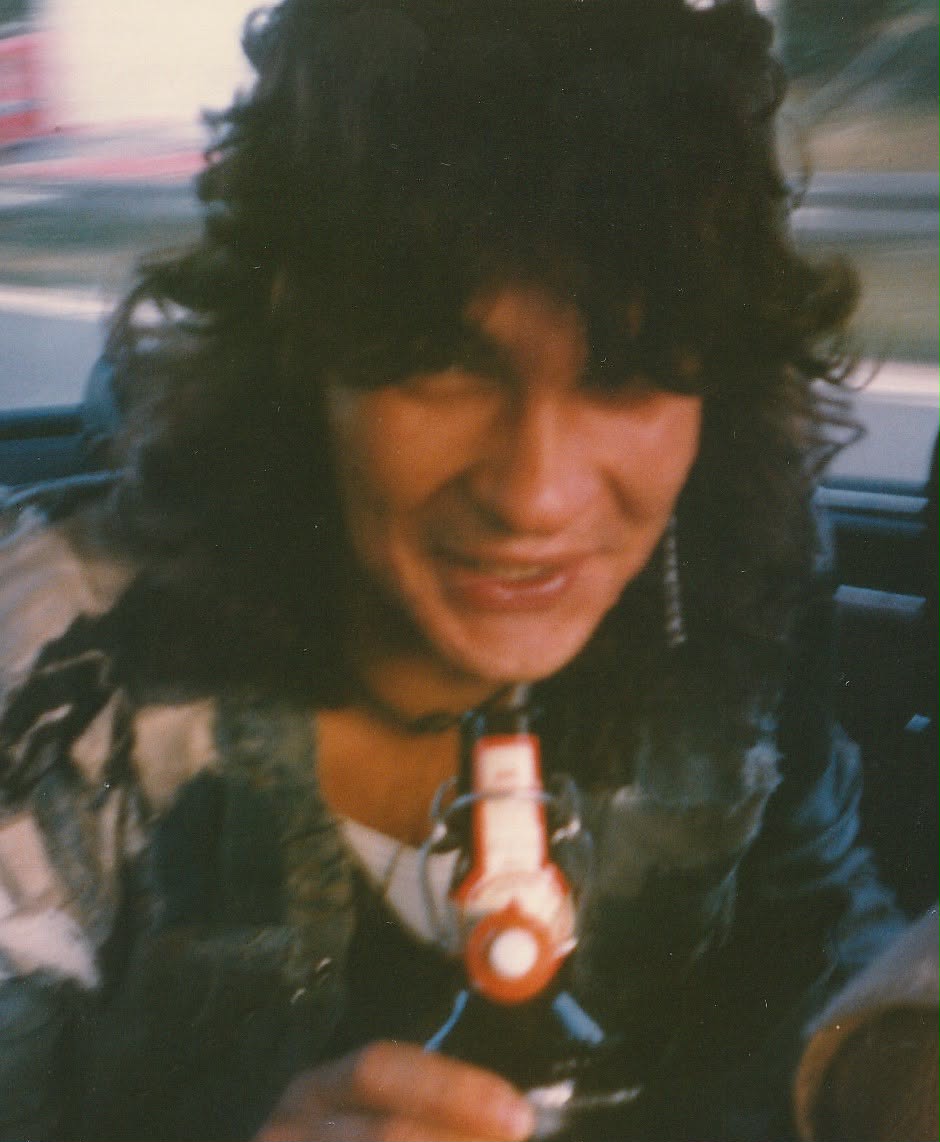
pic by Richard ‘Ricky’ Knorr

Concerts, Chaos And American Soldiers
Franconia had one huge advantage at the time:
the American military bases.
Because of the many U.S. bases in the region, almost every major tour stopped nearby.
Promoters knew that concerts would be well attended simply because of the American soldiers stationed there.
“A lot of GIs came to the New Force too,”
Fok recalls.
“Friendships were formed that still exist today.”
As a result, the region unexpectedly developed into an important location for international Metal concerts.
Venues like the Hemmerleinhalle, the Stadthalle Erlangen, or later the E-Werk became legendary.
Fritz Obermayer (Cronos Titan) remembers seeing Motörhead in the Hemmerleinhalle in 1980, Judas Priest with Def Leppard and Accept in Erlangen in 1981, and later Slayer, Sodom, and Sepultura.
Ricky still enthusiastically talks about one of Metallica’s early German concerts:
“Metallica in Neunkirchen am Brand – maybe 300 people. Incredible.”
Many of those nights turned into chaotic adventures.
Hitchhiking was common.
Cars were hopelessly overcrowded.
Hardly anyone had money for gas.
“Once we drove to a concert with seven or eight people packed into one car,”
Anja remembers.
“A friend’s father drove us. We just had to make sure we didn’t get caught.”
Kai Pasemann recalls driving home from Gunzendorf when the steering wheel suddenly came loose while driving.
Or legendary drinking contests between his band and Tankard.
“Our motto back then was ‘drunk n ready.’”
When Metal Became Faster And More Extreme
The music itself evolved explosively during those years.
At first, classic bands like AC/DC, Black Sabbath, or Judas Priest dominated.
But by the mid-’80s, everything became faster, heavier, and more extreme.
Thrash Metal exploded.
Slayer, Metallica, Sodom, and Destruction defined a new level of aggression.
At the same time, many bands started experimenting with new sounds.
“The music became more and more interesting and diverse,”
says Anja.
“Suddenly there was Speed Metal, Black Metal, and a thousand new directions.”
And despite all the stylistic battles and scene politics, the sense of community remained intact.
“Once we drove to a concert with seven or eight people packed into one car.”
Punker Anja
More Than Music
Maybe that is the biggest difference compared to today.
Back then, Metal was not a consumer scene.
It was a way of life.
You had to work for everything yourself – the music, the contacts, the information, and the concerts.
And precisely because of that, this world meant so much to the people who lived it.
There were no smartphones documenting every second.
No social media profiles.
No influencers.
The memories remained exactly where they belonged:
in the minds of the people who experienced them.
And perhaps that is why those years still feel magical to so many who were there.
Because for one brief moment in time, Heavy Metal truly belonged to the outsiders.
Or, as Kai Pasemann sums it up in typical Franconian fashion:
“We simply had one hell of a booze-soaked, amazing time.”
by Fok ‘bs‘
a big thank you to Anja (Punker Anja), Fritz Obermayer, Kai Pasemann, Lem Parottfish, the New Force Team, Richard Knorr (Ricky) for their pictures and their memories…