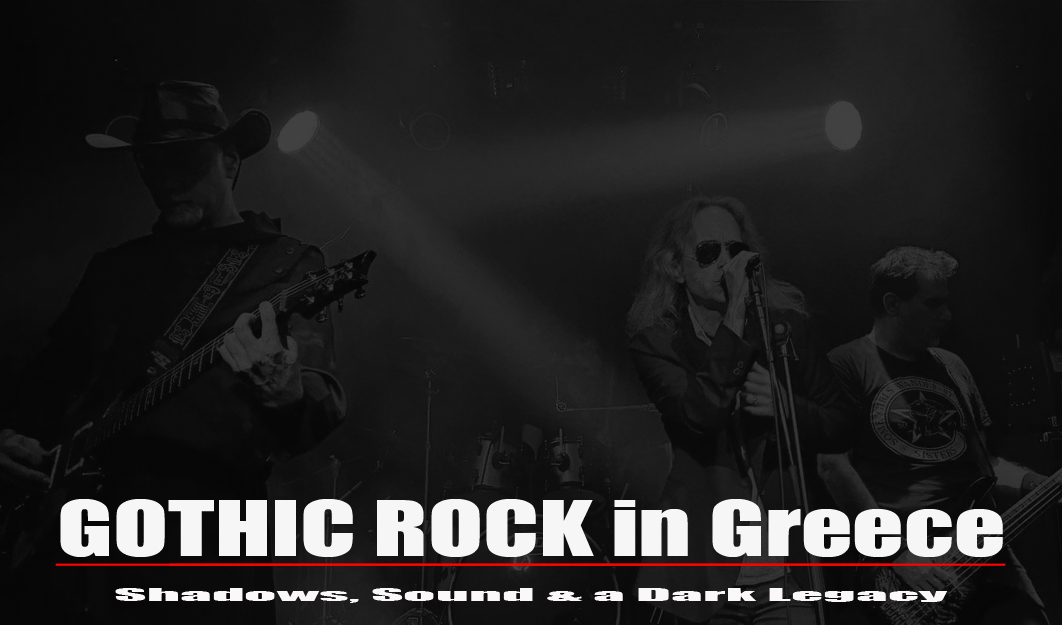
Gothic rock emerged in the early 1980s as more than just a musical style – it became a cultural movement defined by atmosphere, emotion, and identity.
From its origins in the United Kingdom to its gradual arrival in Greece, the sound of post-punk evolved into a dark and deeply expressive underground scene.
What followed was not just a genre, but a lasting legacy that continues to echo through clubs, artists, and devoted audiences to this day.
Gothic Rock: Shadows, Sound, and the Echoes of a Generation
When gothic music emerged in the early 1980s, it didn’t arrive quietly – it announced itself with a distinct identity and a sound that would define a generation.
Bands like The Sisters of Mercy, Fields of the Nephilim and The Cure became cornerstones of the genre, setting standards that many still consider unmatched today.
The United Kingdom served as the genre’s cradle, planting seeds that would soon spread across Europe and beyond.
In Greece, as was often the case at the time, the movement arrived with a slight delay.
Its introduction came through record stores and a handful of forward-thinking DJs who maintained close ties with the international scene.
By around 1984, the first wave of gothic rock had begun to take hold locally.
Imported vinyls circulated among dedicated listeners, while a small but passionate underground started to form.
In Athens, only a few venues embraced this emerging sound, with the legendary Rebound standing out as a key hub.
It wasn’t just a gothic space – it also hosted post-punk, new wave, and other adjacent styles, creating a broader alternative cultural ecosystem.
At its core, gothic rock was never just about aesthetics.
The name itself reveals its essence:
it is, fundamentally, rock.
Many of its pioneers were raised on classic rock or even the sounds of the Woodstock era.
By revisiting and reshaping those influences, they created something both nostalgic and strikingly new.
The result was a sound rich in atmosphere and emotion – music that revived forgotten textures and gave them a darker, more introspective edge.
There was also an undeniable sense of mystique surrounding the scene.
The imagery, the mood, the sense of the ‘undead‘ lingering in the background – it all contributed to a unique cultural experience.
For many, those were formative years, painted in deep, almost crimson tones, where music and identity became inseparable.
As the century drew to a close, the era of black capes and wide-brimmed hats began to fade.
For a time, gothic metal took up the mantle, amplifying the emotional and atmospheric elements of gothic rock with a heavier, metallic force.
The formula proved successful, attracting a wider audience, though its eventual decline felt both inevitable and predictable.
Greece, too, contributed to this legacy.
Several bands embraced the gothic and post-punk ethos, producing noteworthy work and even collaborating internationally.
Much of this history has been documented, yet the challenge of sustaining such a sound – especially in a cultural landscape not always receptive to it – remains significant.
For some, it became more than a passion; it became an obsession.
Whether time will ultimately vindicate these efforts remains uncertain.
What is undeniable, however, is the lasting imprint of this music.
Gothic rock, in all its forms and evolutions, has etched itself deeply into the hearts of its devoted followers – those who continue to carry its shadowed spirit forward.
by George Dedes (The Illusion Fades – Founder/Singer/Songwriter)

– some Greek bands from the early days –
Gothic Rock & Dark Wave in Greece
History, Scene and Legendary Clubs
The roots of Greece’s gothic rock and dark wave scene stretch back to the mid-1980s, when the first echoes of post-punk began to reach cities like Athens and Thessaloniki.
What started as a niche movement soon evolved into one of the most devoted and tightly knit underground communities in the country – small in size, yet rich in identity and passion.
By the late ’80s and early ’90s, a handful of pioneering acts helped define the Greek interpretation of the genre.
Bands such as Film Noir, South of No North, Villa 21 and Yell-O-Yell blended post-punk atmospheres with a darker, more introspective edge.
At the same time, the broader goth aesthetic – black clothing, new romantic influences, and theatrical flair – became inseparable from a culture rooted in introspection, poetry, and alternative expression.
The scene expanded throughout the 1990s, driven by a growing underground network.
Independent record stores imported essential releases, dedicated radio shows exposed audiences to dark wave and industrial sounds, and a number of clubs emerged as key gathering points for the ‘dark‘ community of the city.
Among these, Club Decadence stands out as a long-running institution, hosting countless dark wave and post-punk events from the ’90s into the present day.
Equally iconic was Rebound, which began life in the early ’80s as a rock club called Problem before being transformed in 1986 into a fully realized gothic space – defined by black and red walls, dim lighting, and a now-legendary wooden dancefloor.
Other venues played a crucial role in shaping the scene’s identity.
The elusive Snowball in Kolonaki became a hub for early adopters, introducing sounds from London such as Bauhaus and Siouxsie Sioux.
Meanwhile, MAD Club in Plaka helped bridge the gap between post-punk, new wave, and early electronic music, spinning artists like The Clash, Depeche Mode, and The Sisters of Mercy.
A particularly important chapter in the evolution of the scene belongs to Dark Sun – one of the most historic dark/goth/industrial clubs in Athens.
Active from 1994 to the present, it represents part of the first generation of goth and industrial venues that emerged after the 1980s.
Dark Sun quickly became a central hub for the city’s darkwave, EBM, and industrial audience, offering a musical spectrum that ranged from post-punk and technoid structures to experimental soundscapes and dark ambient textures.
Its identity was further defined by a striking underground aesthetic inspired by the biomechanical, alien-like vision of H. R. Giger, creating a uniquely immersive environment that set it apart from other clubs of the era.
Venues such as Berlin Club further expanded the sonic territory, incorporating industrial and darker electronic elements, while Dada Bar carved out its own place as one of the most authentic underground spots – never mainstream, but deeply connected to artists, musicians, and devoted followers of the darker spectrum of sound.
Although many of these venues have since disappeared, their legacy remains deeply embedded in the DNA of the Greek alternative scene.
They were more than just clubs – they were cultural hubs where music, identity, and community converged.
From its post-punk origins to its lasting influence, Greece’s gothic rock and dark wave scene continues to resonate – proof that even the most underground movements can leave a powerful and enduring mark.
by Sir Demian (Ioannis Malavazos)

George Dedes (Illusion Fades)
Fok ‘bs’ (Radio Highway Pirates)
Johnnie Holiday (Scream Idol)
Between the fading echoes of the first gothic wave and the rise of a localized scene, the sound began to evolve in subtle but significant ways.
What started as a direct influence from the UK gradually transformed into something more personal, shaped by local culture, atmosphere, and interpretation.
In Greece, this transition was not immediate but organic, driven by dedicated listeners, collectors, and DJs who nurtured the sound beyond its origins.
The music became darker, more introspective, and often more experimental, blending elements of dark wave, early electronic textures, and industrial undertones.
It was no longer just about adopting a style, but about redefining it within a new cultural context.
This shift laid the foundation for a uniquely Greek expression of the gothic and dark wave movement, bridging international influence with local identity.
HISTORIC CLUBS IN ATHENS


some bands from the Greek Gothic/Dark Wave/Dark Electronic scene: