Between Humanity And Machines
An Interview with Edge Dennis
from the American Industrial Act
BLITZ
by Fok ‘bs’

“BLiTZ isn’t just a band. It’s a world where every song is another chapter in the resistance.”

“The mask isn’t there to hide me. It lets the character speak louder than the person behind it.”
“The story grew out of the music until the music itself became part of the story.”
“The future of BLiTZ is a warning, not a prediction.”
“Industrial metal has always been about turning frustration into power.”
“Music becomes the battlefield when the audience stops being spectators.”
“I want people to feel like they’re intercepting forbidden transmissions, not just listening to an album.”
“Technology can create perfection, but character often comes from imperfection.”
“The performances provide the emotion; the production gives them impact.”
“Every title is chosen to hit like a weapon before the first note even plays.”
“The live show should feel less like a concert and more like joining a resistance movement.”
“Art doesn’t have to provide answers, but it should force people to ask better questions.”
Industrial metal has always thrived on confrontation, but few emerging artists build entire worlds around that confrontation quite like BLiTZ.
Blending crushing riffs, cinematic electronics, and a dystopian narrative set in the year 2066, the American project turns every song into part of a larger resistance against control, conformity, and technological domination.
With the debut album ‘Bitter Me‘, BLiTZ introduces not just a collection of songs, but an immersive universe where music becomes both weapon and warning.
For this exclusive interview, Fok ‘bs‘ spoke with Edge Dennis, vocalist and rhythm guitarist of the American industrial metal act BLiTZ, about the origins of the project, the philosophy behind its futuristic mythology, the balance between humanity and machines, and why resistance begins long before the first note is played.
‘Bitter Me‘ feels less like a traditional debut album and more like the first chapter of a much larger universe.
When BLiTZ was created, did the character and the dystopian world exist before the music, or did the music itself create the story?
“When I started writing the music, the story formed over time piece by piece. It was initially just a couple songs like ‘Blitzkrieg’ and ‘The Forsaken’ where I could picture specific scenes along with the audio. But eventually, the ideas morphed into a complete cohesive world, and that direction influenced the production and arrangement choices later in the project.”
The year 2066, the Global International Order, the Corp Wars, and the unknown identity of BLiTZ create a very detailed future scenario.
How much of this world is pure fiction, and how much is inspired by real fears about where society might be heading?
“I consider it speculative fiction. It’s certainly inspired by my observations of today’s world and the direction I think certain global trends are heading. At its core, though, the world of BLITZ is a warning, not a prediction. It’s meant to ask what happens if humanity continues to surrender more power, more freedom, and more responsibility without questioning where that path ultimately leads.”
BLiTZ exists as a masked figure whose past remains unclear.
Was hiding the identity of the protagonist important because you wanted listeners to project their own interpretation onto the character?
“The mask actually started for a much less exciting reason. I wanted something that would let me fully step into a new character whenever I performed. Once I introduced it, though, I realized it also made sense for BLITZ himself to remain anonymous. That mystery became part of the world. It allows listeners to focus on the character rather than the person behind him, while leaving room to explore his backstory through future albums and content.”
Industrial music has always explored the relationship between humans and machines.
On ‘Bitter Me‘, the machines sound powerful but there is still a lot of emotion underneath.
Was creating that conflict between technology and humanity a central part of the songwriting?
“Absolutely. I was always obsessed with synthesizers and electronic music and how emotions could be portrayed through machines. With this album, I wanted to capture the feeling of a human band that operates with augmented precision to portray the struggle BLITZ himself goes through to maintain his humanity.”
You describe BLiTZ as ‘Sonic Warfare‘.
In your vision, is musicthe weapon, the message, or the battlefield itself?
“‘Sonic Warfare’ describes both the statement the music makes and the experience it creates. The battlefield ultimately becomes the live show itself, where I want the audience to feel like they’re part of the Resistance rather than simply watching a concert. They’re not spectators, they’re participants.”
The album has a very cinematic quality, almost like the soundtrack to a futuristic film.
When creating the songs, do you imagine specific scenes and images, or do the visuals appear after the music is finished?
“Certainly certain tracks inspired scenes and settings as they were being written. But I’ve always made it a point to craft sonic worlds people can get lost in, so going in I already had a vision for a certain cinematic quality. The only question was what type of world this album would create, and that question was answered fairly early during the writing process.”
The industrial metal genre often deals with themes of control, rebellion, and alienation.
Why do you think these subjects remain so powerful and relevant for listeners today?
“The internet has made it easier than ever for people to challenge institutions, share ideas, and find others who feel the same frustrations. That naturally creates conflict, but it also creates solidarity. Industrial metal has always given people a place to channel anger into something powerful. BLiTZ takes those emotions and amplifies them into a sonic force that people can stand behind together.”
Coming from a background connected to Berklee College of Music, you have a strong foundation in musicianship and production.
How do you balance technical precision with the raw aggression that industrial metal requires?
“Even before my days at Berklee, I was an Electronic Music artist, so I was already used to modern polish and complex production techniques. When I transitioned to metal, quite a bit of what I’d already learned translated into the sound I wanted BLiTZ to have. The performances provide the aggression and emotion, while the production gives those performances the clarity and impact they deserve without making them feel sterile. It’s a difficult balance, but it’s one that modern Bass Music taught me to reach.”
The songs on ‘Bitter Me‘ have titles like ‘Blitzkrieg‘, ‘The Game‘, ‘Sudden Death‘, and ‘The Forsaken‘.
How important is language and terminology in creating the psychological atmosphere of BLiTZ?
“Language is incredibly important because it shapes the identity of the project. I naturally gravitate toward short, aggressive titles because they work almost like percussion. They’re memorable, easy to chant, and immediately create an emotional response. At the same time, terms like ‘Blitzkrieg’, ‘The Forsaken’, or ‘Sudden Death’ help reinforce the psychological atmosphere of the world. Even before hearing the music, those words already place the listener inside BLiTZ’s universe.”
Many concept albums tell a story from the outside looking in.
With BLiTZ, the listener feels almost like they are receiving forbidden transmissions.
Was creating that feeling of being part of the rebellion one of your goals?
“Absolutely. The album serves as both an introduction to BLiTZ and a call to action. I never wanted listeners to feel like passive observers. They’re meant to feel like they’re intercepting classified transmissions from an active resistance movement. That’s something I want to push even further during live shows, where the audience becomes part of the operation rather than simply attending a performance.”
The album presents a world where systems of power have collapsed and technology dominates.
Do you see BLiTZ as a warning about the future, or as a fantasy about a possible transformation of humanity?
“BLiTZ is intentionally both. On one level it’s a fictional universe that’s exciting to explore creatively. But underneath that, it’s also a warning about what can happen when people gradually surrender their independence, curiosity, and willingness to question authority. I don’t think art has to provide answers, but I do think it should encourage people to ask difficult questions. If BLiTZ inspires someone to think more critically about the world around them, then it’s accomplished something beyond entertainment.”
Industrial metal has changed massively since its early days, from analogue machinery and physical samples to modern digital production.
How do you see the role of technology in creating heavy music today?
“A lot of the production work I do with BLiTZ is actually based on using modern tools like software to emulate older hardware from the 80s and 90s to get that rougher industrial edge. It’s ironic, but the more advanced technology gets, the more I find myself reaching for vintage-inspired tools that prioritize character over optimized digital perfection. So I think there’s a lot of places for technology in modern music both for bands that want a more futuristic sound, and bands like BLiTZ that combine modern polish with vintage grit.”
If someone discovers BLiTZ decades from now, what do you hope they understand about the world, the character, and the message behind ‘Bitter Me‘?
“Hopefully the fictional world of BLiTZ never becomes reality. Beyond that, I hope people understand that ‘Bitter Me’ is not just about rage. It is about resistance, identity, and the refusal to accept a world built on control. The anger is there because it has to be, but beneath it is the belief that resistance is always possible. The only question is how loud you are willing to become.”
With ‘Bitter Me‘, BLiTZ demonstrates that industrial metal can still feel visionary decades after the genre first emerged.
Edge Dennis has created more than a debut record.
He has laid the foundation for a growing dystopian universe where music, storytelling, and visual identity merge into a single artistic experience.
Whether listeners embrace it as science fiction, social commentary, or pure sonic assault, one thing is certain:
this is only the beginning of the BLiTZ saga.
Our thanks to Edge Dennis for taking the time to speak with Radio Highway Pirates and sharing the ideas behind one of the most ambitious industrial metal debuts in recent years.
We look forward to discovering where the resistance will lead next.
by Fok ‘bs‘
American Industrial Outfit
BLITZ
Released Album
‘Bitter Me’

track-list:
Blitzkrieg
The Score
Sudden Death
My Enemy
The Game
Bitter Me
Vermilion Vein
The Forsaken
Carnival
Take Me Alive
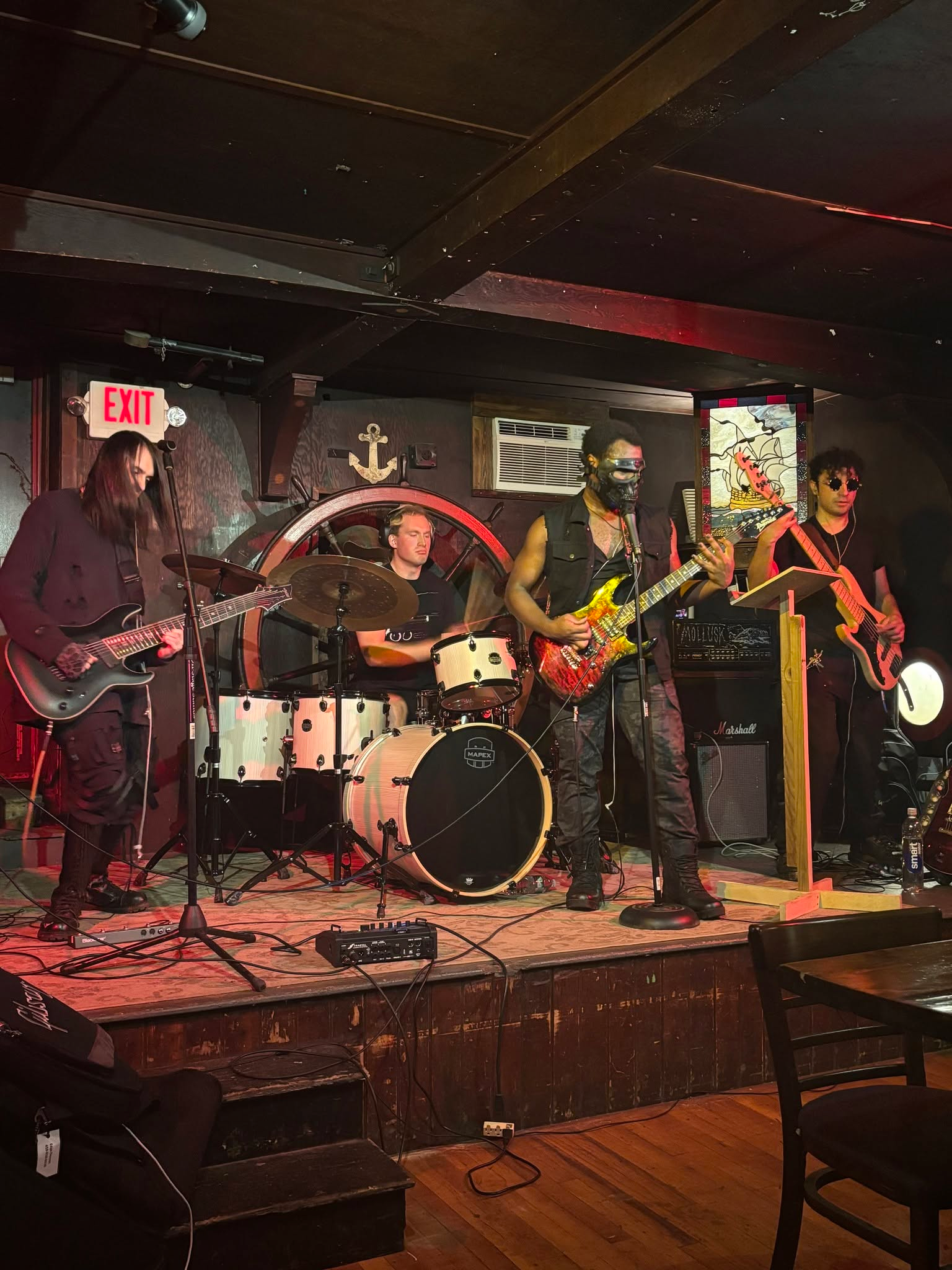
BLiTZ are:
Edge Dennis – vocals, rhythm guitar
Sharpshooter Fade – lead guitar
The Mad Dr. Fuse – synths, electronics
General Maul – bass
Heavy Weapons Specialist Bane – drums
In a world where reality increasingly feels like a warning of what could come next, Boston-based industrial metal project BLiTZ delivers its debut album ‘Bitter Me‘, a dark, cinematic transmission from a dystopian future where rebellion is the only remaining form of resistance.
Set in the year 2066, ‘Bitter Me‘ introduces listeners to BLiTZ, a masked insurgent whose identity remains unknown.
Governments have collapsed, and the Global International Order (GIO) has taken control over almost every remaining system of power.
Whether BLiTZ is a former soldier, a survivor of the devastating Corp Wars, or even a weapon created by the very regime he now fights against remains uncertain.
What matters is the message:
the uprising has begun.
The album represents the first series of encrypted broadcasts released by BLiTZ.
Together, they transform this fictional rebellion into a soundtrack built from industrial metal machinery, crushing electronics, and razor-sharp guitar work.
Musically, ‘Bitter Me‘ thrives on the collision between human emotion and machine-like precision.
The album’s rigid, militaristic rhythms are combined with cinematic synth layers, powerful low-end, and a constant sense of controlled chaos.
Drawing influences from industrial metal, Neue Deutsche Härte, modern metal, and electronic music, BLiTZ creates a sound that feels both calculated and dangerously alive.
Rather than simply combining different styles, ‘Bitter Me‘ turns them into one unified system:
mechanical yet emotional, aggressive yet atmospheric.
Every element serves the larger concept, creating an album that feels less like a collection of songs and more like the soundtrack to a collapsing world.
Behind BLiTZ stands Boston-based musician and producer Edge Dennis, who developed the project as a complete creative vision.
Originating from his background at Berklee College of Music, BLiTZ combines precise musicianship, electronic experimentation, and detailed world-building into a single artistic identity:
Sonic Warfare.
With ‘Bitter Me‘, BLiTZ presents a debut that goes beyond traditional album boundaries.
It is a story of control, rebellion, and survival.
A transmission from a possible future where the machines have taken over, but the human spirit refuses to disappear.